
Cultural Heritage CMS: Bridging Deep Learning and Ancient Thai Architecture
Cultural Heritage Content Management System by Deep Learning
This paper presents a Cultural Heritage Content Management System (CH-CMS) specifically designed for Thai architecture. By integrating Deep Learning (CNN) with Scale-Invariant Feature Transform (SIFT), the system identifies historical eras (Ayutthaya, Sukhothai, and Rattanakosin) and automatically generates descriptive narratives for stupa images.
TL;DR
This research introduces an automated system capable of "reading" historical Thai architecture. By merging Deep Learning with SIFT feature extraction, the system classifies stupas into three major historical eras—Ayutthaya, Sukhothai, and Rattanakosin—with over 80% accuracy, enabling automated storytelling for cultural tourism and historical preservation.
Deepening the Problem: Why Context Matters in Heritage
The management of cultural heritage data often suffers from a "semantic gap." While a professional archaeologist can distinguish a Sukhothai-style stupa (characterized by its lotus-bud shape) from a Rattanakosin-style one, digital databases struggle to do the same without human-provided tags. Traditional Content-Based Image Retrieval (CBIR) systems focused on simple colors or textures, but they lacked the "morphological intelligence" required to understand architectural evolution over centuries.
Methodology: The Hybrid Synergy
The author’s core insight is that while Deep Learning is powerful, it can benefit from the explicit geometric descriptors provided by SIFT (Scale-Invariant Feature Transform).
1. The Processing Pipeline
The system follows a rigorous sequence to ensure high-fidelity classification:
- Edge Detection: Using the Laplacian operator to define the structural silhouette of the stupas.
- Feature Extraction: Instead of feeding raw pixels into a network, the system uses SIFT to identify 128-dimensional keypoint descriptors. These descriptors are invariant to scale and rotation—crucial for tourist photos taken from various angles.
- Neural Training: These high-level features are then passed through hidden layers of a Deep Neural Network to map the visual patterns to specific historical eras.
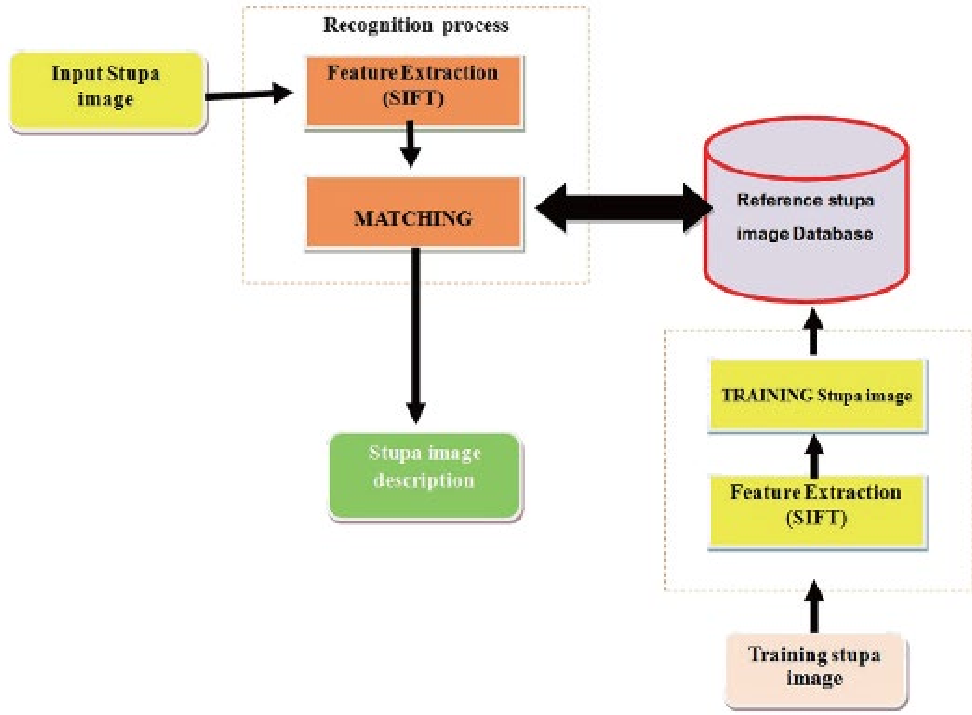 Figure: The end-to-end workflow from input image to historical description.
Experiments: Proving the Value
The model was tested using a dataset of 1,570 images across three Thai provinces. The research compared the proposed DNN+SIFT approach against traditional baselines like k-Nearest Neighbors (k-NN) and simple Euclidean Distance.
Key Results
The performance gap was substantial:
- Proposed Method: Achieved ~81% average accuracy.
- Euclidean Distance: plateaued at ~73%.
- k-NN: Struggled at ~62%.
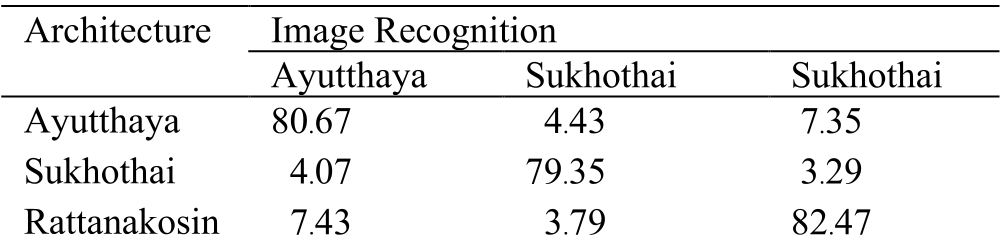 Table: Confusion Matrix showing the high precision of the proposed algorithm in era classification.
The results indicate that the hybrid approach successfully captures the "Inductive Bias" necessary for architectural identification—specifically the unique shapes and proportions (stupa height, base width) that distinguish different Thai eras.
Critical Analysis & Conclusion
The value of this work lies in its domain-specific optimization. While general models like ResNet or EfficientNet are trained on ImageNet (mostly cats, dogs, and vehicles), they often overlook the fine-grained structural features of ancient ruins.
Limitations & Future Path:
- Dataset Diversity: The current accuracy is high, but the dataset is relatively small (1,570 images). Expanding this to include Khmer or Srivijaya styles would test the model's robustness.
- Lighting Sensitivity: Although SIFT is scale-invariant, Thai monuments are often subject to extreme lighting conditions (high noon sun vs. sunset). Future work could integrate specialized normalization layers to handle "high-dynamic-range" architectural photography.
In summary, this research serves as a pivotal bridge between Machine Learning theory and Digital Humanities, providing a blueprint for how AI can help the "new generation" reconnect with the greatness of their ancestors through the lens of a smartphone camera.