
Culturally Embedded Computing: Beyond Engineering to Human Experience
Culturally Embedded Computing
This paper introduces "Culturally Embedded Computing," a paradigm that shifts Human-Computer Interaction (HCI) from pure engineering efficiency toward a "Critical Technical Practice." Through five interdisciplinary projects, the authors demonstrate how technologies can be designed to provoke social reflection, situate computing within historical contexts, and address personal, non-formalized experiences.
TL;DR
Ubiquitous computing is no longer just about leaving the desktop—it is about entering our social and cultural fabric. This paper argues that the purely functional engineering approach to HCI is insufficient. By introducing Culturally Embedded Computing, the authors present a series of provocative design projects—from emotion-sensing art to "socialist" light switches—that force users to reflect on how technology shapes their identity, history, and daily social interactions.
The Problem: The "Engineer’s World" Fallacy
Imagine a world where buildings are designed only by engineers. They would be structurally sound and functional, but they would lack the "soul" of architecture—the connection to history, culture, and lived experience. The authors argue that we are inadvertently creating such a world in ubiquitous computing.
Prior work in HCI often treats "user experience" as a narrow metric of efficiency. By focusing solely on whether a tool "works," researchers ignore a critical transition: as computing leaves the lab, it crosses physical, social, and cultural boundaries. If we don't account for these, our technology becomes irrelevant to the personal concepts of how people actually live.
Methodology: Design for Thinking, Not Just Doing
The researchers at Cornell University pivoted from traditional HCI toward a Critical Technical Practice. Their methodology is built on three pillars:
- Reflective Design: Building things "to think with" rather than just "to use."
- Personal Experience: Focusing on the ambiguous and emotional, rather than the formal and computable.
- Cultural Context: Situating gadgets within history (e.g., domestic roles or spiritual practices) rather than just technical benchmarks.
Key Project: Miro & Collective Emotion
One of the core experiments, Miro, illustrates these pillars perfectly. Unlike typical "ambient displays" that show stock prices or weather, Miro tracks the "affective climate" of a shared office.
 Figure 1: The Miro display projected onto a wall, morphing based on office sound levels and surveys.
Instead of providing a precise "Emotion: 72% Happy" readout, the display remains enigmatic. This multivalence forces employees to talk to one another to interpret the art. Is the background red because of a deadline? Is the agent moving fast because of a Friday mood? Here, the technology isn't a "tool" for data—it's a "catalyst" for social reflection.
Insights from Experiments
Across five projects, the team discovered that ambiguity is a feature, not a bug.
- The Influencing Machine: A mailbox that "reacts" to postcards. It taught the researchers that people project their social relationships onto the machine. One group's argument over the machine’s "sentience" revealed more about their marital dynamics than the computer's code.
- iFortune: A digital "shrine" for the kitchen that reads tea leaves in a coffee cup. It critiques the idea that kitchen appliances must be for "cleaning" or "efficiency," suggesting instead a role for spirituality and play.
- Trigger Spray Bottles: This project reimagined cleaning tools for the elderly. By adding a "monocle" to read small print or styling bottles as books, the design addressed the dignity and physical reality of aging, rather than just the utility of cleaning.
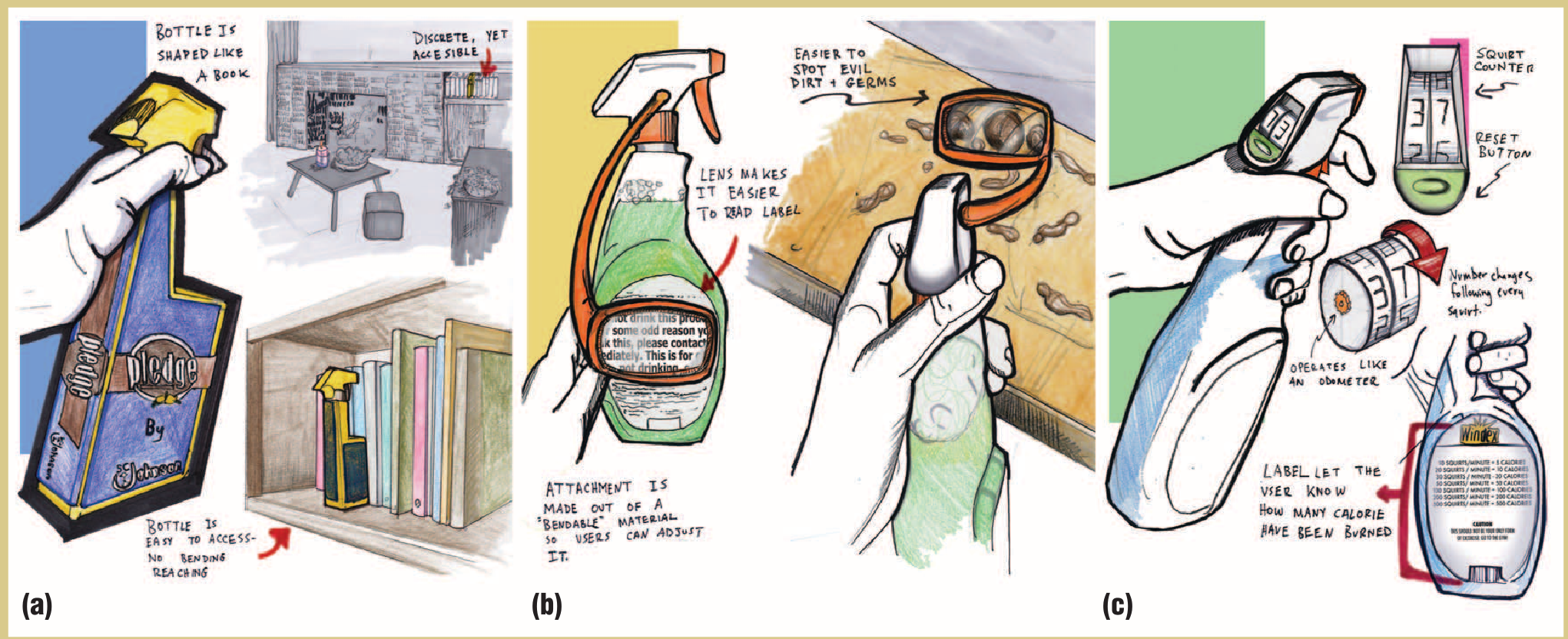 Figure 2: Challenging the "institutional" look of elderly assistance through Book Bottles (a), Bottle Monocle (b), and Calorie-Counter (c).
Critical Analysis & Future Outlook
The success of these projects is measured not by "task completion time," but by the richness of the conversations they trigger.
Takeaways for Modern Tech:
- Expert Participants: We should treat users as experts in their own experience, inviting them into the analysis process (as seen in the "Cultural Switches" study).
- Provocation over Smoothness: The current trend of "frictionless" design may actually be depriving us of the opportunity to think critically about our tools.
Limitations: The authors acknowledge that some users—particularly those less tech-literate—may find "enigmatic" or "ambiguous" interfaces intimidating rather than reflective. Finding the balance between "approachability" and "critical depth" remains the primary challenge for this field.
As we move toward a world of AI-driven pervasive systems, the lessons of Culturally Embedded Computing are more vital than ever: our devices should not just serve us; they should inspire us to reflect on who we are.