
Beyond One-Shot Influence: Mastering Cumulative Activation in Social Networks
Cumulative activation in social networks
The paper introduces the Cumulative Activation (CA) model for social networks, addressing scenarios where users require multiple exposures to information before adopting a product. It formally defines two optimization problems: Seed Minimization with Cumulative Activation (SM-CA) and Influence Maximization with Cumulative Activation (IM-CA), utilizing a reverse reachable set approach for efficiency.
TL;DR
Most viral marketing research assumes that "seeing is buying." In reality, we often need to see an ad multiple times before we act. This paper introduces the Cumulative Activation (CA) model, which mathematically treats adoption as a threshold of exposure frequency. The authors tackle the resulting computational complexity with the Activation Dominance Greedy (ADG) algorithm, significantly outperforming current SOTA methods by up to 162% in high-threshold scenarios.
The Problem: The Myth of the Single Cascade
In classical models like the Independent Cascade (IC), influence is a one-and-done affair. If a friend influences you, you are "active." However, expensive decisions (like buying a car or switching software) follow the Threshold Theory: a single piece of information isn't enough. You need cumulative impact.
From an algorithmic perspective, this is a nightmare. The standard "Influence Spread" function in IC models is submodular (the social equivalent of diminishing returns), which allows simple greedy algorithms to be nearly optimal. But Cumulative Activation is NOT submodular. Adding a seed might have zero effect for a long time until it finally tips a node over its internal threshold, causing a sudden "jump" in activation.
Methodology: Frequency-Based Thresholding
The authors propose a two-phase process:
- Independent Cascades: Multiple independent pieces of information flow through the network.
- Cumulative Adoption: A node activates only if the probability of being reached across these cascades exceeds a threshold .
The Algorithm: From Math to Heuristics
Since the problem is inherently harder (reaching NP-hard inapproximate bounds for partial coverage), the authors focus on two innovative strategies:
- Balanced Truncation Greedy (BTG): Uses a surrogate function . By tuning , the algorithm rewards nodes that bring others closer to the threshold without ignoring those who have already crossed it.
- Activation Dominance Greedy (ADG): This strategy prioritizes nodes that maximize the count of newly "threshold-passed" users immediately.
To make this scalable for millions of edges, they utilize the Reverse Reachable (RR) Set approach, which effectively "samples" the graph's influence paths in reverse to estimate activation probabilities without costly Monte Carlo simulations.
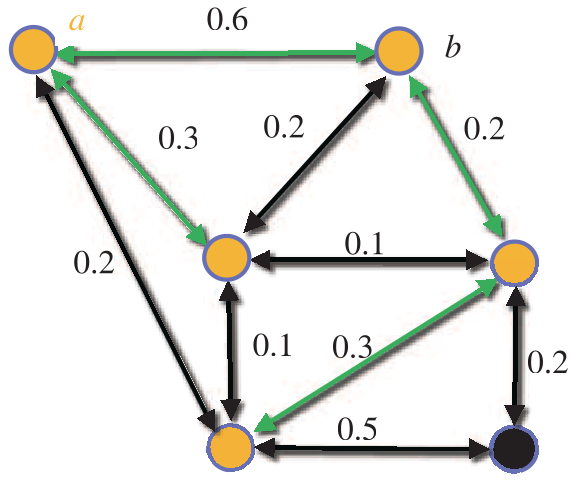 Figure 1: Illustration of how multiple cascades contribute to the final activation of node b.
Experimental Battleground
The authors tested their methods on Flixster, NetPHY, and DBLP (a massive 2-million-edge graph). The results were striking when the "difficulty" of activation was high.
Key Findings:
- Superiority at High Thresholds: When users are "stubborn" (), standard algorithms like TIM+ fail because they seek broad, thin influence. ADG wins because it concentrates influence to actually break the thresholds.
- Efficiency: Despite the complexity of the CA model, the RR-set based ADG algorithm can process the million-node DBLP graph in under 2.5 hours—a feat impossible with traditional simulation methods.
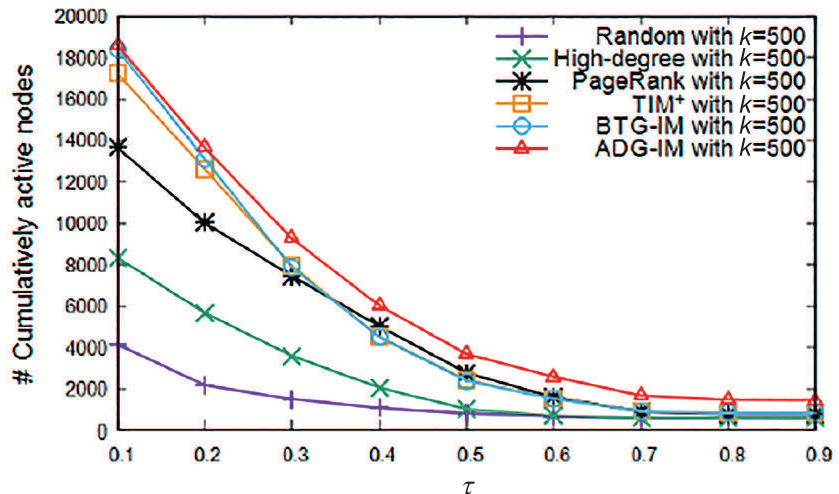 Figure 2: Performance comparison on the DBLP dataset showing ADG-IM-CA leading as the seed budget increases.
Critical Analysis & Takeaways
The brilliance of this paper lies in its realism. It acknowledges that social influence is often a slog of repeated exposures rather than a lightning strike.
Limitations:
- The model assumes independent cascades; however, in reality, the second exposure might be more (or less) effective than the first (synergy or fatigue).
- The requirement of tuning the parameter in BTG makes it slightly less "out-of-the-box" than ADG.
Future Outlook: This framework opens the door for multi-channel marketing optimization, where "cascades" could represent different platforms (e.g., Twitter, TV, Email). The research suggests that if you know your audience is "hard to move," you should stop aiming for reach and start aiming for density.