
Curious Cat: Bridging the Gap Between Chatbots and Common Sense Knowledge
Curious Cat--Mobile, Context-Aware Conversational Crowdsourcing Knowledge Acquisition
The paper introduces Curious Cat, a mobile, context-aware conversational agent designed for large-scale crowdsourced Knowledge Acquisition (KA). By integrating the Cyc Common Sense Knowledge Base with real-time mobile sensor data, the system proactively engages users in natural language dialogues to acquire, validate, and refine structured knowledge, achieving a 95% accuracy and utility rate.
TL;DR
Building comprehensive knowledge bases (KBs) has historically required thousands of human-years. Curious Cat changes the game by turning mobile users into "accidental" knowledge engineers. By tracking where you are and what you're doing, this AI-driven chatbot proactively asks questions like, "Does Joe's Pizza have Wi-Fi?" or "What did you order?" It then uses formal logic to verify your answers against what it already knows, ensuring that the acquired data is both high-quality and logically sound.
The Bottleneck: Why AI "Doesn't Get It"
Most modern conversational agents operate on statistical patterns or fixed scripts. They might remember your name, but they don't truly reason about the world. This creates a "Knowledge Bottleneck." Manually coding every fact about every restaurant in the world is impossible. Conversely, web mining (like NELL) often picks up "noise" and incorrect facts.
The authors of Curious Cat identified that the missing link is Contextual Proactivity. By knowing a user is currently at a specific location, the system can ask highly relevant questions that the user is uniquely qualified to answer at that exact moment.
Methodology: Logic-Driven Curiosity
Curious Cat isn't just a chatbot with a database; it is a reasoning engine that happens to speak English.
1. The Architecture
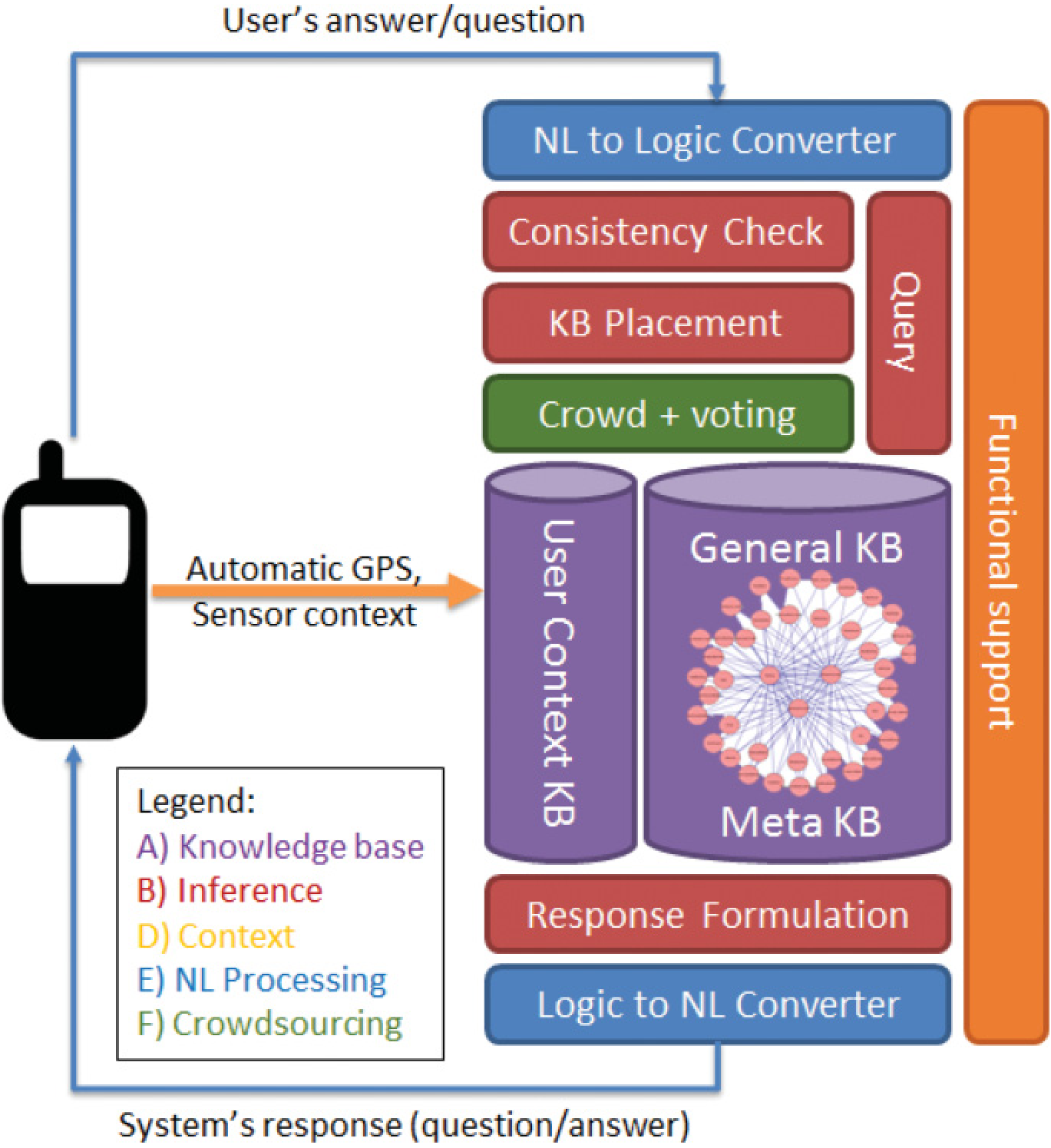
At its core, the system revolves around the Cyc Knowledge Base. It uses three layers:
- Global Common Sense: Basic facts about the world (e.g., "A car is a vehicle, not a food").
- User Context: Real-time sensor data (GPS, accelerometer) processed into "staypoints."
- Meta-Rules: Logic that looks at the KB, realizes it doesn't know what Joe's Pizza serves, and triggers a question.
2. The Consistency Check
When a user says they ordered a "car" at a restaurant, Curious Cat doesn't just record it. It runs a Consistency Query. It checks if Car is a subclass of Food. Since the Cyc ontology says Car is a Vehicle, the system rejects the entry, preventing the KB from becoming "corrupted" by nonsensical data.
Experiments: Real-World Intelligence
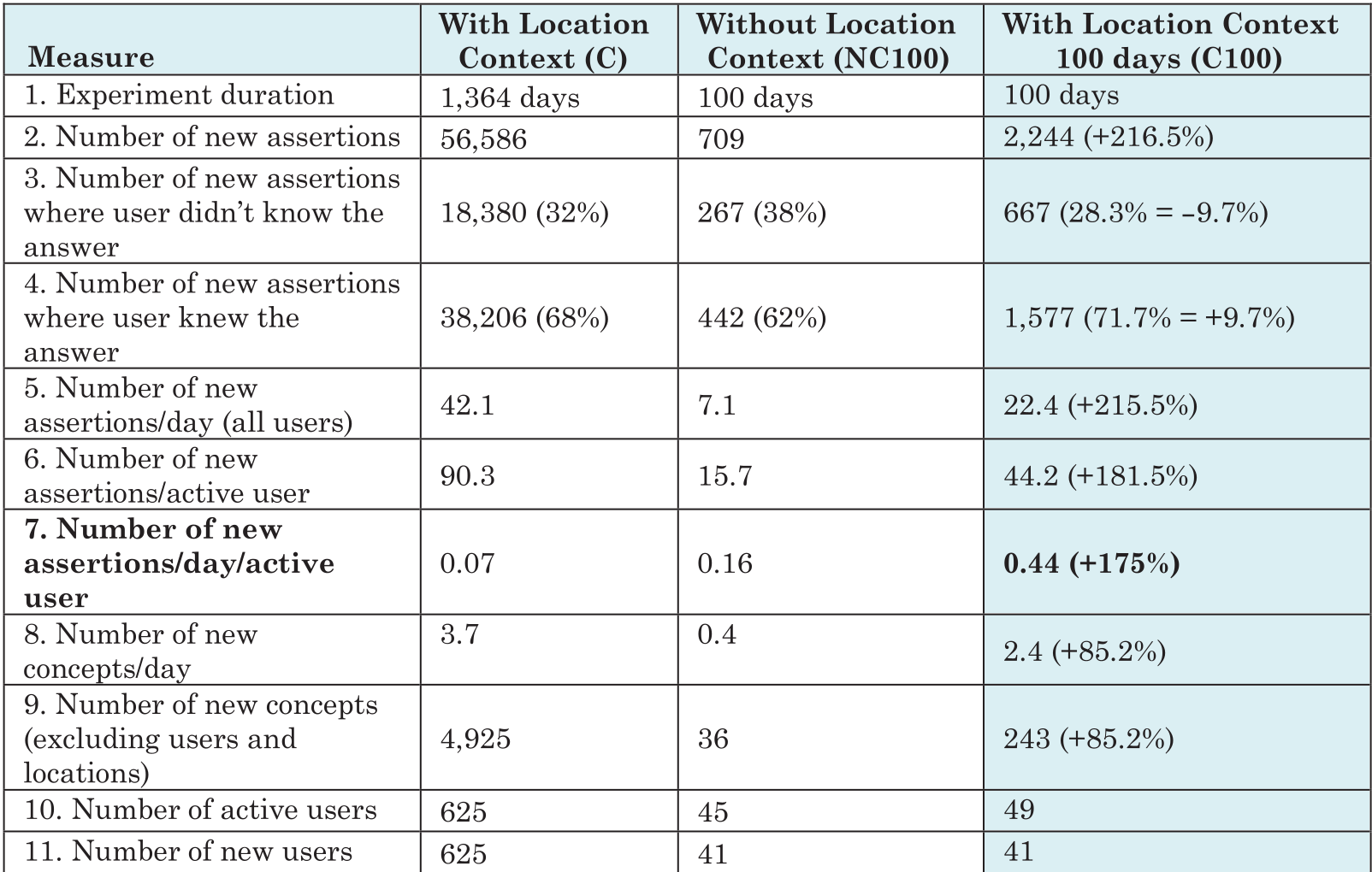
The system was tested over 1,400+ days. The results prove that context matters:
- Proactivity Boost: Users provided 216% more assertions when the system used GPS context to trigger questions compared to a passive "No Context" baseline.
- Quality Control: The system's logical "immune system" successfully identified and rejected over 1,400 inconsistent answers.
- Crowdvoting: By asking other users "Is it true that...?", the system validated 4,703 answers as reliable "General Knowledge."
Deep Insight: Beyond Pattern Matching
What makes this work significant is the shift from NL-pattern-driven agents to knowledge-driven agents. In Curious Cat, the Natural Language (NL) is just a wrapper for First-Order Logic. This allows the system to engage in "Machine-Mediated Human-to-Human Interaction" (MMHHI). If User A asks a question the AI can't answer, the AI parses the logic, finds User B who is in the right location to know, and forwards the query.
Critical Analysis & Conclusion
While the 2017 publication date means the NLP components (like SCG) are now superseded by Large Language Models (LLMs), the underlying philosophy remains vital. LLMs suffer from "hallucinations" because they lack a grounding in formal logic and consistency checks.
The Takeaway: Integrating the intuitive fluency of modern LLMs with the rigorous logical framework and contextual proactivity of Curious Cat represents the likely future of reliable, self-updating AI assistants.
Limitations: The system still struggles with "obsolete knowledge" (e.g., prices changing) and requires sophisticated meta-rules to prevent users from accidentally creating duplicate concepts with different names. Future work points toward merging this logical grounding with broader conversational engines.