
From Engagement to Stickiness: Cracking the Code of Brand Social Networks
Influence of customer engagement with company social networks on stickiness: Mediating effect of customer value creation
This study investigates the impact of customer engagement (CE) on website stickiness and Word-of-Mouth (WOM) in Company Social Networks (CSNs). Using Structural Equation Modeling (SEM) on Sina Microblog data, it identifies that customer value creation—comprising functional, hedonic, and social dimensions—acts as a critical mediator between multi-dimensional engagement and long-term user retention.
TL;DR
In an era where brand loyalty is increasingly fragile, this study quantifies how "engaged" followers become "sticky" users. By analyzing 260 enterprise microblog users, researchers found that customer engagement doesn't lead to loyalty directly; it must first be converted into Functional (utilitarian) and Hedonic (pleasure) value. Interestingly, pure social connection often fails to keep users coming back.
The "Easy Come, Easy Go" Problem
The digital landscape has shifted from passive reception to active co-creation. However, Company Social Networks (CSNs) face a paradox: while it is easy to gain followers, it is harder than ever to achieve Stickiness—the combination of visit duration and user retention.
The researchers identified that the missing link in existing literature was a granular understanding of how psychological engagement transforms into behavioral commitment. They hypothesized that Value Co-creation acts as the engine of this transformation.
Methodology: The Interaction-Value-Stickiness Triad
The study breaks down Customer Engagement (CE) into three specialized dimensions:
- Conscious Participation: The cognitive focus on the brand.
- Enthusiasm: The emotional passion and excitement.
- Social Interaction: The behavioral exchange with the brand and peers.
The Conceptual Framework
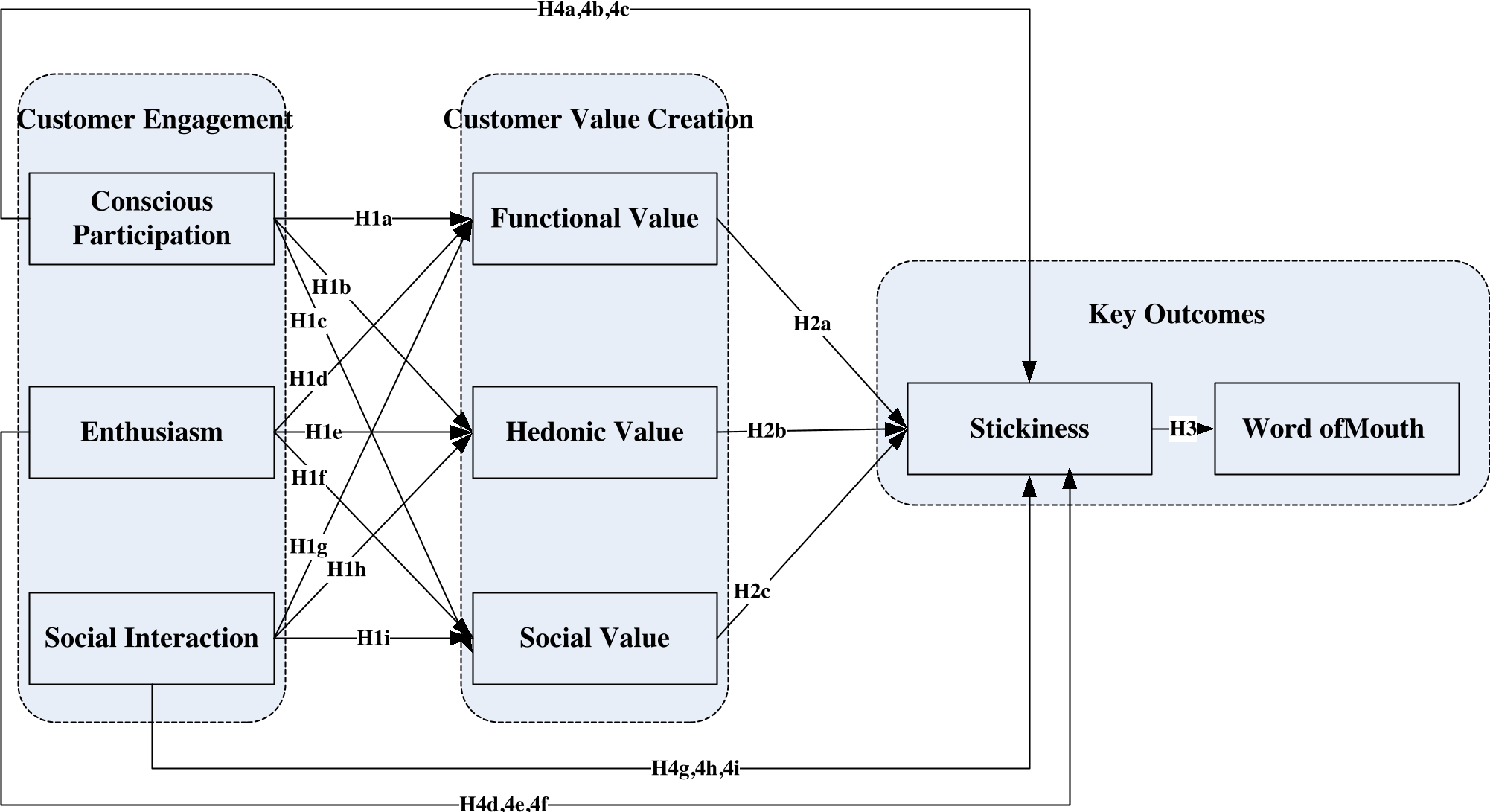
The authors utilized Structural Equation Modeling (SEM) to test these paths, specifically looking at how different values (Functional, Hedonic, Social) act as bridges.
Key Insights: Why Your Social Strategy Might Be Failing
The results provide a reality check for social media managers.
1. Functional and Hedonic Values are the "Golden Bridges"
The study proved that Functional Value (useful info like product tips) and Hedonic Value (the joy and inspiration found in posts) are the primary reasons users stay. Conscious participation is converted into stickiness almost entirely through these two values.
2. The Failure of Social Value
Surprisingly, Social Value—making friends or expanding personal networks—did not significantly correlate with stickiness in the context of enterprise microblogs. In fact, some social interactions received a negative result (H1i).
- The Intuition: If a brand environment facilitates unwanted "commercial" social interactions (like salespeople pestering users), it destroys value rather than creating it.
3. Stickiness Breeds Advocacy
The study confirmed a powerful link between stickiness and Word-of-Mouth (WOM). A user who is "stuck" to your page is not just a consumer; they become a potent marketing channel.
 (Note: Refer to Table 4 in the original paper for specific T-values showing the strength of the Stickiness-WOM link at 0.78).
Critical Analysis & Managerial Implications
- Beyond "Leads": Management must stop viewing CSNs as mere lead-gen funnels. Instead, they should be treated as "value-creation ecosystems."
- Content Precision: Since Functional Value is the strongest driver of stickiness (Path: 0.51***), brands should prioritize high-utility content (tutorials, news, functional updates) over generic "engagement bait."
- Emotional Investment: Enthusiasm (Emotional CE) has a direct line to stickiness that doesn't always require a mediator. Brands that can evoke genuine passion can bypass some of the utilitarian requirements of typical platforms.
Limitations
The study is focused on the Chinese context (Sina Microblog). Cultural nuances—such as the difference between individualist vs. collectivist social behaviors—might alter the weight of "Social Value" in Western contexts like Facebook or X.
Conclusion
This research provides a rigorous empirical foundation for the "Service-Dominant Logic" in social media. To make a customer stay, you must first make the interaction valuable. In the digital economy, value is the currency of attention.