
Decoding Customer Satisfaction: Why Technical Support Trumps Product in Tech ROI
The analysis of customers' satisfaction degree based on decision tree model
This paper applies the ID3 Decision Tree algorithm to analyze factors influencing customer satisfaction (CSAT) in a technology-supported company. By processing 3,000 records, the study identifies that technical support quality (SupportVSAT) is the primary driver of overall satisfaction, surpassing physical product performance.
TL;DR
This research leverages the ID3 Decision Tree algorithm to dissect 3,000 customer records from a tech firm, aiming to identify the real drivers behind high satisfaction scores. The verdict? Technical support quality (SupportVSAT) and resolution speed (TimeToClose) are significantly more influential than the actual product performance, providing a clear roadmap for managerial prioritization.
The "Black Box" of Customer Loyalty
In a competitive market, "satisfaction" is often treated as a vague metric. Managers know it matters, but they often struggle to choose where to invest: Should they spend on R&D for better product features, or hire more support staff? Previous methods of analysis frequently failed to account for the non-linear relationships between service quality and customer perception. This paper treats customer satisfaction as a Classification Problem, using data mining to find the most efficient path to a "Satisfied" label.
Methodology: The Logic of Information Gain
The core of the study lies in the ID3 Algorithm, a classic in machine learning that uses Entropy to measure data impurity. The goal is to select the attribute that provides the highest Information Gain—essentially, the variable that "clears up" the most confusion about whether a customer will be satisfied or not.
The authors evaluated four primary variables:
- SupportVSAT: Satisfaction with technical support.
- TimeToClose: The duration taken to resolve technical issues.
- isresolved: Whether the problem was actually fixed.
- ProductVSAT: Satisfaction with the physical product.
Mathematically Measuring "Certainty"
The model calculates the average amount of information needed to identify a class label (Info(D)). By subtracting the weighted entropy of a specific attribute (e.g., SupportVSAT) from the total entropy, the researchers quantify the "Gain" provided by that attribute.

Experimental Analysis: Data Don't Lie
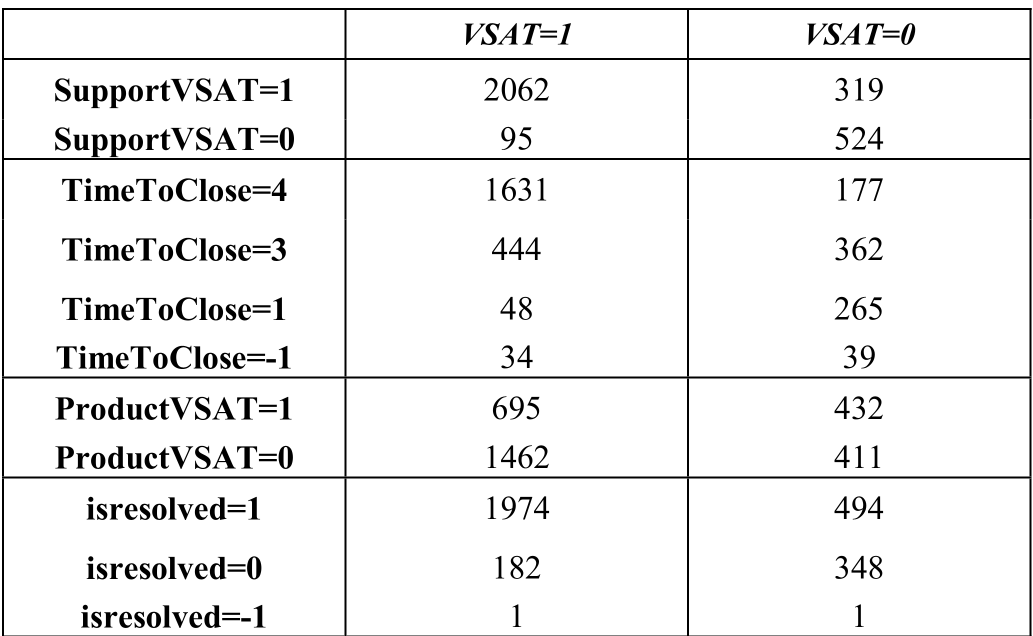
Processing 3,000 records, the ID3 algorithm produced a clear hierarchy of importance. The "Gain" values provided a scientific ranking for business strategy:
| Attribute | Entropy | Information Gain | Ranking |
|---|---|---|---|
| SupportVSAT | 0.5786 | 0.2782 | 1 (Root Node) |
| TimeToClose | 0.6340 | 0.2227 | 2 |
| isresolved | 0.7587 | 0.0980 | 3 |
| ProductVSAT | 0.8347 | 0.0220 | 4 |
Deep Insights: The Support Paradox
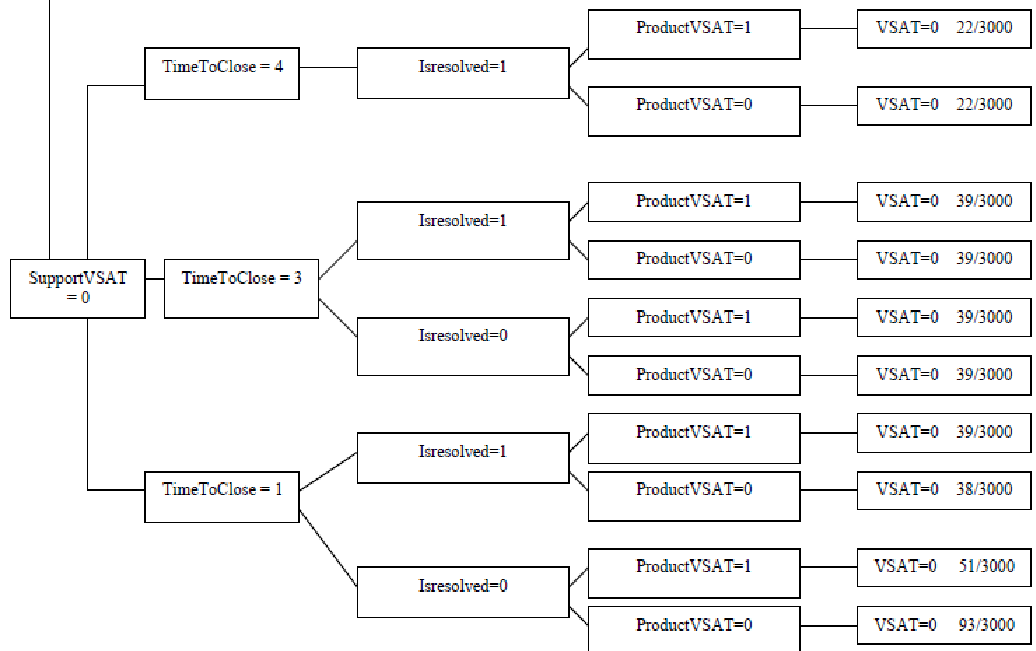
The most striking finding is the low ranking of ProductVSAT. In the technology sector, customers seemingly expect the product to work, making it a "baseline" factor. However, their ultimate satisfaction is forged during the support experience. If a product fails but the support is exceptional and fast, the customer remains "satisfied."
The resulting Decision Tree (illustrated below) shows that once SupportVSAT is high, the probability of overall satisfaction is remarkably stable.
Critical Analysis & Managerial Takeaways
- Focus on the Human Element: Managers should prioritize training employees' professional skills and improving the efficiency of the help desk.
- Speed is a Feature: "TimeToClose" emerged as the second most critical factor, meaning that a fast "okay" resolution often beats a slow "perfect" resolution.
- Methodological Limitations: While ID3 is highly interpretable (a major plus for business stakeholders), it can struggle with continuous data (like exact seconds for resolution) compared to newer algorithms like C4.5 or Random Forests.
Conclusion: This study proves that in the tech world, your support team is essentially your most effective marketing department. By using ID3 to move from "gut feeling" to data-driven decision trees, companies can pinpoint exactly where their customer relationship is failing.