
Beyond the Feedback Loop: Modeling Municipal Satisfaction through System Dynamics
Customer Satisfaction from Inner-City Services: A Case Study
This paper presents a comprehensive evaluation of inner-city municipal service quality using the SERVQUAL instrument and System Dynamics (SD) modeling. By analyzing 634 citizen responses, the study identifies critical quality gaps and simulates strategies to shift overall service quality from negative dissatisfaction to positive outcomes.
TL;DR
This study investigates the "hidden mechanics" of citizen satisfaction within inner-city services. By deploying the SERVQUAL framework alongside System Dynamics (SD) simulation, the researchers identify that while municipal physical facilities (Tangibles) often meet expectations, the critical "human" factors—Reliability, Empathy, and Responsiveness—are where the most significant service gaps reside. The paper demonstrates how a simulation-driven approach can turn negative satisfaction trends into positive service outcomes.
The "Municipality Trap": Why Static Surveys Aren't Enough
Public service quality is notoriously difficult to measure because "customers" are also taxpayers with high expectations and no alternative "competitor" to turn to. Most local governments rely on annual surveys that tell them what is wrong, but not how different service variables interact over time.
The authors argue that the mismatch between citizen expectations and actual perceptions creates a "Service Gap" that, if left unmanaged, cascades into increased complaints and declining trust as city populations grow.
Methodology: Bridging Psychometrics and Simulation
The research methodology involves two distinct stages:
- SERVQUAL Audit: Applying the classic 22-statement instrument across five dimensions.
- Dynamic Simulation: Using Vensim PLE to model the flow of citizen complaints and the "decay" of satisfaction over a 36-month period.
The Core Architecture
The researchers mapped the flow of complaints through different channels (in-house vs. outsourced) to determine the speed of resolution, which directly feeds back into the perceived quality dimensions.
Key Findings: The Anatomy of a Gap
The study revealed a stark contrast between physical attributes and service delivery:
- Tangibles & Assurance: Citizens were generally satisfied with physical facilities and the knowledge of staff (Perception > 3.7).
- The "Satisfaction Killers": Reliability, Empathy, and Responsiveness all showed negative gap scores. Reliability, in particular, had a negative unweighted gap of -0.043, which amplified significantly when weighted.
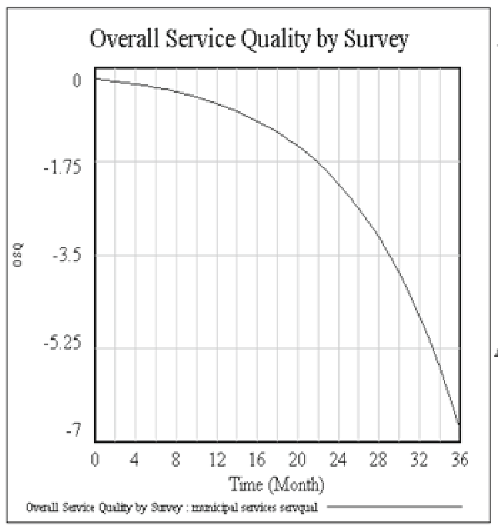
- The OSQ Score: The Overall Service Quality (OSQ) was calculated as: A negative value indicates that the local government is systematically failing to meet its citizens' basic desires.
Experimental Simulation: Turning the Tide
The standout contribution of this paper is the sensitivity analysis using System Dynamics. The authors performed a "What-If" analysis: If we ignore Tangibles but improve Reliability and Empathy, what happens to the overall city reputation?
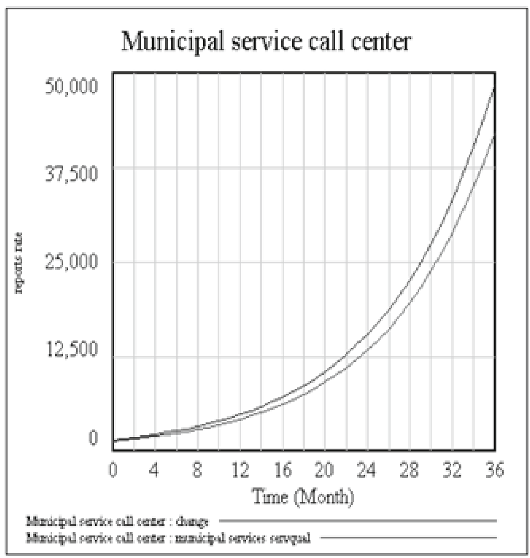
The results shown in the simulation (Fig. 4 and Fig. 5) indicate that as the population grows (and complaints naturally increase), the Overall Service Quality can still trend upward if the feedback mechanisms for responsiveness are optimized.
Critical Insight & Conclusion
This paper moves municipal management from a reactive "firefighting" mode to a proactive strategic model.
Takeaways for Tech and Policy Leaders:
- Prioritize Soft over Hard: Improving the "empathy" of service staff has a higher ROI for citizen satisfaction than renovating a town hall.
- Continuous Monitoring: Satisfaction is not a static metric; it must be monitored annually to identify emerging trends before they become systemic failures.
- The Power of SD: System Dynamics serves as a powerful bridge between qualitative social science data and quantitative engineering management.
Limitations: The study is geographically specific (Israel) and focuses primarily on the municipal call center as the primary touchpoint. Future research should look into digital-first interactions (AI chatbots) and how they influence the "Empathy" dimension of SERVQUAL.