
Unmasking Hostility: How Anonymity Fuels the Aggression Cycle on Ask.fm
Analysis of Cyber Aggression and Cyber-Bullying in Social Networking
This paper investigates the relationship between online anonymity and aggressive user behavior on Ask.fm, a popular social networking site. By analyzing over 2.4 million question-answer pairs, the authors quantify how anonymity serves as a catalyst for cyber-aggression and social hostility.
TL;DR
Anonymity is often cited as the "wild west" of the internet. This study provides empirical confirmation by analyzing 2.4 million data points from Ask.fm. It reveals that (1) anonymous users are naturally more aggressive, and (2) users who are attacked anonymously are significantly more likely to retaliate with even higher levels of aggression compared to when they are attacked by identifiable users.
The "Cloak of Invisibility": Motivation and Impact
Cyber-bullying is not just a collection of bad words; it is a power imbalance facilitated by digital mediums. The researchers set out to test the hypothesis that anonymity is the primary driver of cyber-aggression.
While previous studies focused on automated detection via machine learning, this paper digs into the user psychology of Ask.fm—a site where 96% of users allow anonymous questions by default. The core insight is that anonymity doesn't just protect the sender; it changes the behavioral norms for the entire interaction.
Methodology: Quantifying Aggression
The researchers crawled 9,778 user profiles, extracting question-answer pairs. To measure "aggression," they used a frequency count of 349 specific negative words (as a proxy for hostility).
Data Pipeline:
- Collection: BFS-based crawling of Ask.fm profiles.
- Preprocessing: Filtering for English, removing bot-generated "random questions," and stripping media/emojis.
- Metrics: Calculating the probability of negative word occurrence () in both questions () and answers ().
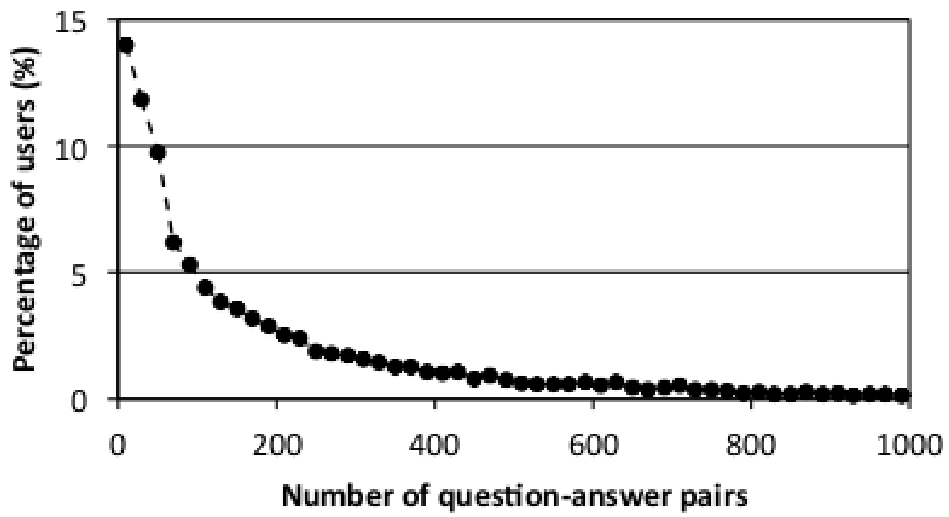 Figure 1: The distribution shows that while some users are inactive, a significant "power user" base engages in high-volume QA interactions, many of which contain aggressive content.
Key Findings: The Retaliation Loop
The study discovered a fascinating socio-technical phenomenon: Asymmetric Retaliation.
1. The Anonymity Penalty
Anonymous users were found to be more aggressive than their non-anonymous counterparts across the board. The probability of an anonymous question containing negative words was statistically higher ().
2. The Feedback Loop
The most striking result is found in the response behavior. When a user receives an aggressive question:
- If the asker is non-anonymous, the responder tends to be less aggressive than the asker (Regression slope ).
- If the asker is anonymous, the responder becomes more aggressive (Regression slope ).
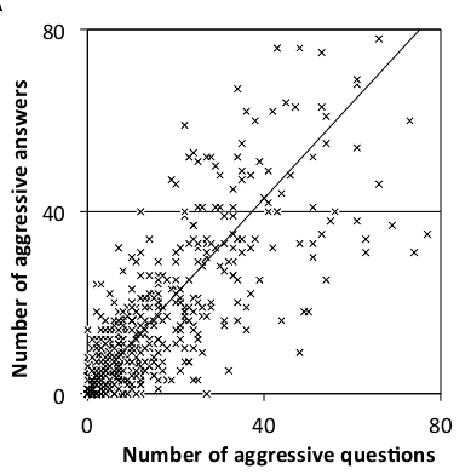 Figure 2: Comparing the relationship between aggressive questions and aggressive answers. Note the steeper trajectory in the anonymous interaction quadrant.
Critical Analysis & Conclusion
This paper highlights a critical "Inductive Bias" in online behavior: anonymity removes the social cost of aggression for the attacker and removes the empathy/restraint for the defender.
Takeaways for AI Researchers:
- Context Matters: As the authors note, negative words aren't always bullying; they can be used for defense or casual slang. Modern LLM-based classifiers must distinguish between "proactive aggression" and "reactive defense."
- System Design: The fact that 91% of users answer mostly anonymous questions suggests that while anonymity breeds toxicity, it is also the primary driver of user engagement on these platforms.
Future Outlook: Future research should look beyond word counts and use graph-theoretic measures to see if these aggressive "clusters" form long-term bullying structures or are merely isolated "flaming" incidents. Objective assessment of toxicity requires understanding the intent behind the negative word, a frontier still being explored in NLP today.
Main Contribution: Statistical evidence that anonymity not only encourages toxicity but actively amplifies retaliation, creating a more hostile environment for all participants.