
Automating the Information Front: A Faster Approach to Social Media Cyber Forensics
Analyzing deviant behaviors on social media using cyber forensics-based methodologies
This paper introduces an automated cyber forensics JavaFX application designed to identify and analyze deviant behaviors and propaganda campaigns on social media. Developed for the Blogtrackers and COSMOS research groups, the tool automates Open Source Intelligence (OSINT) collection to track influential bloggers and information warfare actors.
TL;DR
Information warfare (IW) has moved from a theoretical threat to a daily reality, with groups like ISIL using social media to militarize propaganda. This paper presents a specialized JavaFX-based automation tool that streamlines cyber forensic workflows, achieving a 120% speed increase over traditional manual methods. By automating the extraction of Open Source Intelligence (OSINT), researchers can now identify influential deviant actors and their digital footprints in seconds rather than minutes.
Problem & Motivation: The Bottleneck in Modern OSINT
In the theater of online warfare, the ability to gain situational awareness quickly is a tactical necessity. Organizations such as COSMOS and Blogtrackers analyze vast quantities of blog posts and social media interactions to assist agencies like NATO and the Office of Naval Research (ONR).
However, the standard industry tool, Maltego, presented a significant hurdle. While powerful for visualization, it required researchers to:
- Manually create domain entities.
- Wait for individual transformations to execute.
- Manually transcribe and export data for database entry.
The authors recognized that in high-stakes environments, these manual steps are not just "slow"—they are a liability that hinders real-time response to radicalization and "lone wolf" threats.
Methodology: Operationalizing Digital Forensics
The core innovation lies in the transition from a general-purpose forensic tool to a bespoke automated pipeline. The JavaFX application acts as a wrapper around the investigative logic required by the Blogtrackers group.
The Forensic Logic
The application automates a chain of transformations to uncover the hidden infrastructure of deviant actors:
- Identification: Extracting unique identifiers like Google Analytics IDs to link seemingly unrelated websites to the same owner.
- Mapping: Resolving URLs to IP addresses.
- Geolocating: Using the Wolfram|Alpha API to translate IPs into physical coordinates (achieving ~90% country-level accuracy).
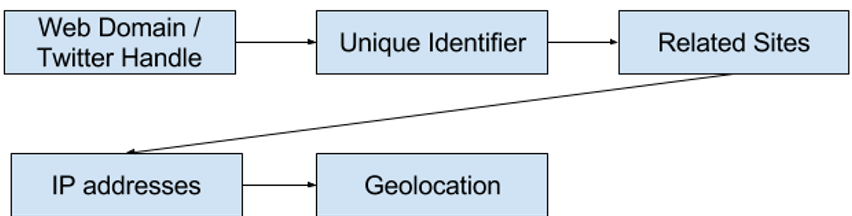 Figure 1: The automated transformation pipeline from URL/Twitter handle to Geolocation.
The system handles I/O flexibly, allowing researchers to feed in text files or connect directly to a MySQL database, effectively bridging the gap between raw data collection and actionable visualization.
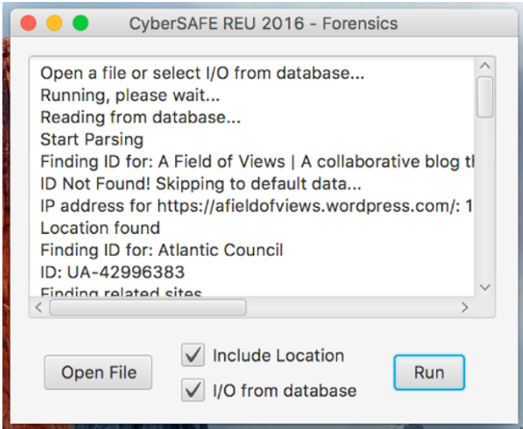 Figure 2: The streamlined JavaFX GUI designed for rapid execution.
Experiments & Results: Efficiency Gains
The authors conducted comparative testing between the traditional Maltego workflow and the new JavaFX solution. The results were stark.
| Tool | Test 1 | Test 2 | Test 3 | Test 4 | Average |
|---|---|---|---|---|---|
| JavaFX Tool | 7.2 s | 7.1 s | 6.3 s | 6.4 s | 6.75 s |
| Maltego | 42.0 s | 41.0 s | 43.0 s | 41.0 s | 41.75 s |

The JavaFX application demonstrated an 84% reduction in runtime compared to scripted "Maltego Machines." When compared to the original manual process, the speedup reached 120%, primarily because the tool eliminates the "human-in-the-loop" transcription errors and wait times.
Critical Insight & Conclusion
This research highlights a shift in the cyber forensic landscape: generalist tools are often the bottleneck. By building domain-specific automation, the researchers successfully turned a laborious manual task into a two-click operation.
Limitations and Future Work
While successful, the authors acknowledge that geolocation via IP is not perfect (90% accuracy). Future iterations aim to integrate Skyhook Hyperlocal IP services for higher precision and DomEye for broader site-linkage analysis.
Takeaway: In the context of information warfare, the "speed of insight" is a competitive advantage. This tool provides the Blogtrackers team with the high-fidelity operational awareness necessary to advise international security organizations like NATO and the ONR on evolving digital threats.