
Cyber-healthcare: Leveraging IoT and ML to Revolutionize Triage in Developing Nations
Cyber-healthcare for public healthcare in the developing world
This paper introduces a Cyber-healthcare system tailored for the developing world, integrating IoT-based vital sign monitoring with automated patient prioritization. By leveraging off-the-shelf sensors and Machine Learning, specifically Multivariate Linear Regression (MLR), the system achieves a state-of-the-art capability in real-time "Triage" situation recognition.
TL;DR
This research presents a "Cyber-healthcare" framework designed to transform public health in developing regions by digitizing patient vital signs through IoT sensors. By applying Multivariate Linear Regression, the system automates patient prioritization (Triage) with 90% accuracy, significantly reducing the workload on medical staff and eliminating manual entry errors.
Context & Motivation: The Infrastructure Gap
In many developing countries, healthcare centers are often overcrowded, under-staffed, and rely on paper-based records. The "Triage" process—deciding which patient needs immediate care—is frequently subjective and slow.
The authors identify a critical Research Intuition: Can we use off-the-shelf, low-cost sensors and machine learning to create a "medical leapfrog"? By bypassing traditional infrastructure and going straight to a cloud-based, digitized system, they aim to provide "Cyber-medicine" capabilities where specialized doctors may be scarce.
Methodology: The IoT-to-Cloud Pipeline
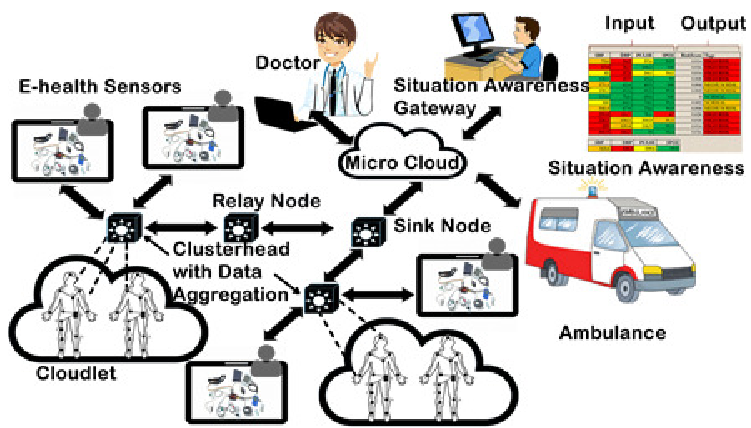
The system architecture is built on a four-tier logic:
- Capture: Mobile nurses or patients use e-Health kits (sensors for Pulse, SpO2, Blood Pressure).
- Aggregation: Data is relayed via "Cloudlets" (local sensor nodes) to a Sink node.
- Analytics: A Micro-cloud server runs Machine Learning algorithms to calculate a Risk Score.
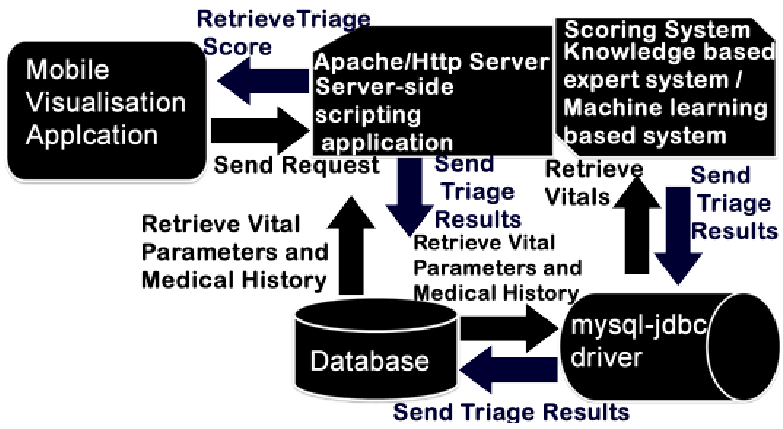
- Visualization: Doctors receive a prioritized list on an Android application.
Algorithm Showdown: MLR vs. SVM
The core of the system is the Situation Recognition module. The authors compared two primary approaches:
- Multivariate Linear Regression (MLR) via Gradient Descent: This model calculates weights for each vital sign to generate a linear hypothesis for the risk score.
- Support Vector Machines (SVM): Uses a hypothesis space of linear functions to predict the output score (Regression-based).
Experimental Insights & Results
The study conducted a rigorous comparison using real patient datasets from MIT's PhysioNet.
Performance Metrics
| Metric | Multivariate Linear Regression (MLR) | Support Vector Machine (SVM) |
|---|---|---|
| Accuracy | ~90% | ~80.67% |
| Processing Time | 5.01s | 10.21s |
| Complexity | Low (Scalable) | Moderate |
The results clearly favored MLR, which showed that as the dataset grows, the accuracy improves without a significant hit to processing speed. This is crucial for field deployment where hardware (like tablets and smartphones) might have limited computational power.
Field Readiness
A vital part of the study focused on whether "off-the-shelf" sensors (Libelium kits) were accurate enough for medical use. The authors compared sensor readings against calibrated hospital equipment under various conditions (resting vs. post-exercise). The results showed consistent patterns, proving that low-cost hardware is now at a level of "field readiness" for clinical data capture.
Critical Analysis & Perspective
Takeaway
The shift from qualitative triage (human clinical judgment) to quantitative triage (ML-driven score) provides a scalable solution for over-burdened health systems. This isn't just about automation; it’s about ubiquitous monitoring—allowing a single doctor to manage a much larger population pool through remote prioritization.
Limitations & Future Work
- Metric Sufficiency: The authors correctly question whether only quantitative vitals are enough for a full diagnosis. A patient might have "normal" vitals while having a critical condition not reflected in BP or Pulse (e.g., specific toxins or early-stage trauma).
- Network Reliability: In rural settings, the "Cyber" in Cyber-healthcare depends heavily on connectivity. The authors plan to investigate Multipath Routing and Quality-of-Service (QoS) protocols to ensure medical data reaches the cloud even during network congestion.
- Ethical Data Use: As the system scales, patient confidentiality and ethical data handling in cloud environments will remain a paramount challenge.
Conclusion
This paper serves as a robust blueprint for digital health sovereignty in the developing world. By proving that high-accuracy triage can be achieved with simple ML models on affordable hardware, it paves the way for a future where "Cyber-doctors" can provide life-saving interventions from anywhere, at any time.