
Cyber-Threat Mitigation: Exploiting the Birth–Death–Immigration Model
14733_Cyber-Threat Mitigation Exploiting the Birth-Death-Immigration Model.
This paper proposes a framework for mitigating cyber-threat propagation across data networks using the Birth-Death-Immigration (BDI) model. It introduces analytical solutions for optimal resource allocation and Maximum Likelihood Estimation (MLE) for unknown attack parameters (birth/immigration rates) to minimize the number of infected nodes.
TL;DR
This research leverages the classical Birth-Death-Immigration (BDI) stochastic process—originally from population biology—to model and defeat self-propagating cyber-threats like worms and malware. By viewing the attacker as an "immigrant" and host-to-host infections as "births," the authors derive a mathematically rigorous pipeline to estimate attack parameters and optimally allocate security resources (cures) across different subnets.
The Core Challenge: Managing the Exponential Chaos
Modern networks, specifically IoT environments, are highly susceptible to "chameleonic" threats that spread via cascade mechanisms. A defender faces three brutal realities:
- Heterogeneity: Different subnets have different vulnerabilities and hardware.
- Resource Scarcity: You cannot patch everything instantly; you have a limited "curing capacity" ().
- Uncertainty: You don't know exactly how fast a new malware is spreading () or how many entry points the attacker is using ().
Methodology: The BDI Abstraction
The authors utilize the Kendall BDI Model to simplify this complexity into three variables per subnet:
- Immigration (): The primary source of infection (the attacker).
- Birth (): Secondary infection (one sick node infecting another).
- Death (): The mitigation/curing process (security patches, anti-virus).
The Three Regimes of Threat
The ratio determines the network's fate:
- Subcritical (): The threat is stable; the number of infected nodes fluctuates but doesn't explode.
- Critical (): The threat grows linearly over time.
- Supercritical (): The threat grows exponentially. (This is where most modern attacks sit).
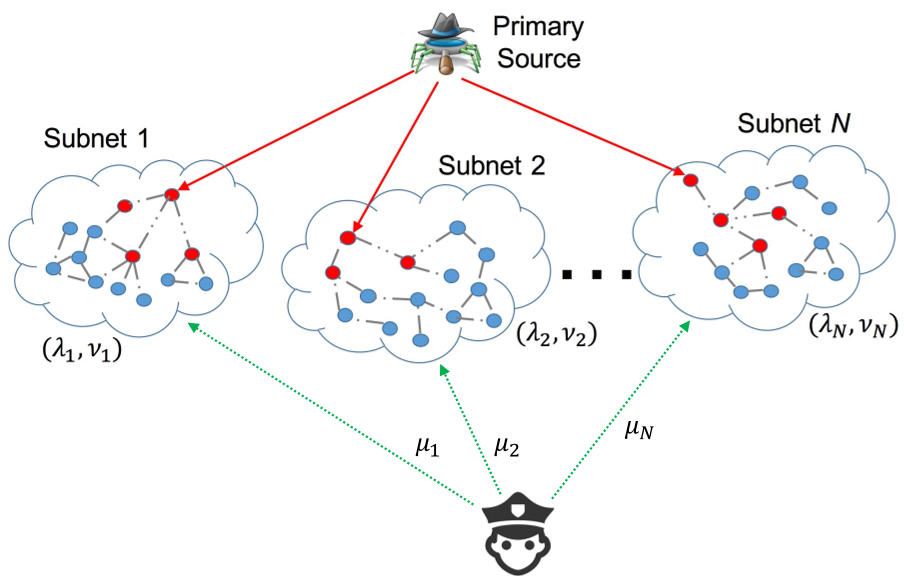 Figure 1: Conceptual view of multiple cyber-threats spreading across heterogeneous subnets and the defender's resource allocation problem.
Optimal Resource Allocation
The paper provides a dual-strategy for defenders depending on their total curing capacity ():
-
Case I: Insufficient Capacity (): If you can't stop the explosion, you must minimize the growth rate. The authors prove that an optimal allocation follows a Reverse Water-Filling logic: equalize the "effective" growth rates () across the most dangerous subnets to minimize the overall exponent.
-
Case II: Sufficient Capacity (): In this scenario, you can force the system into stability. The goal shifts to minimizing the expected number of infected nodes using Lagrange multipliers.
Handling the Unknown: Estimation via MLE
Since defenders rarely know the attack's "speed," the paper introduces Maximum Likelihood Estimators. For the supercritical (exponential) regime, they derive a simplified, highly efficient estimator: This allows a network analyst to observe the infection for a short period, estimate the threat speed, and immediately deploy the optimal curing strategy.
Experimental Validation
The authors tested their model against a semi-realistic Scanning-Threat Model (mimicking real-world IP scanning behavior).
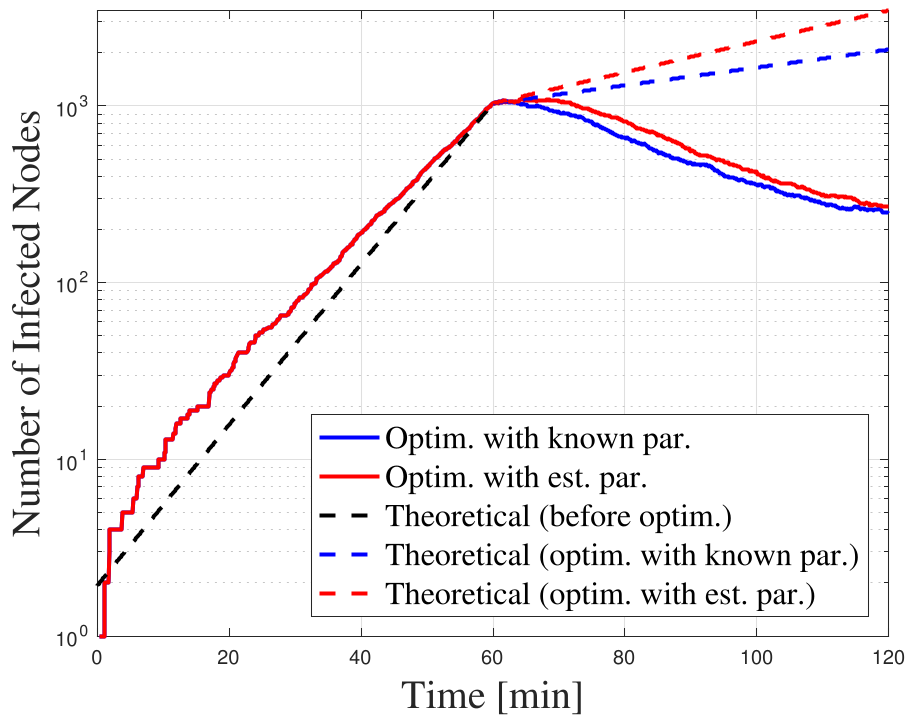 Figure 2: Simulation of a scanning-threat with timely cure. The "Theoretical" lines predict the slope of the infection, showing a sharp decrease once the optimized countermeasures are injected.
The results confirm that even with imperfect knowledge (using estimated parameters instead of true ones), the BDI-based mitigation significantly outperforms naive, uniform resource distribution.
Critical Insight & Conclusion
The beauty of this work lies in its thermodynamic approach. Instead of getting lost in the "microscopic" details of specific network topologies (routing, node-to-node links), it uses "mean-value" parameters that capture the essence of the threat's momentum.
Limitations: The model assumes an "infinite population" of vulnerable nodes. As we see in Figure 7 of the paper, if the network is small or the quarantine rate is extremely high, the BDI model's infinite-horizon assumption breaks down as the pool of susceptible nodes is exhausted.
However, for early-stage mitigation in massive networks (like the Internet or large-scale IoT), the BDI model provides a tractable and mathematically elegant "playbook" for the age-old battle between predator (hacker) and prey (defender).