
The Facebook Paradox: Why Seeking Support Can Sometimes Make Adolescents Feel Worse
The impact of daily stress on adolescents’ depressed mood: The role of social support seeking through Facebook
This study investigates the complex interplay between daily stress (school/family), Facebook social support seeking, and adolescent depressed mood. Using structural equation modeling (SEM) on a sample of 910 adolescents, it identifies Facebook as a double-edged sword for coping with daily stressors.
TL;DR
Is Facebook a digital life raft or a weight that pulls distressed teens deeper? This study reveals that for adolescents facing family and school stress, turning to Facebook only helps if they perceive they are being supported. If their "cry for help" goes unnoticed or feels inadequate, the act of seeking support itself significantly increases depressed mood—a phenomenon not findings in traditional face-to-face interactions.
Problem & Motivation: The Digital Coping Gap
Adolescents live in an era of "hyper-connectivity," yet clinical depression rates remain alarmingly high. Traditional psychological models suggest that seeking social support is a "functional" or "active" coping mechanism. However, the authors of this study noticed a discrepancy: whereas a face-to-face conversation involves rich non-verbal cues (eye contact, tone, touch), Facebook is "cue-poor."
The researchers hypothesized that the unique environment of Social Networking Sites (SNSs)—characterized by many "weak ties" and potential for public rejection—might alter how support-seeking affects mental health.
Methodology: Mapping the Digital Psyche
The researchers surveyed 910 adolescents in Belgium, focusing on two common "daily hassles": Stress of School Performance and Stress of Home Life. Using Structural Equation Modeling (SEM), they mapped the path from Stress Support Seeking Perceived Support Depressed Mood.
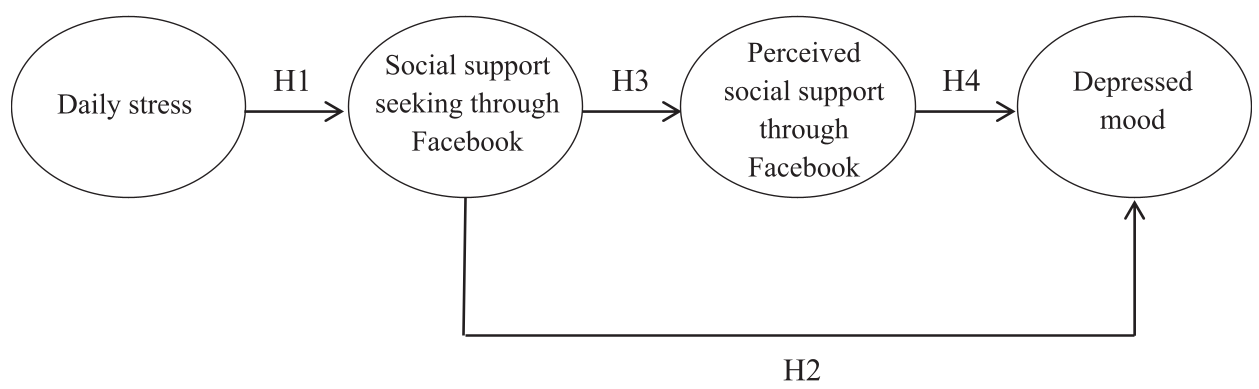 Figure: The hypothesized model showing the dual paths (direct vs. mediated) of social support seeking.
The Core Insight: Seeking Is Not Receiving
The study’s findings are a stark reminder of the "Optimal Matching Theory." This theory suggests that for stress to be mitigated, the type of support must match the need.
1. The Positive Loop (Mediation)
When an adolescent turned to Facebook and perceived that friends were caring, empathetic, and helpful, their depressed mood decreased. This is the successful "digital match."
2. The Negative Loop (Direct Effect)
Shockingly, the direct relationship between social support seeking and depressed mood was positive (). This means that when we control for the support actually received, the mere act of posting about problems on Facebook makes teens feel worse.
Why?
- Hyperpersonal Theory: Digital communication lacks the warmth of physical presence.
- The "Unanswered" Problem: On Facebook, a post about feeling "blue" might be met with silence or a mismatched "like," signaling a lack of social value to the seeker.
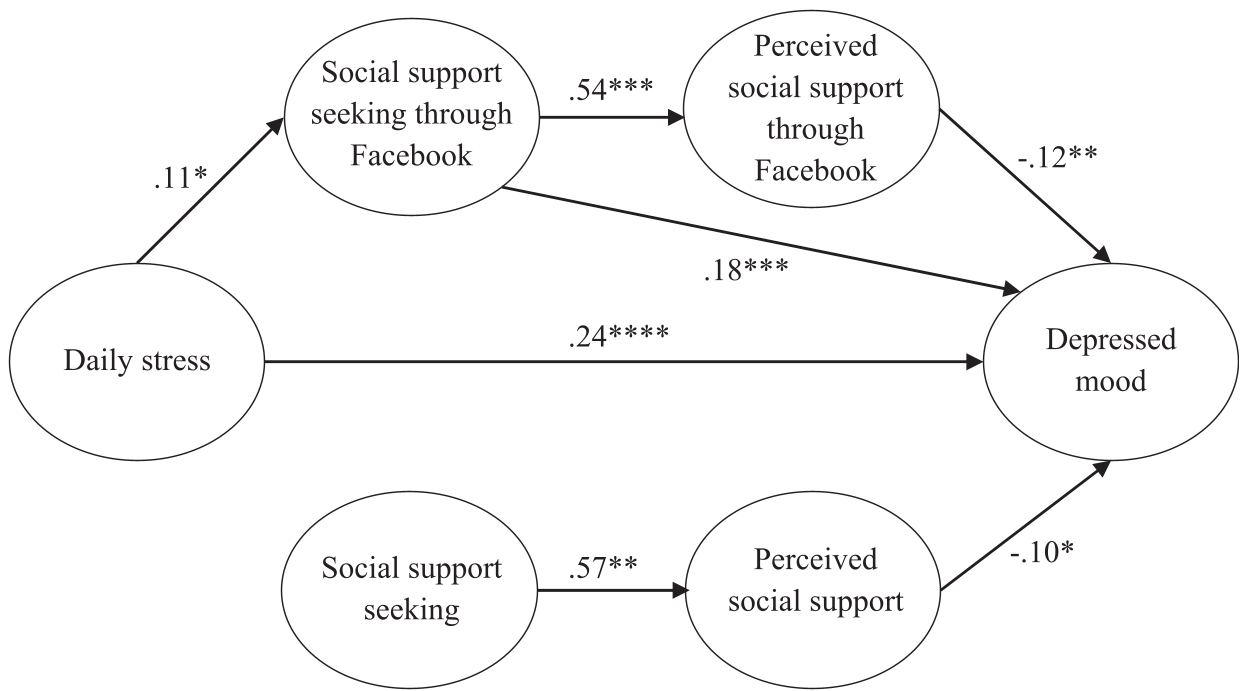 Figure: The multi-context model comparing Facebook vs. face-to-face outcomes.
Results: Facebook vs. Reality
When comparing these digital paths to traditional face-to-face support, the difference was clear:
- In Person: Seeking support did not have a direct negative impact on mood, even if support wasn't immediately perceived. The social "safety net" of physical presence is sturdier.
- On Facebook: The act is riskier. The study found that daily stress specifically drives girls more than boys toward depressive symptoms, and social media acts as a catalyst in this process.
Critical Analysis & Future Outlook
Takeaway for Today: Parents and educators should not assume that a teen "reaching out" on social media is adequately coping. Without the perception of being heard, the digital cry for help is actually harmful.
Limitations: The study is cross-sectional, meaning it captures a snapshot in time. It cannot definitively prove that Facebook causes the mood drop, only that they are strongly linked. Furthermore, the "cues" in 2014 (status updates) have evolved into "cues" in 2026 (short-form video, ephemeral stories), which may change the "perceived support" dynamic.
Future Work: Investigation is needed into how private settings (DMs) versus public settings (Wall posts/Stories) change the outcome. A private interaction might better fulfill the "Optimal Matching" requirement than a public post for "likes."