
DAN-SNR: Unifying Social Ties and Spatiotemporal Dynamics via Self-Attention
DAN-SNR: A Deep Attentive Network for Social-Aware Next Point-of-Interest Recommendation
The paper introduces DAN-SNR, a Deep Attentive Network for Social-aware next Point-of-Interest (POI) recommendation. By implementing a multi-channel architecture powered by multi-head self-attention, it effectively unifies sequential, spatiotemporal, and social influences to predict a user's next destination.
TL;DR
Predicting a user's next stop in a city is no longer just about where they were ten minutes ago; it's about the complex interplay between personal habits, geographical constraints, and the "social gravity" of their friends. DAN-SNR (Deep Attentive Network for Social-aware Next POI Recommendation) breaks away from the traditional RNN-heavy paradigms. By leveraging a dual-channel Multi-Head Self-Attention architecture, it captures long-range dependencies and social influences in parallel, achieving SOTA accuracy with significantly lower latency.
The "Social Gap" in Mobility Prediction
In the world of Location-Based Social Networks (LBSNs) like Gowalla or Yelp, we are influenced by our proximity to friends. If two friends both visit a specific museum after a hotel stay, you are likely to follow suit.
However, previous research faced two major hurdles:
- Dynamic Social Influence: Social ties aren't static; their relevance changes depending on the context (time of day, current location).
- RNN Limitations: Recurrent Neural Networks process data sequentially, making them slow and prone to "forgetting" distant but relevant historical check-ins.
Methodology: The Parallel Dual-Channel Architecture
The core innovation of DAN-SNR lies in its rejection of the "recursive" nature of RNNs in favor of the "relational" nature of Self-Attention.
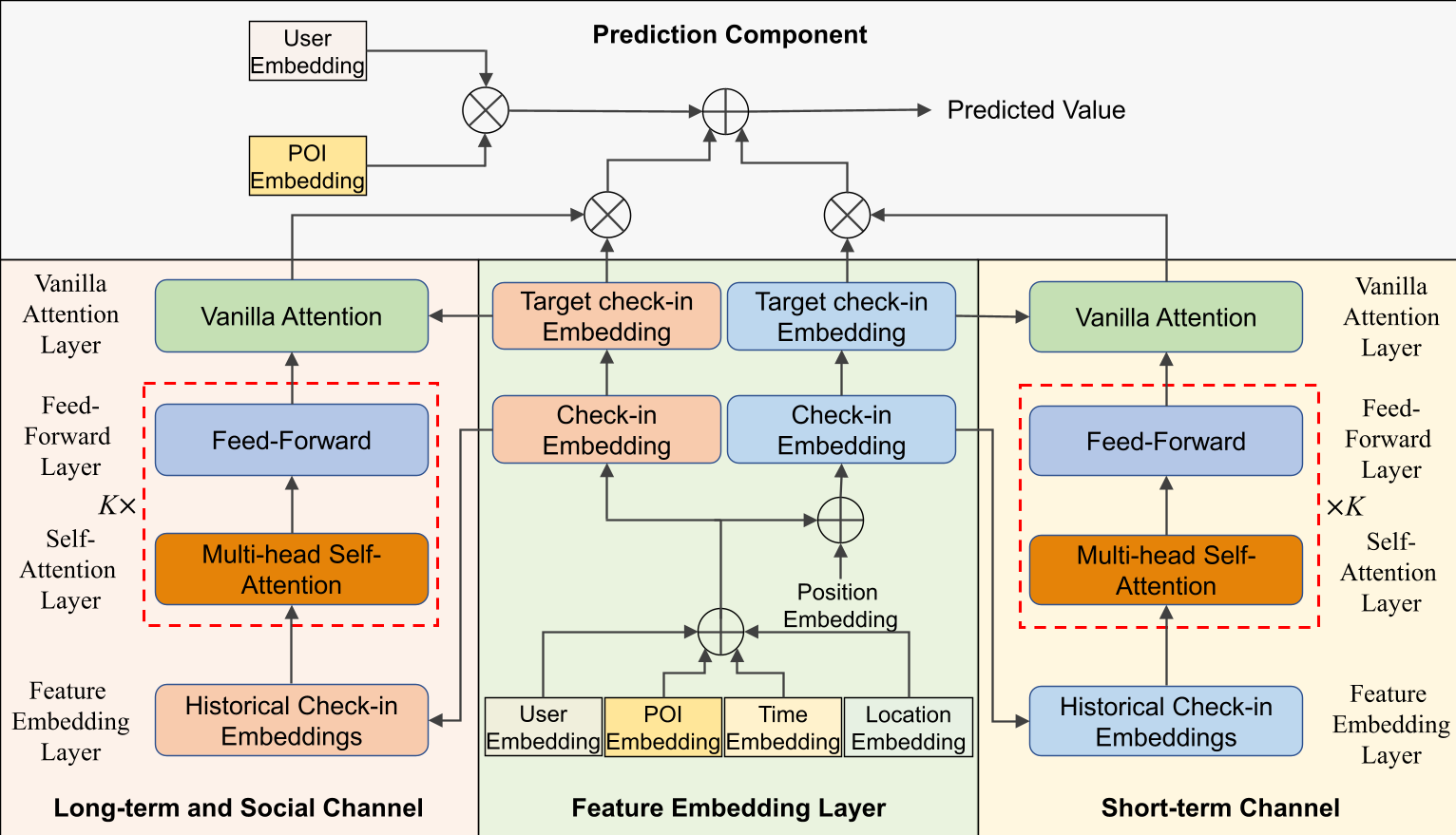
1. Feature Embedding Layer
The model translates five distinct signals into a shared latent space:
- User & Social: Network-based embeddings (node2vec) capturing friendship structures.
- POI & Location: An L2L (Location-to-Location) graph that models 2D geographical proximity beyond simple distance.
- Time & Position: Exponentially scaled temporal intervals and sinusoidal position encodings.
2. The Twin Channels
- Short-Term Channel (STC): Focuses on the "immediate" trajectory—what you've done in the last few hours to capture ongoing sequential influence.
- Long-Term & Social Channel (LTSC): Aggregates your entire history and the check-in patterns of your direct friends to distill persistent preferences and social "peer pressure."
Experimental Breakthroughs
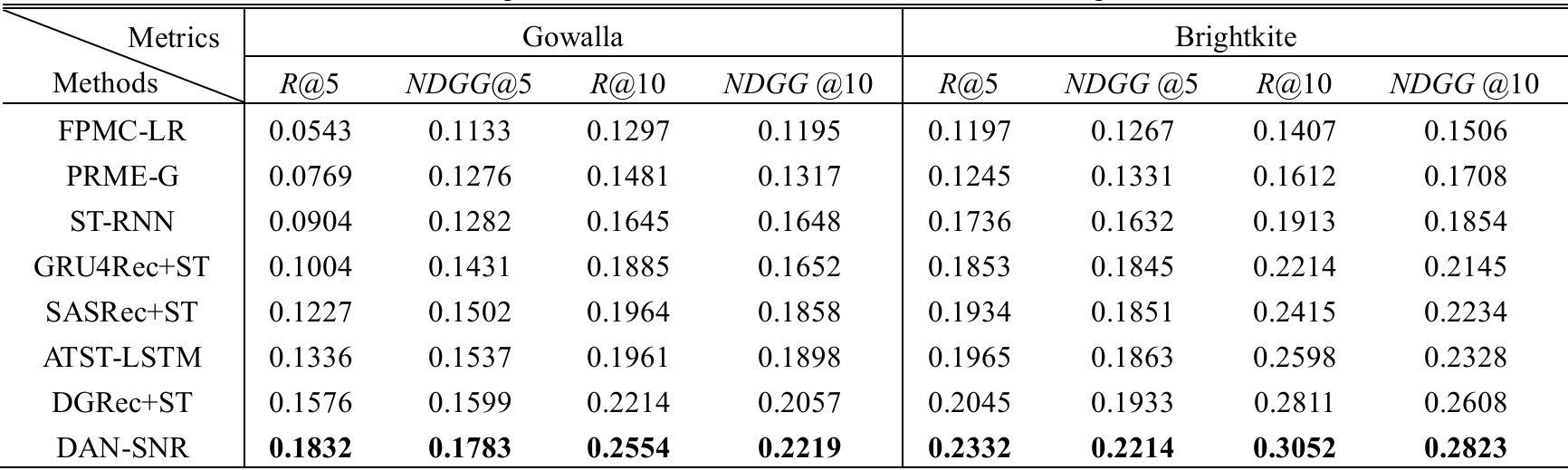
The authors tested DAN-SNR against seven baselines (including FPMC, ST-RNN, and ATST-LSTM) using real-world data from Gowalla and Brightkite.
SOTA Performance
DAN-SNR didn't just win; it dominated. On the Gowalla dataset, it achieved:
- Recall@5: 0.1832 (a ~16% improvement over the nearest social-aware competitor, DGRec).
- NDCG@10: 0.2219.
The Efficiency Edge
Because Self-Attention allows for massive parallelization, DAN-SNR is remarkably fast. While RNN-based models like GRU4Rec+ST take ~3.6s per batch, DAN-SNR clocks in at just 0.25s. This is critical for real-time recommendation engines.
Visualizing the "Intuition"
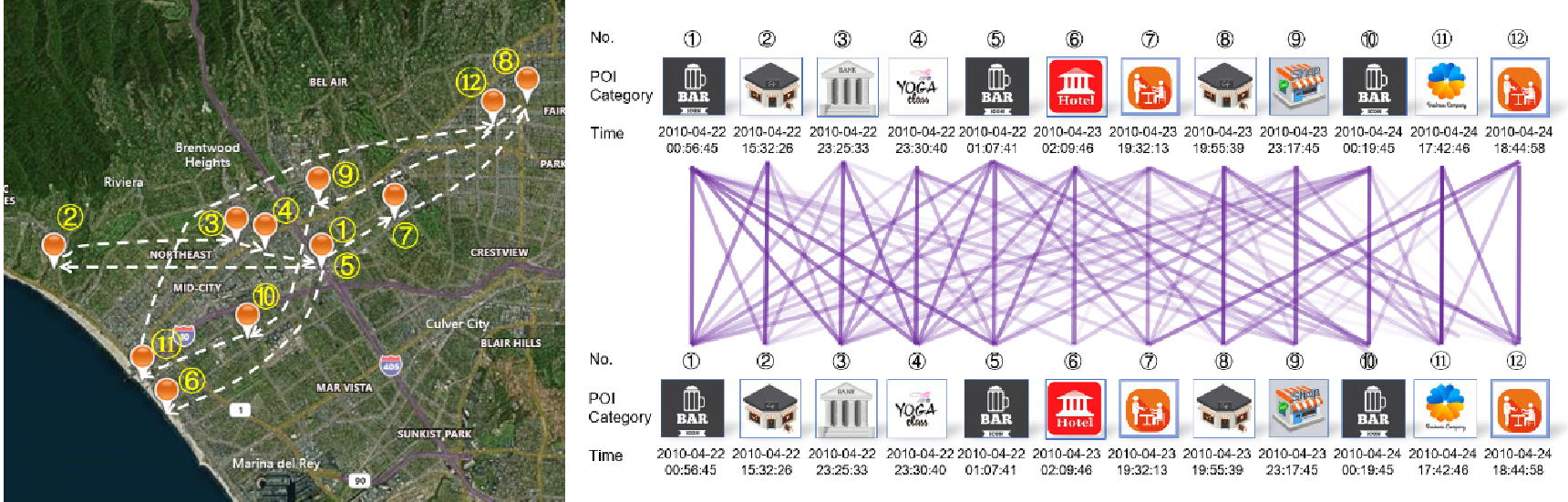
The paper provides a fascinating look at the attention weights (the "Why").
- Periodic Patterns: The model shows high attention weights between check-ins separated by days, proving it can "remember" that you go to the gym every Monday even if you've visited ten other places in between.
- Dynamic Social Weights: The heatmaps reveal that a specific friend's influence isn't constant; their impact on your next move fluctuates as you move through different contexts of your day.
Critical Insight & Conclusion
The Ablation Study in the paper yields a vital takeaway: while personal preference (history) is the strongest predictor, the inclusion of Social Influence provides the "extra mile" in accuracy. DAN-SNR effectively proves that social awareness is the missing link in mobility modeling.
Future Outlook: The authors suggest that the next frontier involves integrating "heavy" context like visual photos and text reviews into this attentive framework. For now, DAN-SNR stands as a robust blueprint for the next generation of smart travel assistants and localized mobile advertising.