
Dynamic Emotion Recognition: Building Self-Evolving Lexicons for Social Media Streams
A Data-Driven Approach to Dynamically Learn Focused Lexicons for Recognizing Emotions in Social Network Streams
This paper presents a data-driven, iterative framework for emotion recognition in social media streams by dynamically expanding an affective lexicon. Using a seed lexicon of 1,500 terms, the system employs Naïve Bayes and Class Association Rules (CAR) to learn and tag new, evolving terms from a dataset of 4 million tweets.
TL;DR
Static emotion lexicons are increasingly insufficient for the "wild west" of social media linguistics. This research proposes an iterative, data-driven framework that listens to social media streams and automatically expands its emotional vocabulary using Naïve Bayes and Class Association Rules (CAR). By analyzing 4 million tweets, the authors demonstrate a system that "learns" new emotional cues in real-time, adapting to the ever-shifting landscape of online expression.
The Challenge: The Linguistic Volatility of Social Networks
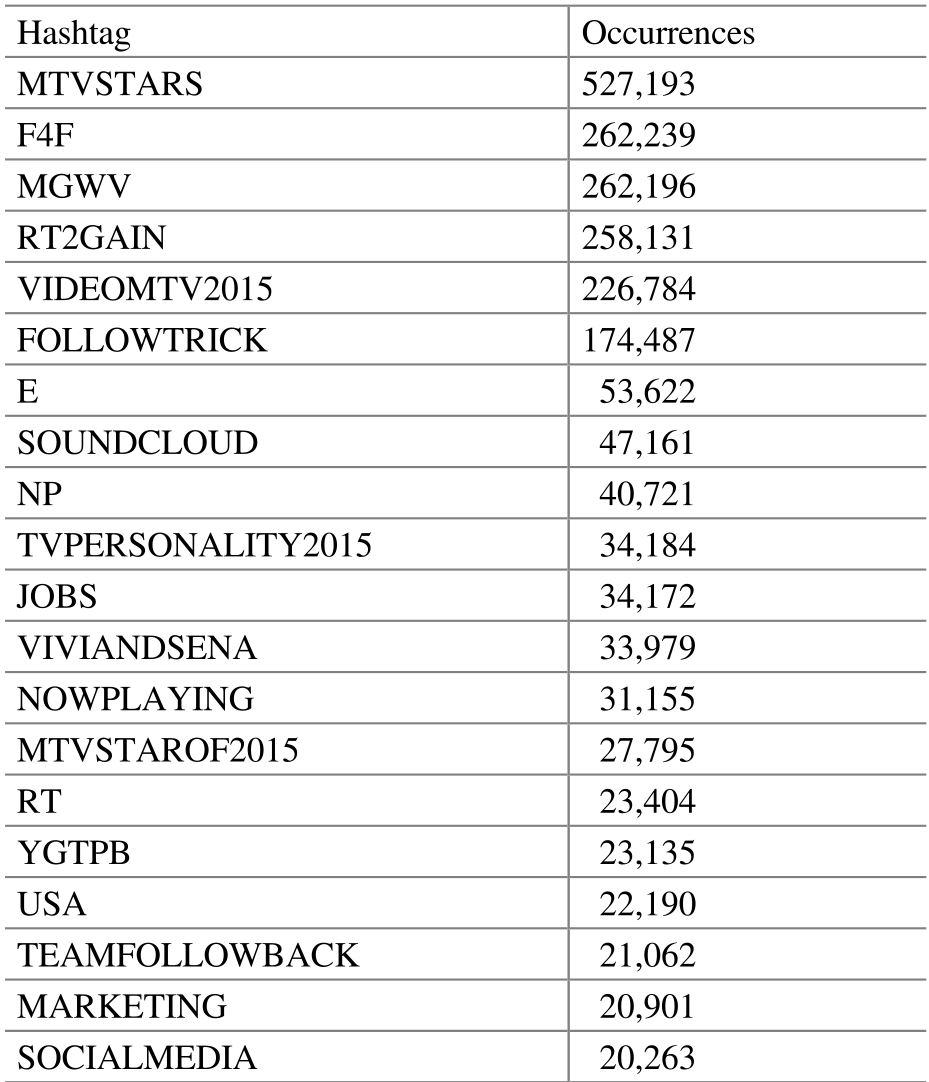
Traditional Opinion Mining often hits a wall when faced with social media. Why? Because language on platforms like Twitter is not static. New hashtags (#MTVSTARS), abbreviations, and emojis emerge daily.
Previous works relied on fixed datasets like WordNet-Affect, which, while precise, are limited in scope and cannot account for the "slang of the moment." The researchers identified a critical need for an evolving model that simulates human cognitive processes by updating its internal dictionary as it encounters new data.
Methodology: The Virtuous Cycle of Learning
The core of this paper is an iterative loop. Instead of treating training as a one-time event, the authors treat it as a continuous process.
1. The Iterative Framework
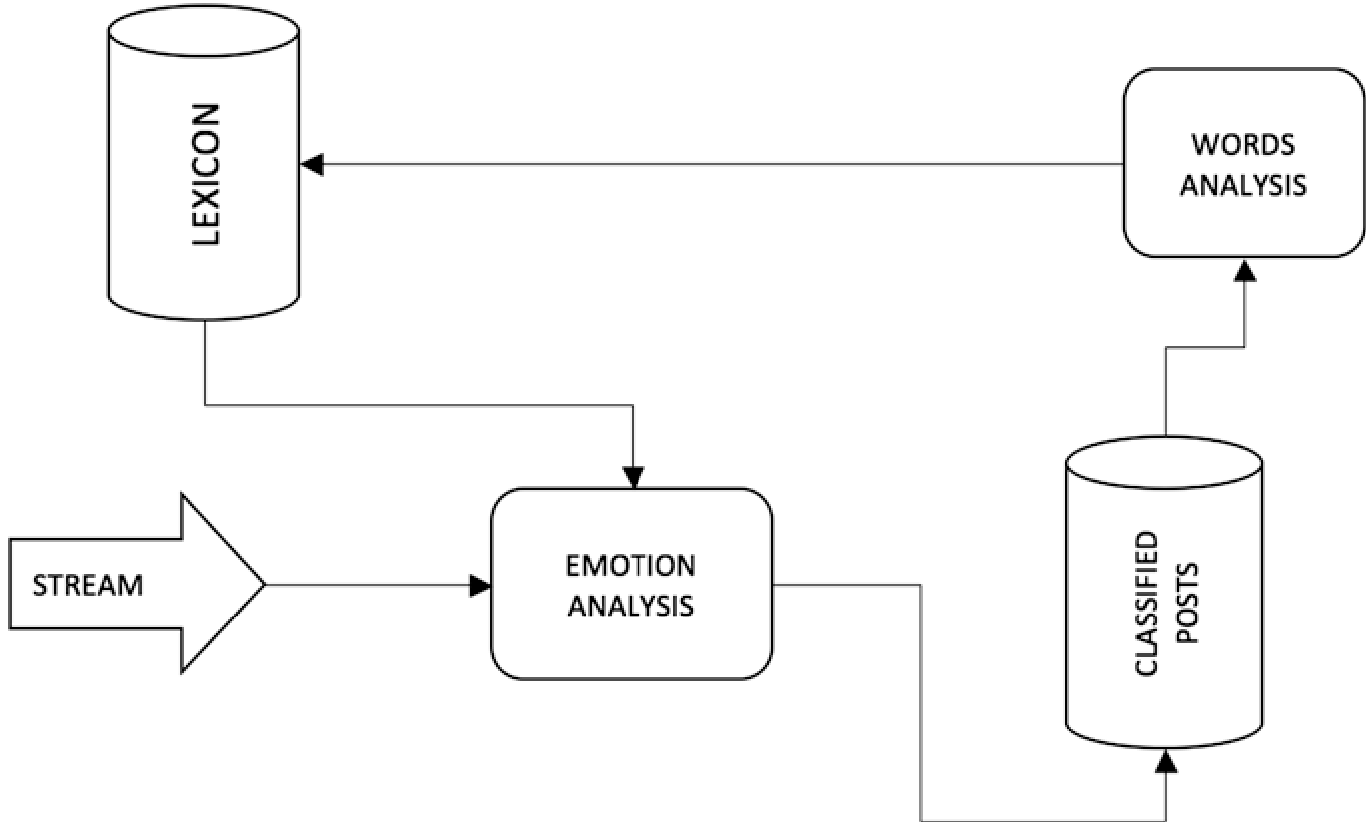
The process follows a four-step cycle:
- Connect: Listen to the live social network stream (Twitter API).
- Classify: Use the current Lexicon () to label posts in Dataset .
- Expand: Once enough posts are gathered, perform a token-level analysis to extract new emotional terms.
- Refine: Clean and merge new terms back into .
2. Stream and Word Analysis
The authors employ two distinct phases:
- Stream Analysis: Utilizes a Naïve Bayes classifier to calculate the likelihood of a term-vector belonging to one of Ekman’s six fundamental emotions (Anger, Disgust, Fear, Joy, Sadness, Surprise).
- Words Analysis: This is where the magic happens. To find new words, they use Class Association Rules (CAR). A rule looks for correlations between a specific token and an emotion label based on frequency and confidence.
Experimental Setup & Results
The researchers tested their approach on a massive dataset of 4,000,000 tweets collected in December 2015. They focused on the top 50 hashtags to see if the machine could learn the "vibe" of specific events.
Performance Comparison
They compared four types of lexicons:
- L1 (TF-IDF): Captured 7x more terms than CAR.
- L2 (CAR): More selective, with a high concentration of "Disgust" (45%) and "Joy" (21%) tags.
- L3 (Intersection): Lexicon formed by the overlap of L1 and L2.
- L4 (Union): The combined power of both methods.
Interestingly, even though L1 (TF-IDF) was significantly larger, the intersection-based L3 provided remarkably similar results in tracking the "Joy" trend for the popular hashtag #MTVSTARS, proving that the quality of the association is often more important than the quantity of the terms.
Deep Insight: Beyond Static Dictionaries
The real value of this work lies in its Inductive Bias toward dynamicity. By using a "distant supervision" approach, the model treats its own early predictions as silver labels to discover new features. This mirrors how humans learn: we understand a new slang word by seeing the emotional context of the people using it.
Limitations and Future Outlook
While effective, the current model relies heavily on the accuracy of the initial Naïve Bayes classifier. If the "seed" classification is wrong, the error might propagate into the lexicon expansion. The authors suggest that moving toward Support Vector Machines (SVM) or Neural Networks for the word analysis phase could further harden the system against noise.
Conclusion (Takeaway)
This research provides a blueprint for real-time social sensors. By allowing lexicons to "grow" alongside the communities they monitor, we can achieve a more granular and accurate understanding of global sentiment trends without the need for constant manual re-labeling.