
Scaling the Social Graph: Architectural Insights from LinkedIn’s Data Stack
Data infrastructure at LinkedIn
This paper presents LinkedIn’s large-scale data infrastructure, detailing four specialized open-source systems: Voldemort (KV store), Databus (CDC framework), Espresso (document store), and Kafka (distributed messaging). Together, they form a cohesive ecosystem for handling massive social graph data, real-time activity streams, and cross-datacenter replication.
TL;DR
LinkedIn's infrastructure is a masterclass in breaking down a monolithic data problem into specialized, high-performance components. By evolving systems like Kafka, Voldemort, Databus, and Espresso, LinkedIn solved the challenges of handling hundreds of millions of users. The core philosophy? Move state out of the service tier, optimize for the OS page cache, and treat every database update as a stream.
Background: The Three-Tier Reality
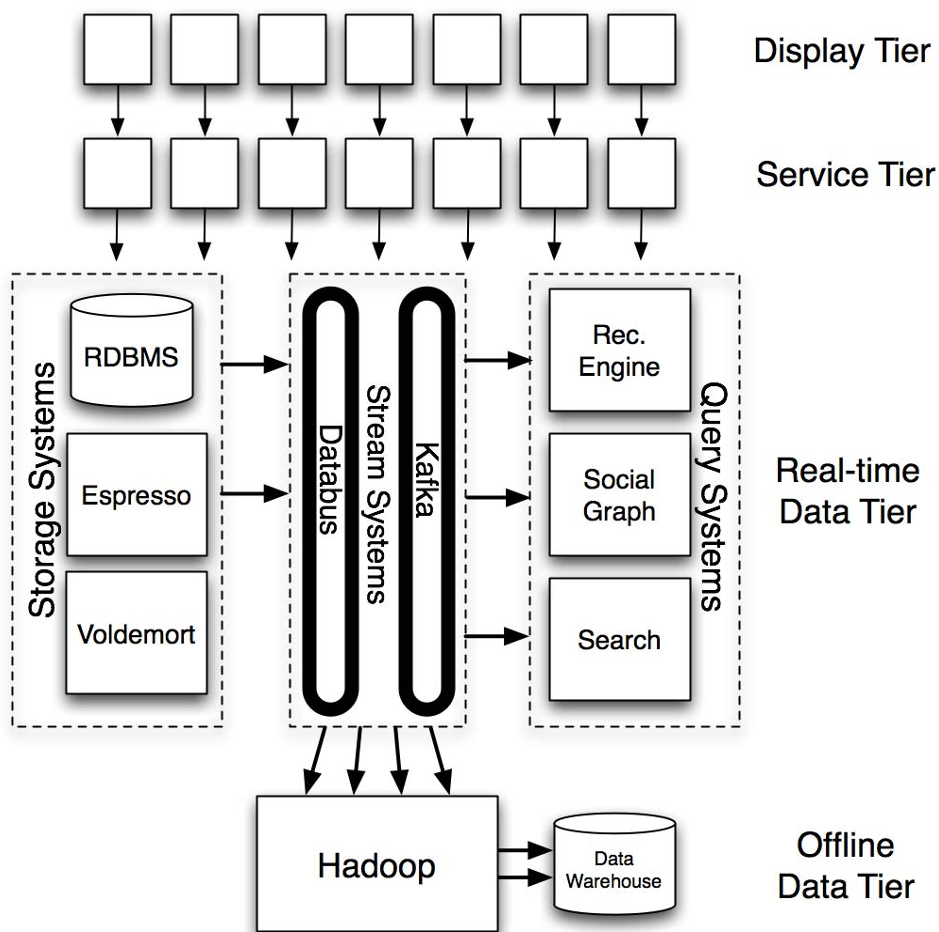
LinkedIn logically divides into a display tier, a service tier, and a data tier. While the first two are stateless and easily scalable, the data tier is where the complexity lies. The paper outlines a strategy where "state is pushed down," necessitating a diverse set of tools to handle different query patterns—from simple Key-Value lookups to complex person-to-person pathfinding in the social graph.
1. Voldemort: High-Availability KV Storage
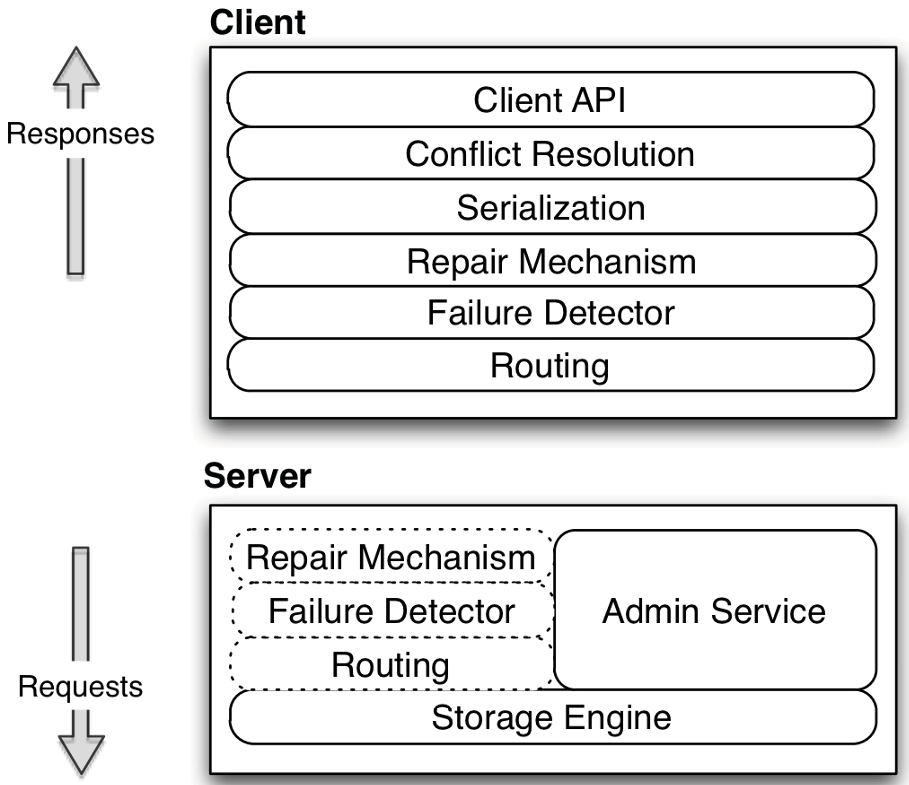
Inspired by Amazon's Dynamo, Voldemort is a Distributed Hash Table (DHT) optimized for data-center environments where "node churn" is low, but transient failures are common.
- The Insight: By storing the complete cluster topology on every node, Voldemort reduces lookup complexity from to compared to systems like Chord.
- Conflict Resolution: It uses Vector Clocks to allow any replica to accept a write, delegating conflict resolution to the application—a necessary evil for "Always-On" availability.
- Hybrid Storage: LinkedIn famously uses a custom "Read-Only" engine for Hadoop-generated data, where indices are built offline and memory-mapped for sub-millisecond retrieval.
2. Databus: The Pulse of Data Consistency
How do you keep a search index or a cache consistent with a primary Oracle database? You don't use triggers; you use Change Data Capture (CDC).
- The Relay: Databus captures transaction logs and serves them through an in-memory buffer.
- The Bootstrap Server: This is the "time machine" of the stack. If a subscriber falls behind, the Bootstrap server provides a "consolidated delta" (only the latest state of a row) to allow the client to catch up quickly without replaying millions of redundant events.
3. Espresso: The Best of Both Worlds
Espresso was born to bridge the gap between simple KV stores (Voldemort) and complex RDBMS (Oracle). It is a document store that supports local secondary indexing and local transactions.
- Architecture: It uses MySQL as a storage plugin and Lucene for indexing.
- Timeline Consistency: By using Databus for internal replication, Espresso ensures that slave partitions see changes in the exact same commit order as the master.
4. Kafka: Log Processing at Scale
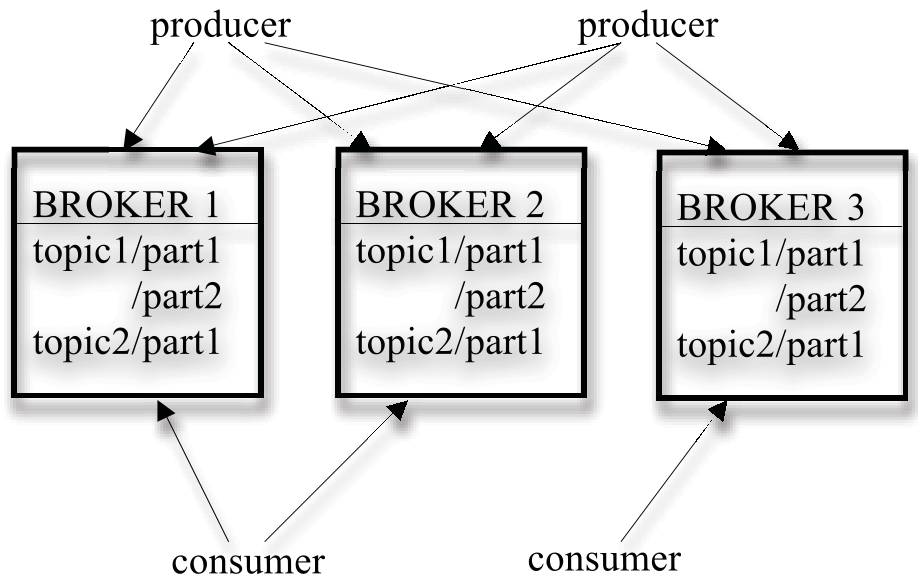
Perhaps the most famous export from this paper, Kafka treats user activity (clicks, logins) as a persistent log.
- Zero-Copy Magic: Kafka’s efficiency doesn't come from complex in-memory caching. Instead, it relies on the OS Page Cache and the
sendfilesystem call to bypass the application buffer, essentially piping data directly from the disk to the network card. - Stateless Brokers: Brokers don't track what consumers have read. Consumers manage their own "offsets" in Zookeeper. This allows a consumer to "rewind" time and re-process data if a bug is found—a feature traditional message queues lack.
Critical Analysis & Conclusion
The LinkedIn stack proves that there is no "silver bullet" database. By specializing—using Voldemort for latency, Kafka for throughput, and Espresso for structured queries—they achieved a level of scalability that a single RDBMS could never reach.
Takeaway: The real innovation here isn't just the individual tools, but the connective tissue (Databus/Kafka) that allows data to flow reliably between them.
Limitations: Managing four distinct distributed systems introduces significant operational overhead. Future work, as noted by the authors, involves unifying these components under shared coordination frameworks like Helix.