
Data-Driven Intelligence: Navigating the Big Data Era in Smart Production
Data and knowledge mining with big data towards smart production
This paper provides a comprehensive review of Data Mining Techniques (DMTs) applied to production management in the big data era. It categorizes methodologies into Statistical Analysis (SA) and Knowledge Discovery (KD) oriented approaches, demonstrating how these tools achieve smart manufacturing goals like real-time, self-adaptive, and precise control across tasks such as scheduling and fault diagnosis.
TL;DR
Modern manufacturing is drowning in data but starving for actionable knowledge. This seminal review by researchers at Beihang University dismantles the limitations of traditional "paper-and-math" management, advocating for a dual-path approach using Statistical Analysis (SA) and Knowledge Discovery (KD). By synthesizing decades of research, the authors demonstrate how data mining transforms raw industrial signals into a "triple-threat" of efficiency: predictive quality, adaptive scheduling, and autonomous fault diagnosis.
The "Data Grave" Dilemma
In the 1990s, manufacturing was static. Decisions were made based on the "gut feeling" of senior engineers or rigid expert systems. Today, with the influx of IoT, ERP, and MES data, enterprises face a "Data Grave": they collect massive amounts of data but lack the tools to exhume value.
The authors argue that traditional methods fail because:
- Manual Inspection is subjective and destructive.
- Mathematical Models require human assumptions that oversimplify the chaotic reality of the shop floor.
- Expert Systems lack the "inheritance" needed to adapt when the manufacturing environment changes.
Methodology: The DMT Architecture
The paper categorizes Data Mining Techniques (DMTs) into two fundamental families, each serving a unique role in the Smart Factory:
1. SA-Oriented DMTs (The Verifiers)
These use mathematical models (Regression, Bayesian, KNN) to verify hypotheses. They are the "Scalpels" used to optimize known parameters and describe total means.
2. KD-Oriented DMTs (The Explorers)
These are data-driven engines (Neural Networks, SVM, Decision Trees, GA) that search for patterns without prior assumptions. They are the "Radars" that find hidden correlations and "mutations" in production flow.
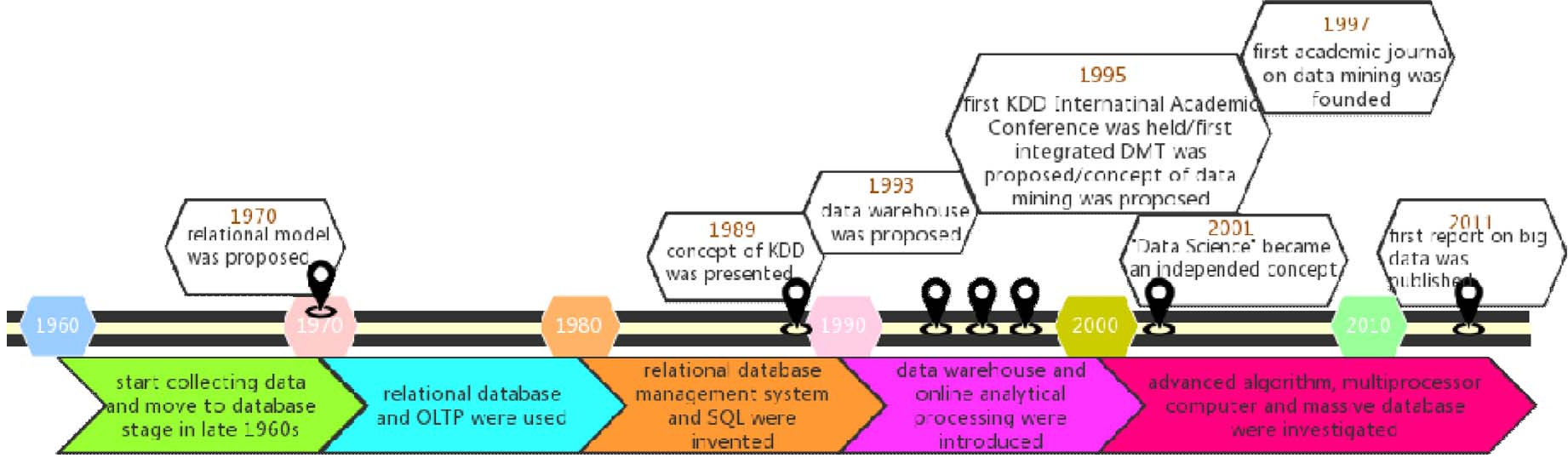 Figure 1: The historical evolution from file processing to the KDD (Knowledge Discovery in Databases) paradigm.
Key Application Domains
The paper maps DMTs across 47 high-impact studies, revealing how AI is actually used on the floor:
- Advanced Planning & Scheduling (APS): Moving from static rules to "Neural Scheduling." By using Gaussian Process Regression, systems can now predict dispatching performance and switch rules dynamically as bottlenecks appear.
- Quality Improvement: Instead of checking quality at the end (Post-hoc), Bayesian frameworks now update parameter estimates in real-time (Sequential Monte Carlo), providing a "continuous prediction" of performance.
- Fault Diagnosis: Utilizing Sliding Window Associated Frequency Patterns (SAFP) to identify bearing failures before they cause a line stoppage.
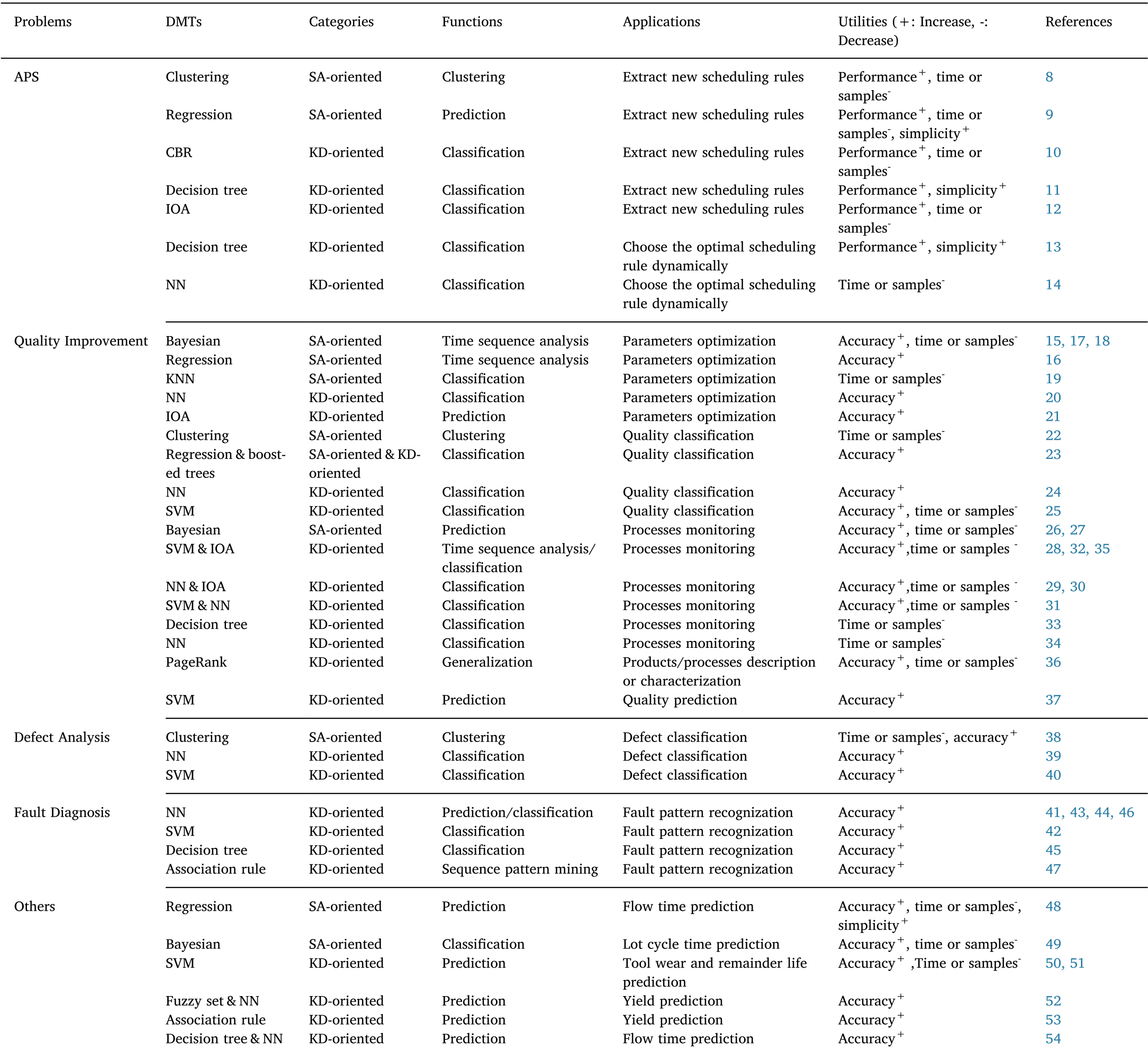 Figure 2: Comprehensive mapping of algorithms to production problems, highlighting the dominance of KD-oriented methods in fault diagnosis.
Deep Insight: Why Integrated DMTs are the Future
The authors observe a critical trend: 25% of modern studies now use hybrid models.
Why? Because a single algorithm has an "Inductive Bias." A Decision Tree is easy to explain but brittle; a Neural Network is powerful but a "black box." By combining them (e.g., GA for feature selection + SVM for classification), researchers are achieving SOTA results that are both accurate and robust.
Strategic Roadmap & Limitations
Despite the hype, the paper identifies "The Curse of Dimensionality" and the "Inconsistency of Industrial Data" as major hurdles. The roadmap for future research (towards "Smartness") includes:
- Complexity Handling: Moving beyond structured data to handle non-structural "Industrial Noise."
- Self-Learning: Developing DMTs that automatically update defect categories without manual retraining.
- Visualization: Transforming complex "High-D" latent spaces into natural language/graphics that a floor manager can understand.
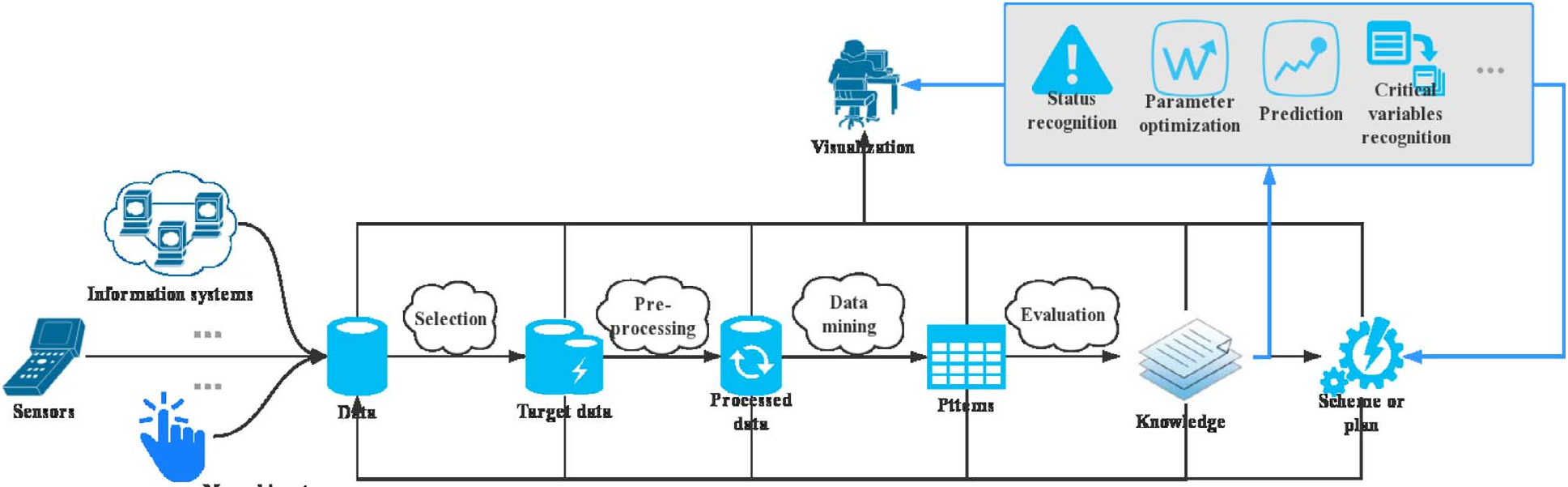 Figure 3: The standard workflow for deploying Data Mining in a production environment.
Critical Analysis & Conclusion
This paper serves as a bridge between computer science and industrial engineering. While it focuses heavily on traditional DMTs, it lays the groundwork for the current "AI for Science" movement. The primary takeaway for manufacturers is clear: Data is not noise; it is a dynamic constraint that, when mined correctly, eliminates the need for human guesswork in high-stakes production environments.
The transition from "Digitalization" to "Intelligization" depends entirely on how well we can bridge the gap between abstract algorithms and physical shop-floor dynamics.