
Friendlysourcing: Shielding Competitive Crowdsourcing from Social Network Data Leaks
Data Leak Aware Crowdsourcing in Social Network
The paper introduces Friendlysourcing, a privacy-preserving crowdsourcing framework for social networks. It utilizes a Markov-chain based algorithm to model implicit data propagation and a modified K-means clustering approach to form collaborative teams while preventing sensitive information leakage between competitive groups.
TL;DR
In the world of crowdsourcing, your social ties can be a liability. This paper introduces Friendlysourcing, a framework that uses Markov chains and specialized clustering to build crowdsourced teams. By predicting how information "hops" through a social network, it ensures that competitive teams remain strategically isolated, preventing accidental data leaks.
Background & Motivation: The "Hidden" Leak Problem
Modern crowdsourcing has evolved from simple tasks to complex problem-solving. When a company issues an "open call" for a solution, they often want multiple teams to compete. However, we live in a hyper-connected world. If Member A from Team 1 is a close friend of Member B from Team 2, the "secret sauce" of a solution might leak across team boundaries.
Current systems focus on task allocation or user skills but ignore the privacy topology of the social network. The authors argue that it isn't enough to look at who is "friends" with whom; we must understand the probability of data propagation through indirect links.
The Core Mechanism: Markov Chain Propagation
The researchers' first major insight is that data sharing in social networks follows a Markovian property: the probability of you receiving information depends on your direct connections (the current state), not on how that information reached your contact (past states).
1. Modeling the Social Graph
They define the network as , where represents the probability of data sharing based on historical interaction volume rather than just a binary "friend" status.
2. Identifying Implicit Interests
Direct connections only tell half the story. If Alice shares 90% of her data with Bob, and Bob shares 100% with Charlie, Alice’s data will likely reach Charlie even if they don't know each other. The authors develop an Energy Function () to calculate the maximum propagation risk across all possible paths:
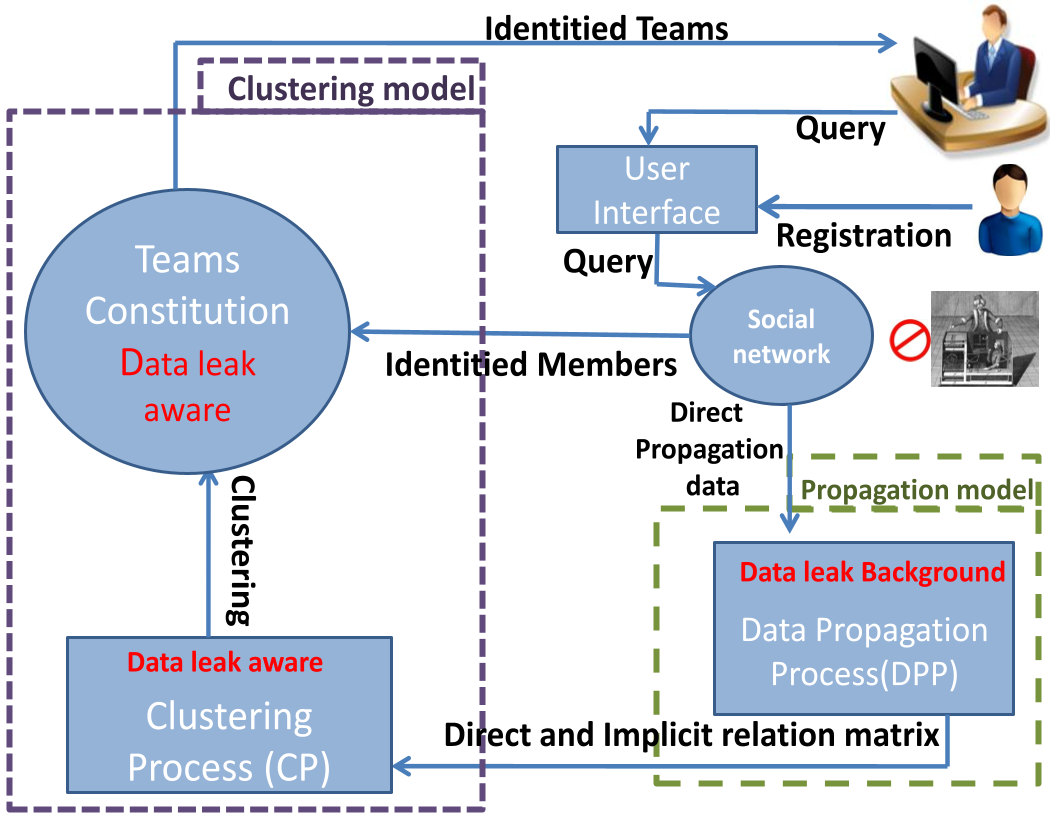 Figure 1: The dual-process architecture separating Data Propagation from Clustering.
Methodology: The D-Max Clustering Algorithm
Once the "leakage risk" between all pairs is mapped, the system needs to form teams. Standard K-means wouldn't work because it doesn't account for the "contagion" of information.
The authors introduce the D-Max Clustering approach:
- Logic: If an individual has a high probability of leaking data to anyone in a specific team, they must be included in that team or the teams must be merged.
- Thresholding: A parameter (eta) defines the "acceptable risk" level. If the propagation probability exceeds , the individuals are considered collaborative (same team) rather than competitive (different teams).
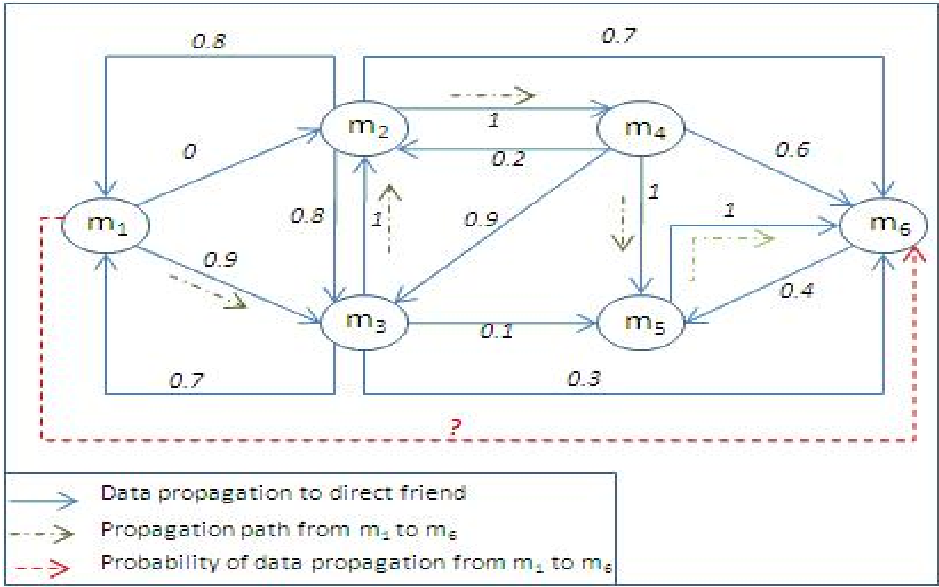 Figure 2: Indirect data propagation paths (dotted arrows) calculated via the Markov model.
Critical Analysis: Impact and Limitations
The primary strength of this work is shifting the focus from static privacy settings to dynamic sharing behavior. By using the actual "rate of shared data," the model adapts to how people actually interact.
Key Takeaways:
- Security by Design: The "Merge" logic in Algorithm 2 is a powerful heuristic. It forces the system to acknowledge that if a person bridges two competitive groups, those groups are no longer truly competitive—they are a single information silo.
- Limitations: The model assumes that sharing rates are . In reality, humans might be more discreet when they know they are on a competitive team. The model also doesn't yet account for the content of the data being shared—only the volume.
Conclusion
Friendlysourcing offers a mathematically grounded way to build teams in a connected world. By treating social networks as a propagation manifold, it provides a roadmap for future crowdsourcing platforms to protect business intelligence while still harnessing the power of the crowd.
Author Note: This work bridges the gap between social computing and information security, serving as a foundational piece for privacy-aware human computation.