
SVR: The New Gold Standard for Precision Agriculture Yield Prediction
Data Mining of Agricultural Yield Data: A Comparison of Regression Models
This paper evaluates four advanced data mining techniques—Multi-Layer Perceptrons (MLP), Radial Basis Function (RBF) networks, Regression Trees, and Support Vector Regression (SVR)—for the task of multi-dimensional yield prediction in precision agriculture. The author demonstrates that SVR consistently outperforms traditional neural network approaches on multiple real-world wheat datasets.
TL;DR
In the era of precision agriculture, sensor-rich data is abundant, but turning it into accurate yield predictions remains a challenge. This paper conducts a rigorous comparison of four regression models, proving that Support Vector Regression (SVR) consistently beats the industry-standard Multi-Layer Perceptrons (MLP) in both accuracy and speed, while maintaining high generalization across different field sites.
The "Data Curse" in Modern Farming
Modern farmers harvest more than just crops; they harvest gigabytes of GPS-stamped data. From soil conductivity (EM-38) to chlorophyll-sensitive spectral data (REIP), the heterogeneity of a field is now visible. However, the "curse" lies in the complexity. Traditional Neural Networks (MLPs) have been the go-to solution, but they are often computationally expensive and difficult to tune. This research asks: Is there a more robust, efficient way to predict yield?
Methodology: A Four-Way Battle
The author tested four distinct regression paradigms on data from three German wheat fields:
- Multi-Layer Perceptron (MLP): The established reference using backpropagation.
- Radial Basis Function (RBF) Network: A three-layer network focusing on high-dimensional Euclidean distances.
- Regression Trees: A high-interpretability model (CART) providing clear decision rules.
- Support Vector Regression (SVR): A technique that minimizes an -insensitive loss function to ignore small errors and focus on a robust "margin."
The inputs included three nitrogen fertilization stages, soil conductivity, and spectral indicators of plant health at different growth stages.
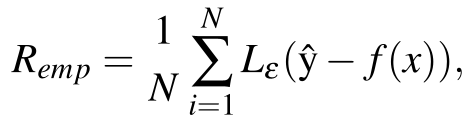 The Empirical Risk Function used in SVR to achieve the robust margin.
Experimental Showdown
The models were parameterized using one field (F04) and then "blindly" applied to others to test generalization.
Performance Metrics
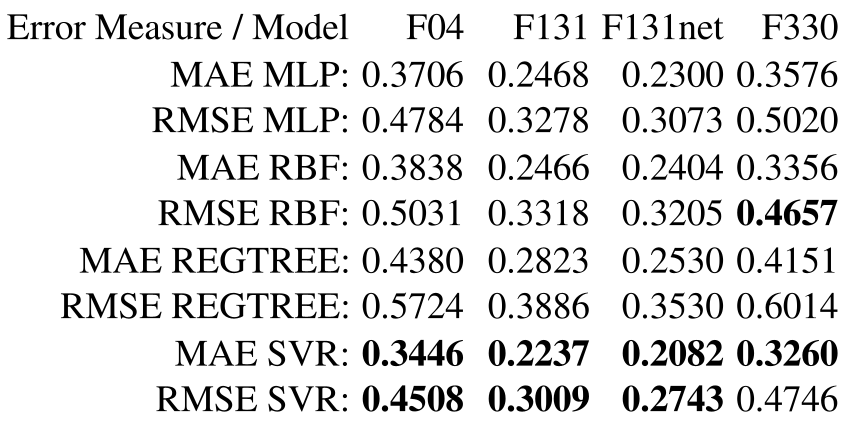
As shown in the table above:
- SVR is the clear winner: It achieved the lowest MAE and RMSE in almost every scenario.
- Regression Trees Failed: While easy to understand, they lacked the nuance required for precision yield estimation, yielding the highest errors.
- Parameter Portability: The experiment confirmed that SVR parameters like and could be successfully transferred between fields of similar attribute structures.
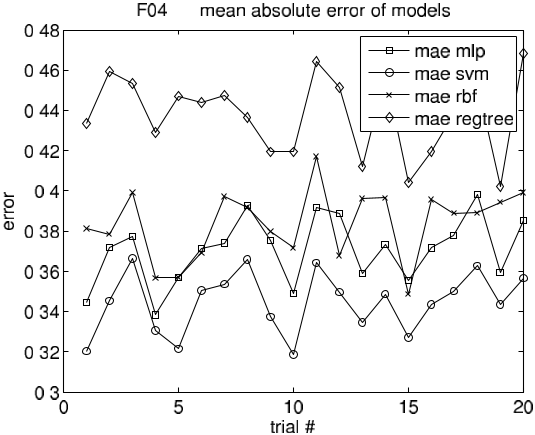 Figure: Consistency of SVR performance (lowest curves) across multiple cross-validation splits.
Critical Insight: Why SVR?
Why does SVR outperform the others? The author suggests that SVR’s ability to map data into a high-dimensional feature space—where it becomes linearly separable—is key. Unlike MLPs, which can overfit or get stuck in local minima, SVR’s optimization is a quadratic problem, ensuring a global solution that balances "flatness" of the model with error tolerance.
Conclusion and Future Outlook
While SVR is the technical winner, it shares the "black box" downside of MLPs. The author notes that future work should focus on interpretability—finding ways to visualize support vectors so farmers can understand why a specific yield was predicted.
For practitioners in the AgTech space, the takeaway is clear: if you are still using basic Neural Networks for regression tasks, it is time to shift your pipeline toward Support Vector Regression to gain a significant edge in both performance and processing time.