
Hybrid Data Mining: Revolutionizing AML in International Investment Banking
Towards a New Data Mining-Based Approach for Anti-Money Laundering in an International Investment Bank
This paper introduces a hybrid data mining framework specifically designed for Anti-Money Laundering (AML) in international investment banking. The system combines K-Means clustering for feature segmentation and Back-Propagation Neural Networks for classification, effectively identifying suspicious transaction patterns.
1. Executive Summary
TL;DR: This research addresses the critical inefficiency of manual and rule-based Anti-Money Laundering (AML) systems by introducing a high-performance data mining framework. Utilizing a combination of K-Means clustering and Back-Propagation Neural Networks, the authors successfully reduced the time required for transaction investigation from over a week to less than five minutes.
Positioning: This work serves as a practical bridge between theoretical data mining and the high-stakes environment of international investment banking, moving beyond simple cash-world detection to handle complex investment behaviors.
2. Problem & Motivation: Beyond Simple Rules
Money laundering in investment banking is far more sophisticated than in retail banking. While standard accounts might be flagged for a single large cash deposit, investment activities are naturally high-frequency and high-volume, influenced by market climate and exchange rates.
The Pain Point: Current market solutions rely on fixed thresholds (e.g., standard deviation from average behavior). These models generate excessive false positives or miss "stealthy" launderers who mimic market-driven fluctuations. The researchers recognized that the "frequency" and "value" markers must be contextualized within the specific investment fund's behavior, not just the individual's history.
3. Methodology: The Duo-Parameter Approach
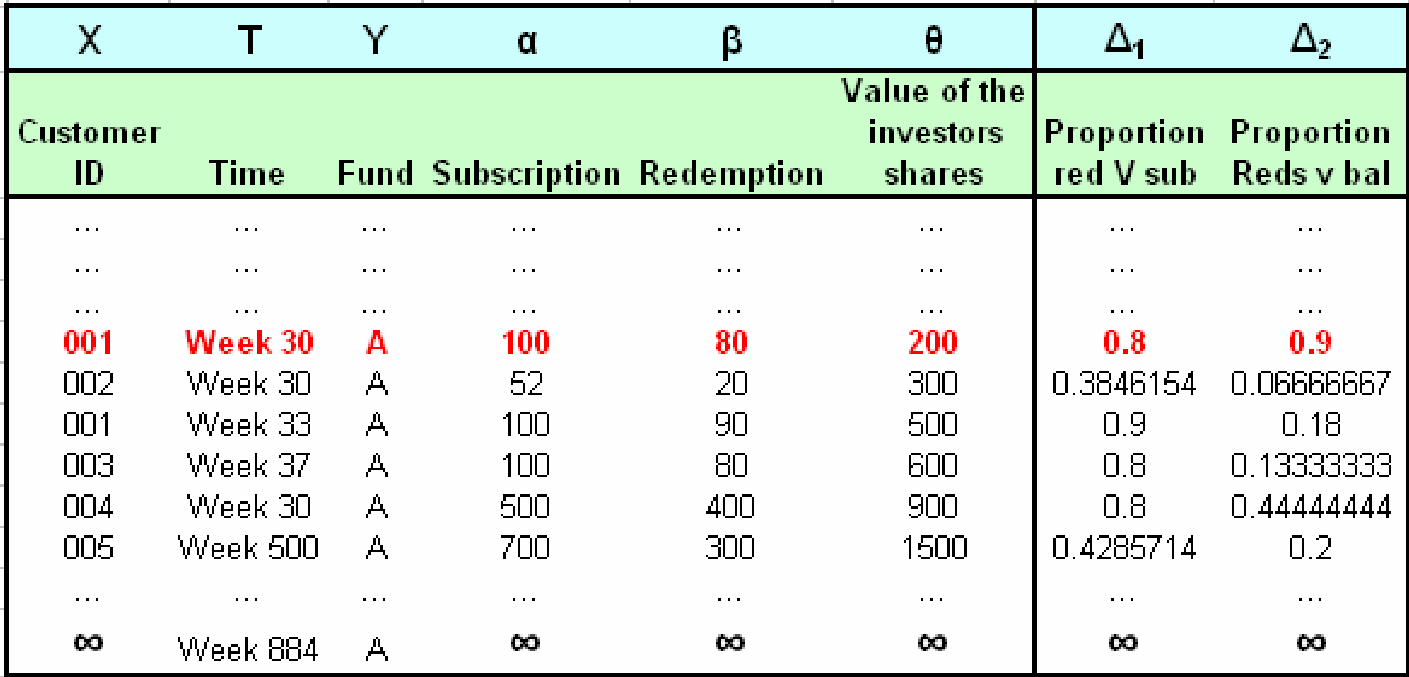
The core innovation lies in the definition of two specific ratios ( and ) calculated across various time frames (daily to yearly).
- (Redemption/Subscription Ratio): Measures the flow of money in versus out. High proportions suggest an account is being used merely as a pass-through.
- (Redemption/Total Value Ratio): Identifies attempts to drain accounts or operate with negative balances.
Architecture Overview
The analytical pipeline consists of two primary stages:
- Clustering (The Baseline): Transactions are grouped to define what "normal" looks like for a specific fund. This accounts for the fact that different funds (e.g., Fund A vs. Fund C) have vastly different transaction frequencies.
- Neural Network (The Classifier): These clusters feed into a neural network that learns to distinguish between legitimate investment spikes and criminal patterns.
4. Experiments & Results: Efficiency Gains
The model was tested using 2 million records from 16 investment funds at Ireland's BEP Bank.
Key Findings:
- Speed: The automated process took under 5 minutes to analyze what typically took humans a full week.
- Precision: The system initially flagged 0.5% of cases. After a refinement process (removing mapping errors), it identified five high-probability suspicious cases, aligning perfectly with the manual reports generated by bank experts.
- Scalability: By reducing the dimensionality of the data through targeted parameters, the system maintained high performance even with large datasets on standard hardware (Intel Dual Core).

5. Critical Analysis & Conclusion
Takeaway: The effectiveness of this approach stems from its multi-level analysis. By looking at both the Fund Level (global context) and the Investor Level (local context), the algorithm gains an inductive bias that rule-based systems lack.
Limitations:
- Data Quality: The authors noted that initial results included "false" suspicious cases due to data mapping and loading errors (e.g., first transaction recorded as a redemption).
- Evolving Patterns: As criminals learn these parameters, they may attempt to mimic the identified "safe" ratios ().
Future Outlook: The next step for this technology is real-time processing and the inclusion of cross-institutional data. As the volume of international transactions grows, the shift from "investigative support" to "automated prevention" will be the next frontier for AML units.