
Evolutionary Forecasting: Using Genetic Algorithms to Solve the Big Data Paradox in Macroeconomics
Data Mining for Big Data Macroeconomic Forecasting: A Complementary Approach to Factor Models
This paper introduces a Genetic Algorithm (GA) based approach for macroeconomic forecasting in big data environments, targeting variables like industrial production, inflation, and unemployment. By treating model selection as an evolutionary search, the method identifies optimal sparse subsets of predictors and time-horizons, outperforming traditional factor models.
TL;DR
Macroeconomic forecasting is increasingly a "Big Data" problem, but traditional factor models often create "black-box" variables that are hard to interpret and sometimes perform worse as more data is added. This paper proposes a Genetic Algorithm (GA) approach that evolves the most effective, interpretable regression models from 150+ variables, optimizing both the predictors and the historical data length simultaneously to achieve SOTA accuracy.
Context: The Factor Model Fatigue
For decades, economists have relied on Factor Models to condense hundreds of indicators into 2 to 4 "factors." While effective, these models suffer from three critical flaws:
- Artificiality: Factors are linear combinations of everything—making it impossible to tell which real-world metric is driving the change.
- The Big Data Paradox: Research by Boivin and Ng (2003) showed that factors from 40 series often beat those from 150+, suggesting that "more data" often injects more noise than signal into traditional estimators.
- Static Constraints: Most models struggle with dynamically changing relationships and non-linearities.
Methodology: Survival of the Fittest Forecasts
Instead of compressing all data, the authors use a Genetic Algorithm to pick the best data.
The Genetic Encoding
Each "individual" in the GA population represents a specific OLS regression model. The "genes" determine:
- Which of the 159 variables (including lags) are included.
- The optimal length of the time-series window (between 20 and 95 observations).
The Fitness Function: Why it Works
The GA doesn't just look for a high . It uses a weighted fitness function: By heavily weighting the out-of-sample performance, the GA naturally selects models that generalize well to unseen data, effectively weeding out "data snooping" or overfitting.
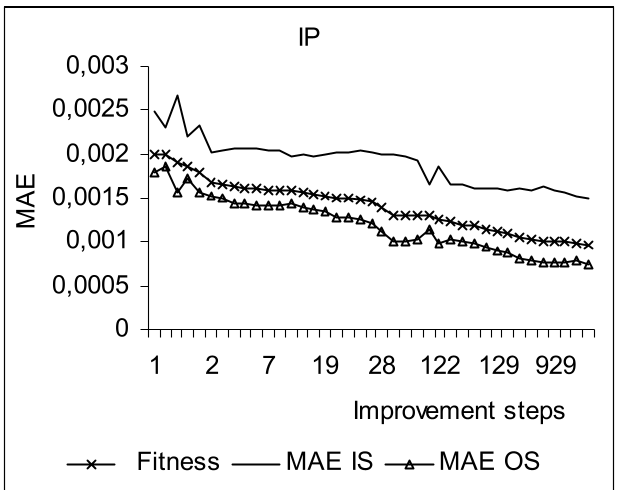 Fig 1: The steady improvement of Fitness and MAE across generations for different variables.
Empirical Results: Precision and Interpretability
The authors tested the GA on four key German indicators: Industrial Production (IP), Bond Yields (BO), Unemployment (U%), and Inflation (IN).
Performance Metrics
The results were striking. For Bond Yields and Unemployment, the models achieved an Adjusted of over 0.91.
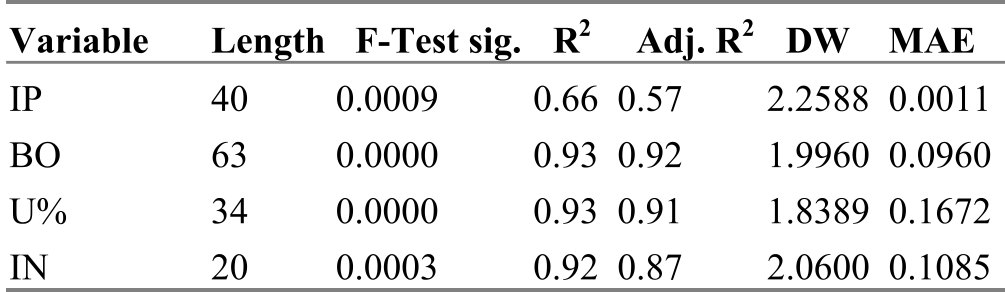 Table 1: Evaluation of the GA-optimized models showing high significance and low MAE.
The Value of Sparsity
Unlike Factor Models, the GA converged on models with only 8 independent variables. For example, the Inflation model (IN) prioritized current inflation, bank lending lags, and consumer price indices. This allows policymakers to see exactly which economic levers are influencing the forecast.
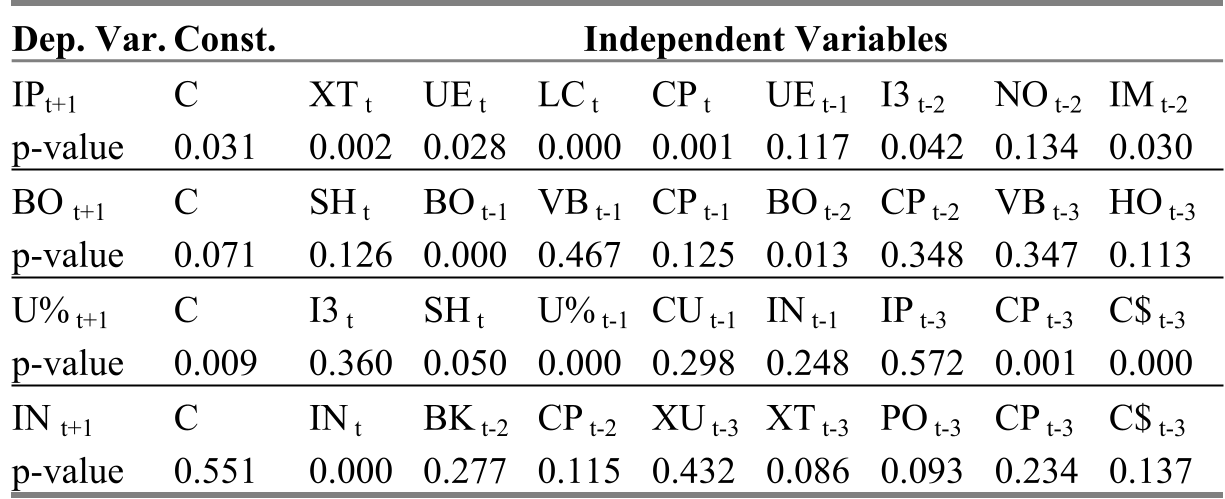 Table 2: The specific variables selected by the GA for each forecasting task.
Critical Insight & Conclusion
The true power of this approach lies in its simultaneous optimization. In macroeconomics, the "relevance" of history changes; some variables need long-term context (like Bond Yields), while others are highly sensitive to recent shifts (like Inflation). The GA identified that Inflation required only the last 20 months of data to be accurate, whereas Bond Yields required 63 months.
Final Takeaway
This paper proves that Data Mining—often a dirty word in econometrics—can be a rigorous, powerful tool when guided by evolutionary principles. It avoids the "complexity trap" of Neural Networks while maintaining the "explanatory power" required for economic policy. For researchers dealing with high-dimensional time-series, GAs provide a robust alternative to factor-heavy dimensionality reduction.