
Mining the Past with Cultural Algorithms: Optimization as a Vehicle for Discovery
Data mining using cultural algorithms and regional schemata
This paper introduces a Data Mining (DM) framework leveraging Cultural Algorithms (CA) and Regional Schemata to extract hidden patterns from large-scale temporal-spatial databases. By modeling data mining as an evolutionary search for functional optima, the authors achieve State-of-the-Art efficiency on archaeological datasets, accessing less than 20% of the database to identify key cultural constraints.
TL;DR
Researchers have pioneered a method to treat Data Mining (DM) not as a brute-force search, but as an evolutionary optimization process. By using Cultural Algorithms (CA) and Regional Schemata, this approach can extract complex spatial-temporal patterns (such as ancient settlement preferences) while ignoring over 80% of irrelevant data, significantly boosting KDD (Knowledge Discovery in Databases) efficiency.
Problem & Motivation: The Exhaustive Search Bottleneck
In the world of Big Data (even in 2026, we look back at these fundamentals), the "curse of dimensionality" and the sheer volume of records make exhaustive mining impossible. Traditional methods often treat data points as independent or rely on simple statistics that miss the interdependent constraints between variables—for example, how "elevation" and "topography" together influenced where a Zapotec elite chose to build their terrace.
The authors' insight was profound: If you search for the "best" examples in a dataset, the constraints you encounter along the way are actually the "knowledge" you are looking for.
Methodology: The Symbiosis of Population and Belief
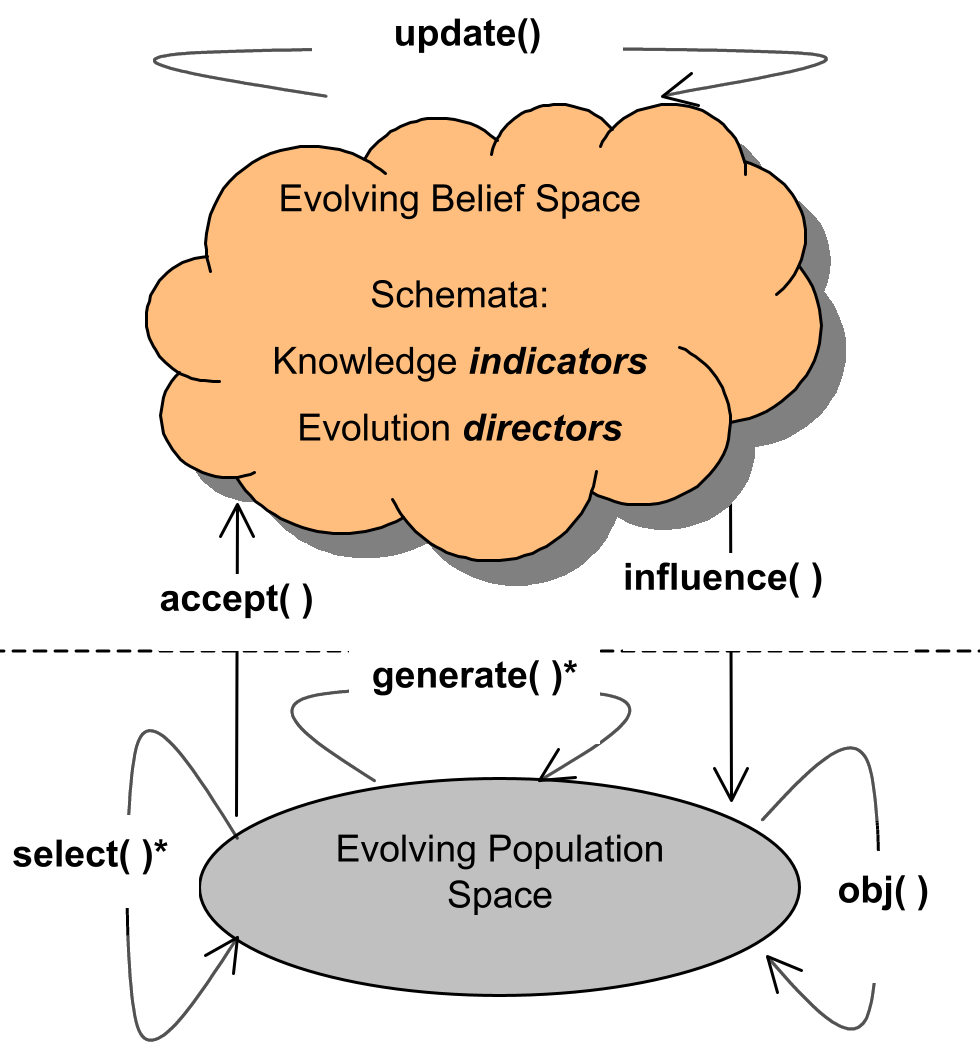
The core of the paper is the Cultural Algorithm Framework, a dual-process system that mimics how human culture evolves alongside biological individuals.
1. The Dual-Inheritance Architecture
- Population Space: This is the raw database. Each record (e.g., an archaeological terrace) is an "individual." The goal is to find individuals with the highest "fitness" (e.g., the most pottery shards).
- Belief Space: This is the "culture." It stores Regional Schemata—multi-dimensional boxes that represent regions of the search space. It tracks which regions are "Good," "Bad," or "Mixed."
2. The Communication Protocol
- Acceptance Function: Only the "best" and "worst" performers from the database are allowed to influence the Belief Space. This prevents the "culture" from being diluted by average, uninformative data.
- Influence Function: The Belief Space then guides the next generation of the search. If a parent is in a "Bad" cell, the influence function "teleports" its offspring to a "Good" or "Mixed" cell, as defined by the current regional knowledge.
Experiments: Decoding the Valley of Oaxaca
The researchers applied this to a massive archaeological dataset from Mexico (9000 B.C. to 1500 A.D.). They aimed to find why people settled where they did in the capital, Monte Alban.
Finding the "Elite" Elevations
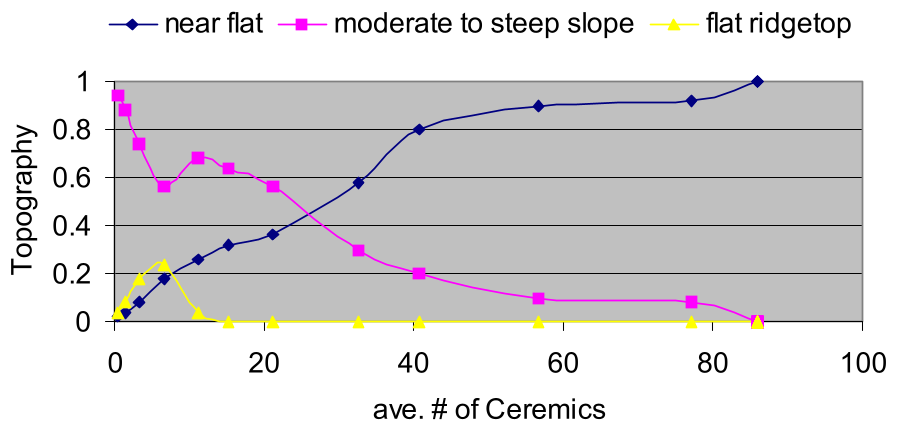
The algorithm discovered that for most periods, the "fittest" terraces (those with high diagnostic ceramic counts) were consistently located between 375m and 400m above the valley floor.
Visualizing Spatial Convergence
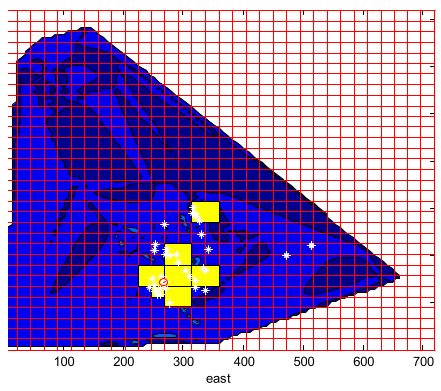
One of the greatest strengths of Regional Schemata is their ability to handle interdependent variables like North/East coordinates. As the generations progressed (from Fig 3a to 3d), the Belief Space refined its "Good" regions into disjoint, specific clusters where the population was densest.
Results & Critical Analysis
The results are a testament to the power of knowledge-based search:
- Efficiency: The system accessed less than 20% of the database records to find the same patterns an exhaustive search would have found.
- Pattern Extraction: It identified a major cultural shift in Period V, where the "favorite" elevation dropped to 300m and residents moved from "flat" to "sloped" terrain—likely a reflection of the political collapse of the Zapotec state.
Limitations
While powerful, the quad-tree decomposition (splitting cells into equal parts) used for regional schemata can be rigid. In highly irregular data landscapes, this might lead to "jagged" knowledge boundaries that don't perfectly fit the underlying data distribution.
Conclusion: A Paradigm Shift for KDD
By treating Data Mining as a symbiotic process between individual search and collective knowledge evolution, this paper provides a robust framework for efficient discovery. It proves that we don't need to look at every piece of data to understand the "big picture"—we just need a "culture" that knows where the good parts are.