
Stratified Diabetes Care: Re-evaluating Treatment Priority through Data Mining
Application of data mining: Diabetes health care in young and old patients
This research applies predictive data mining techniques to analyze diabetes treatment effectiveness in Saudi Arabia using the Oracle Data Miner (ODM) tool. By employing Support Vector Machine (SVM) regression on World Health Organization (WHO) datasets, the study identifies optimal treatment strategies categorized by young and old age groups.
TL;DR
Researchers in Saudi Arabia have leveraged the power of Oracle Data Mining (ODM) and Support Vector Machines (SVM) to determine whether age should dictate the order of diabetes treatment. The study reveals a critical divergence: while young patients can afford to delay drug intervention in favor of lifestyle changes, the elderly require an immediate "heavy-duty" combination of drugs and exercise to maintain blood sugar control.
Background: The Growing Epidemic
In Saudi Arabia, diabetes is no longer just a health concern—it is an epidemic. As the fourth leading cause of death in developed nations, the disease is particularly opportunistic for data mining because of the vast amount of historical patient data available. The core challenge for modern physicians isn't just what to prescribe, but when and in what order to prescribe it to maximize efficacy while minimizing side effects.
Problem & Motivation: The One-Size-Fits-All Fallacy
Traditional clinical guidelines often list treatments (diet, exercise, drugs) as a package deal. However, this ignores the physiological differences between a 25-year-old and a 60-year-old. The authors' insight was that metabolic activity variance necessitates a stratified approach. By using regression analysis, they aimed to quantify the "effectiveness" of these treatments to create a "Preferential Order" for different life stages.
Methodology: SVM Regression and ODM
The study utilized a standard NCD (Non-Communicable Diseases) risk factor report from the WHO. The technical backbone was the Support Vector Machine (SVM), specifically chosen for its prowess in statistical learning theory and its ability to handle regression tasks by finding an optimal hyperplane.
Data Mining Architecture
The workflow involved six distinct stages:
- Data Selection: Cleaning raw WHO NCD reports.
- Data Preparation: Converting spreadsheets into Oracle 10g Database formats.
- Data Analysis: Applying SVM algorithms to target variables (effectiveness percentages).
- Knowledge Evaluation: Using the Oracle Data Miner GUI to visualize patterns.

Experimental Analysis: Young vs. Old
The study split the population into two overarching groups:
- Young (p(y)): Ages 15–44.
- Old (p(o)): Ages 35–64.
The common intersection point (ages 35–44) allowed the model to maintain continuity while highlighting the shifts in treatment response.
Key Comparison Findings
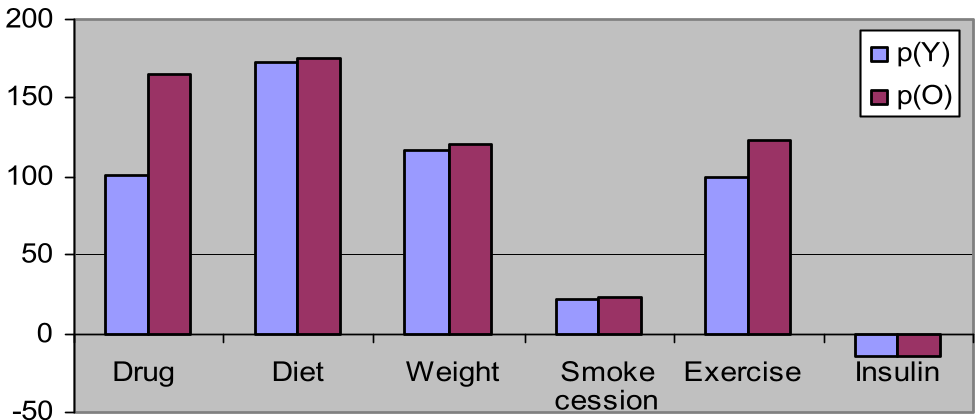
The SVM regression yielded scores that directly correspond to the predicted effectiveness of each mode:
| Treatment | Young p(y) | Old p(o) | Insight |
|---|---|---|---|
| Drug | 101.31 | 164.77 | Highly effective for elderly |
| Exercise | 99.31 | 123.77 | More crucial as metabolic rate drops |
| Diet | 172.04 | 175.32 | Essential for both groups |
Deep Insight: The "Preferential Order"
The most significant contribution of this work is the generation of a "Treatment Hierarchy" based on predicted success rates:
For the Young (p(y)):
- Diet Control (Primary Focus)
- Weight Control
- Drug Treatment (Can be delayed to avoid side effects)
- Exercise
- Smoking Cessation
For the Old (p(o)):
- Diet Control
- Drug Treatment (Immediate Prescription Required)
- Exercise (Vital to augment insulin sensitivity)
- Weight Control
- Smoking Cessation
Conclusion & Future Outlook
The study proves that for younger patients, lifestyle intervention is not just a "bonus" but a viable strategy to postpone the onset of chemical dependency on drugs. Conversely, for the elderly, the "Drug + Diet + Exercise" triangle is non-negotiable because metabolic activity is naturally slower.
Limitations: The study relies on 2005 dataset parameters. Modern datasets including genetic markers (DNA level) and real-time wearable data could refine these SVM models significantly.
Takeaway: Data mining isn't just for business analytics; in healthcare, it provides the "clinical logic" needed to tailor treatments to age-specific biological realities.