
Data Mining in Healthcare: Unmasking Fraud in the Medical Billing Process
A Critical Analysis of the Application of Data Mining Methods to Detect Healthcare Claim Fraud in the Medical Billing Process
This paper provides a critical analysis of data mining applications for detecting healthcare claim fraud. It evaluates supervised, unsupervised, and hybrid methods, such as Decision Trees, Neural Networks, and Benford’s Law, highlighting their effectiveness in identifying fraudulent billing patterns across various global healthcare systems.
TL;DR
Healthcare fraud results in massive revenue losses and delayed patient care. This paper analyzes how Data Mining (DM) and Knowledge Discovery in Databases (KDD) are replacing manual audits. By evaluating supervised and unsupervised frameworks, the authors highlight a 99% accuracy potential in specific tasks while warning about the lack of computational efficiency and adaptability in current systems.
Background & Motivation
The medical billing process is a complex ecosystem involving patients, practitioners, clearinghouses, and insurers. According to the authors, the rise of electronic health records (EHR) has created a "double-edged sword": while it streamlines billing, it also opens digital avenues for sophisticated fraud, waste, and abuse.
Existing detection methods are often reactive rather than proactive. The authors argue that the industry must move beyond simple "rule-matching" to intelligent systems capable of identifying "unknown unknowns"—novel fraud patterns that haven't been seen before.
The Core Methodology: A Multi-Angle Approach
The paper categorizes current technological efforts into two primary methodology camps:
1. Supervised Learning (The "Know-What" Approach)
These models are trained on historical records where fraud has already been confirmed.
- Process Mining: Using clinical pathways to identify when a physician deviates significantly from a standard multidisciplinary care plan.
- Scoring Models: Utilizing Decision Trees and Logistic Regression to assign "abusiveness scores" to providers based on indicators like average drug cost and consultation fees.
2. Unsupervised Learning (The "Anomalous-How" Approach)
Used when labeled data is scarce—a common problem in healthcare.
- Benford’s Law: A statistical insight into the distribution of digits. Fraudulent claims often "break" these natural mathematical distributions.
- Clustering & Segmentation: Grouping physicians by practice patterns to identify outliers who behave differently from their peers.
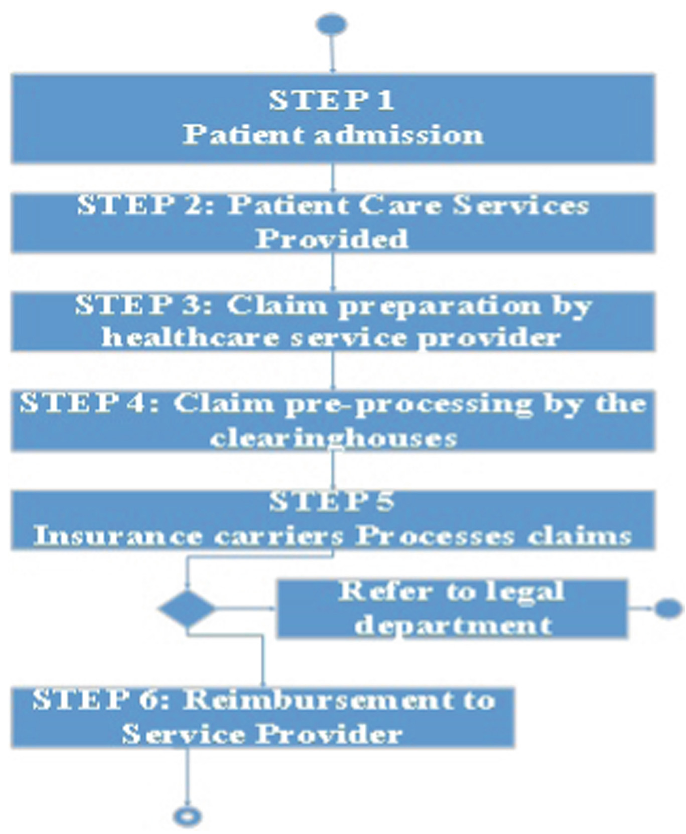 Figure 1: The standard medical billing workflow, showing the critical points where data mining can be injected.
Experimental Insights and Results
The authors evaluated several SOTA implementations from Taiwan (NHI), Korea (HIRA), and Canada. Key findings include:
- High Accuracy, Low Generalization: While specific Decision Tree models reached 99% accuracy, they were often trained on narrow datasets (e.g., only providers who had their contracts terminated), failing to capture "stealthier" fraudsters who pad claims but escape legal penalty.
- The Benford Advantage: Unsupervised methods proved robust in discovering root causes of anomalies without the heavy administrative burden of manual labeling.
- Feature Importance: Across all studies, "Average Medical Expenditure per Day" and "Percentage of Antibiotic Prescriptions" emerged as the most critical features for flagging potential abuse.
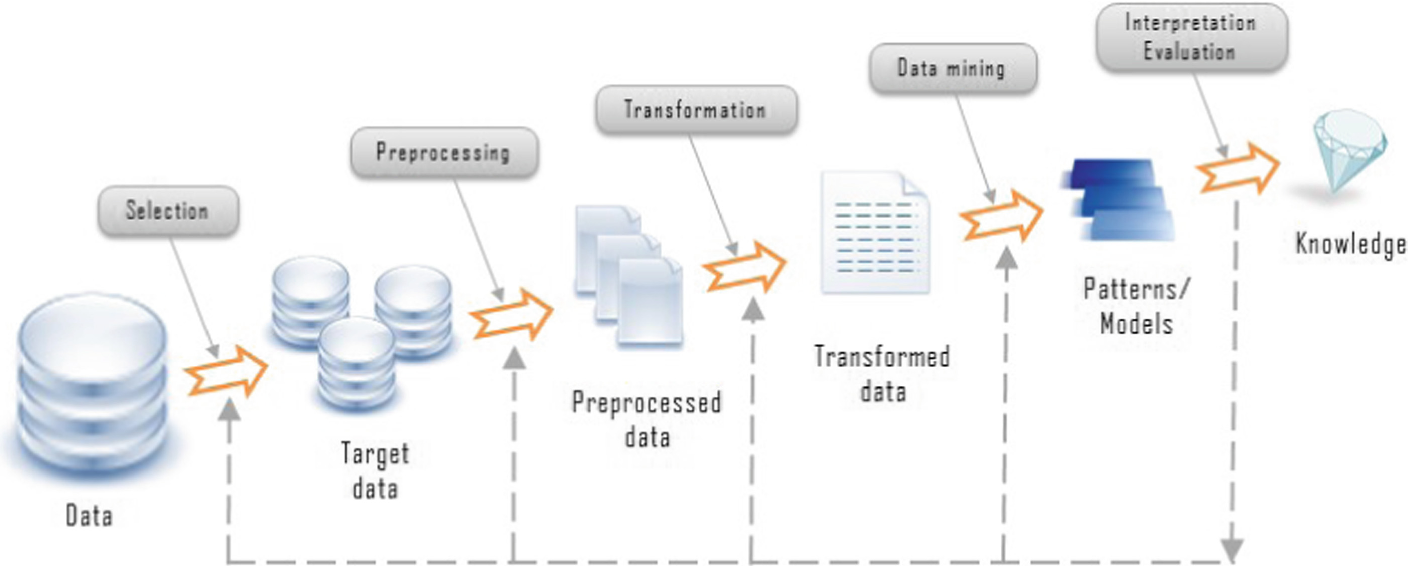 Figure 2: The Data Mining (KDD) process: from raw data to actionable patterns.
Critical Analysis & Future Outlook
The paper concludes that the current state of healthcare fraud detection is promising but flawed in implementation.
The Missing Gaps:
- Computational Efficiency: Most researchers focus on accuracy but ignore the resource cost. In a system processing millions of claims daily, efficiency is as important as precision.
- The "Third-World" Data Void: There is a severe lack of research on implementing these tools in regions without fully electronic billing systems.
- Adversarial Evolution: Fraudsters adapt. Static models become obsolete quickly.
The Takeaway: The authors advocate for Semi-Supervised Online Learning. This hybrid approach allows the model to learn from a small amount of labeled data while continuously updating its understanding of "normal" vs. "anomalous" through unsupervised observation of incoming real-time traffic. This is the only sustainable way to fight the growing sophistication of global healthcare fraud.