
Data Mining in HOSCM: Turning Big Data into Operational Excellence
Data mining and predictive analytics applications for the delivery of healthcare services: a systematic literature review
This paper presents a systematic literature review (SLR) on the application of data mining and predictive analytics within Healthcare Operations and Supply Chain Management (HOSCM). By synthesizing 22 core studies using the CRISP-DM framework, the authors categorize how big data techniques achieve SOTA outcomes in clinical pathway identification, capacity planning, and quality of care.
Executive Summary
TL;DR: This systematic review explores how data mining and predictive analytics are revolutionizing Healthcare Operations and Supply Chain Management (HOSCM). By analyzing the lifecycle of research from 2001 to 2015, the study identifies a shift from mere clinical diagnosis to operational optimization—specifically in Capacity Planning, Workflow Analysis, and Quality of Care. While the theoretical potential is vast, the paper highlights a critical "deployment gap" where many models remain academic concepts rather than clinical tools.
Positioning: This work serves as a foundational "mapping" study, defining the academic coordinate system for HOSCM and identifying the transition from Big Data hype to structured knowledge discovery.
Problem & Motivation: The Looming Crisis in Healthcare Delivery
The healthcare sector is facing a "scissors crisis": shrinking budgets and aging populations are increasing demand while resources remain static. Traditional management relies on heuristic decision-making, which is insufficient for the complexity of modern "Care Value Delivery Chains."
The authors argue that the "process view" of hospitals—treating patient care as a sequence of resource-transforming steps—is the only way forward. The motivation behind this review is to determine why, despite the explosion of Electronic Health Records (EHR), operational productivity in healthcare still lags behind industries like retail (e.g., Amazon’s anticipatory shipping).
Methodology: The CRISP-DM Lens on Operations
The research utilizes the CRISP-DM (Cross-Industry Process for Data Mining) framework to audit existing literature across five stages:
- Business Understanding: Mapping data tasks to HOSCM functions.
- Data Collection: Analyzing sources (primarily secondary EHR data).
- Modeling: Identifying the tools of the trade (SVM, Neural Networks, Process Mining).
- Evaluation: Distinguishing between internal validation (MSE, AUC) and field-relative measures (waiting time, hospital profit).
- Deployment: Testing for real-world impact.
Core HOSCM Functional Framework
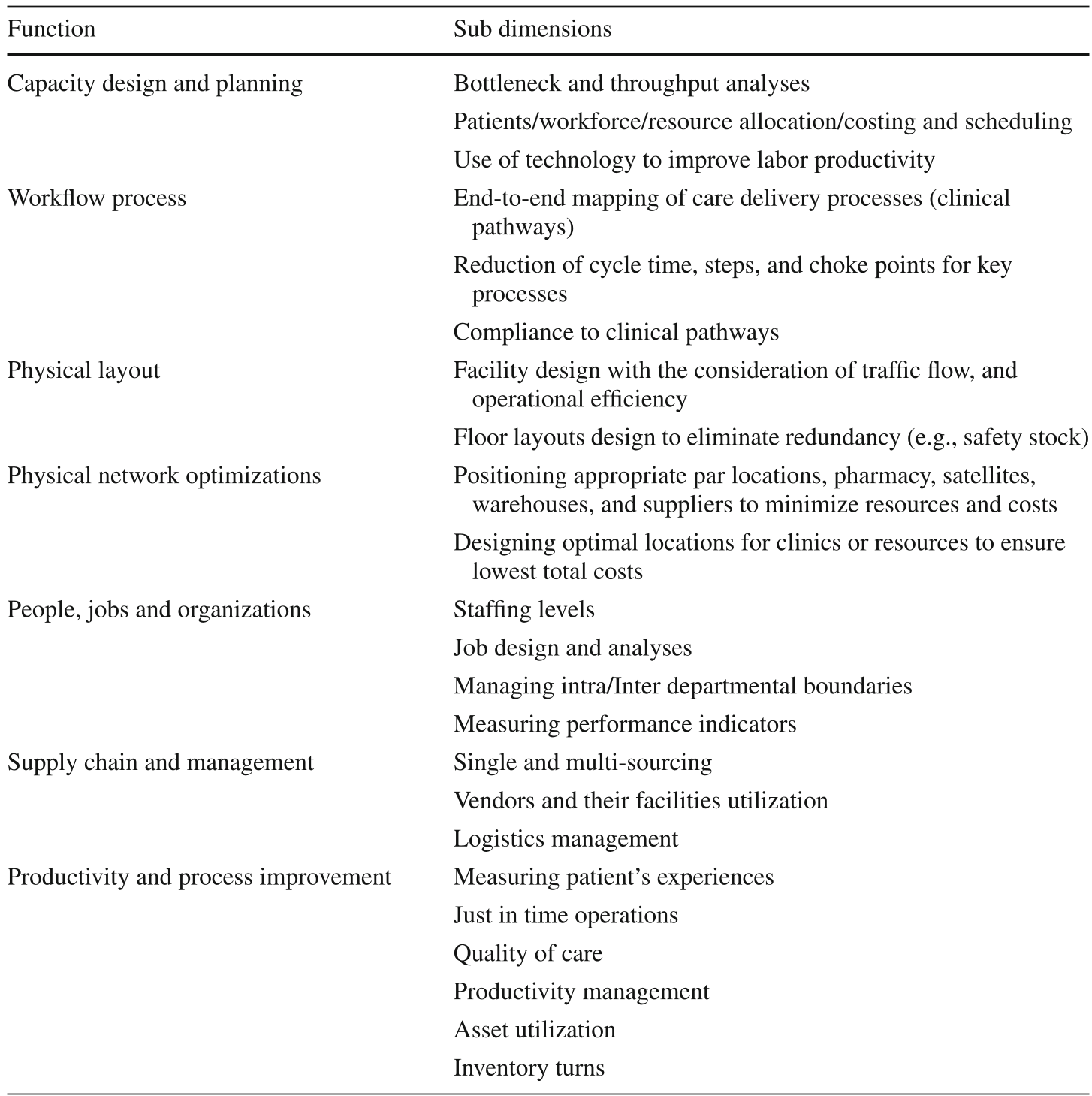
The researchers categorized the operational landscape into seven key dimensions, as shown in the table below:
Experiments & Results: The Three Pillars of Impact
The review synthesized findings into three dominant application areas:
1. Clinical Pathway Discovery (Workflow Analysis)
Data mining is used to map "on-the-ground" patient care flows versus idealized guidelines. By identifying deviations (variants), hospitals can standardize care and predict Length of Stay (LOS) accurately.
- Insight: Sequence pattern mining (Markov Models) is the SOTA approach for capturing these complex interdependencies.
2. Capacity Design and Resource Planning
The studies reviewed used predictive analytics to manage outpatient overbooking and "no-shows."
- Result: Hybrid models combining data mining with Discrete Event Simulation (DES) allow for adaptive workforce scheduling based on predicted arrival rates (e.g., blood donor patterns).
3. Productivity and Quality Improvement
Focusing on "Safety" and "Effectiveness," models were trained to predict readmission risks for Acute Myocardial Infarction (AMI) and secondary safety incidents (e.g., patient falls).
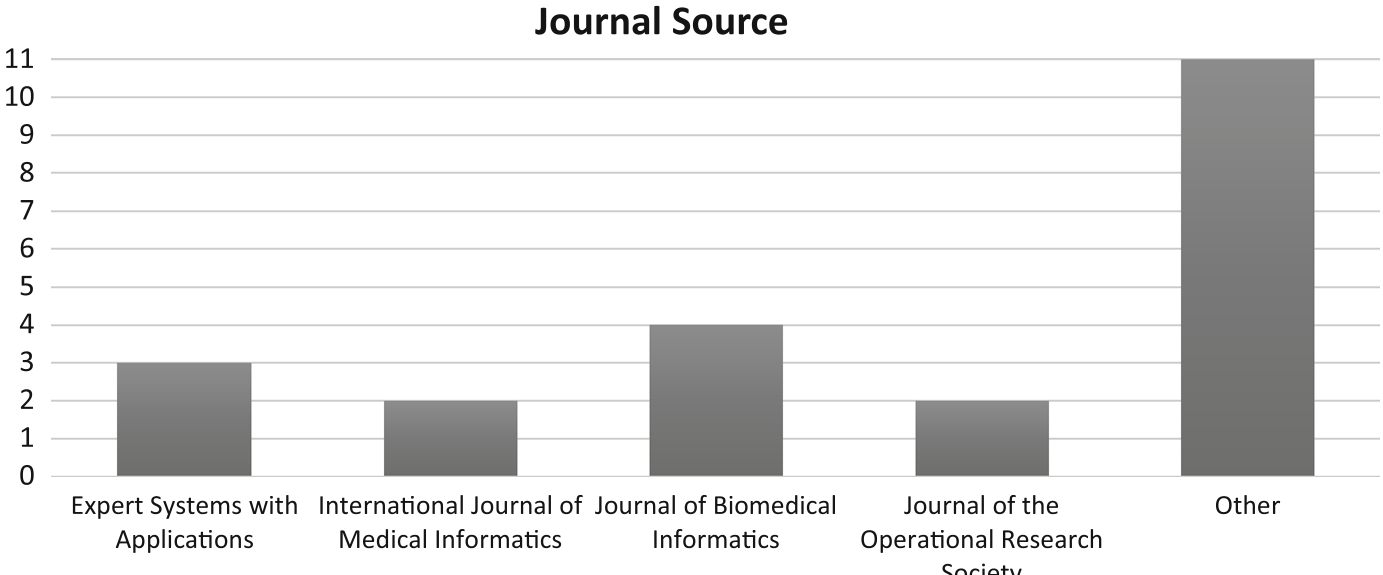 Above: The spread of research across multidisciplinary journals highlights the cross-functional interest in HOSCM.
Critical Analysis & Conclusion
The Deployment Gap: A Reality Check
A significant finding of this paper is the Deployment Gap. While researchers are proficient at building models with high AUC and Accuracy, the leap to "Actual Deployment" is rare. Most models remain "Concept Realizations," tested on historical data but never integrated into the live workflow of a hospital.
Future Outlook
- Holistic Value Chains: Future research must move beyond narrow clinical segments (like just Radiology) to model end-to-end care delivery.
- Advanced Classifiers: There is a shift toward more complex ensembles (Random Forest, MARS) that offer superior predictive power over traditional Logistic Regression.
- Operational Excellence: The authors predict that "big data" will eventually automate physical layout design and resource logistics, much like it has for global supply chains.
Final takeaway: For healthcare practitioners, the message is clear: data mining is no longer just for medical diagnosis; it is the fundamental engine for operational survival in a resource-constrained world.