
The Datacatcher: When Big Data Becomes a Tangible Social Provocateur
The Datacatcher: Batch Deployment and Documentation of 130 Location-Aware, Mobile Devices That Put Sociopolitically-Relevant Big Data in People's Hands: Polyphonic Interpretation at Scale
The paper introduces the Datacatcher, a custom-built, location-aware mobile device designed to stream sociopolitical "Big Data" to users in real-time. By deploying 130 units in a large-scale field trial, the authors explore Polyphonic Interpretation at Scale, achieving a unique intersection between Research through Design (RtD) and social commentary.
TL;DR
In a massive experiment shifting HCI from the lab to the street, researchers at Goldsmiths deployed 130 "Datacatchers"—handheld devices that scrape localized big data to reveal the sociopolitical hidden layers of a neighborhood. By moving away from "apps" and toward "objects," the study reveals how design can spark critical debates about inequality, data authority, and the "lived environment."
Academic Positioning: This work is a landmark in Research through Design (RtD), moving the field beyond small-scale prototypes into "Batch Deployment" and using documentary film as a rigorous qualitative evaluation tool.
Problem: The Abstraction of Big Data
We live in an era of Big Data, yet most of it remains invisible—locked in servers or presented through sterile dashboards. Existing HCI methods often focus on utility (how to help a user find a cafe). However, they rarely address the political topology of where we live: Why is the life expectancy 10 years shorter in this borough? Why are there 500 homeless families next to a 3-million-pound vacant property?
The authors argue that Big Data needs a "body"—a physical presence that provokes questioning rather than just providing answers.
Methodology: Batch Production and "The World-Making"
To test their theories, the team didn't just build one prototype; they built a batch of 130.
The Device Architecture
Datacatchers are physical narrators. Using mobile networks, they ping nearby cell towers to pull data from 14 sources (Census, Twitter, Experian, etc.). A central server transforms this raw data into provocative, localized sentences using predefined templates.
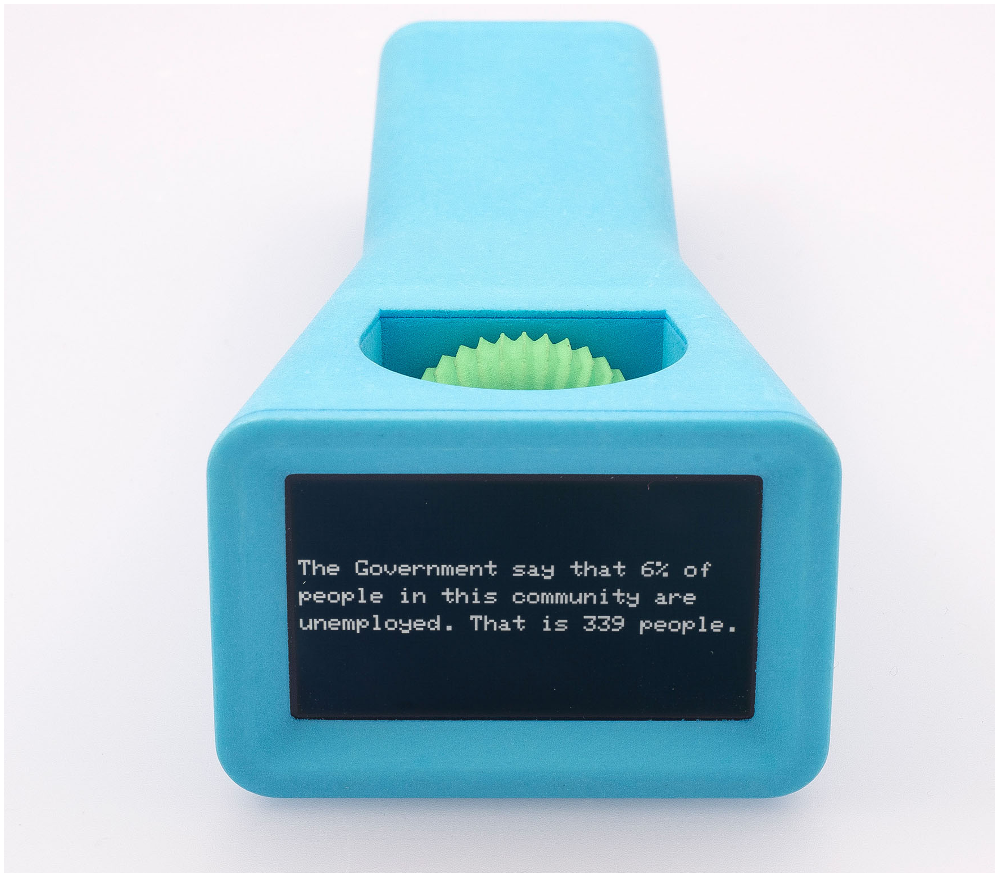 Figure: The Datacatcher displaying real-time unemployment stats for the user's current community.
Deployment as Performance
The team treated deployment as "World-Making." By using yellow wheelbarrows and balloons in street markets, they framed the device not as a commercial product, but as a "unique research tool." This helped bypass the expectation of "narrow utility" (like Google Maps) and invited "ludic" (playful) exploration.
Experiments & Results: Thick Descriptions via Film
Rather than dry surveys, the researchers hired documentary filmmakers. This captured the participants' raw, emotional reactions to the data.
1. Data as a "New Layer" to the City
Participants found that the device added a "hidden layer" to their commute. Users reported being "shocked" by the stark differences in health and wealth as they crossed borough boundaries.
2. The App vs. Object Debate
While some participants suggested "this should just be an app," others argued that the physicality of the Datacatcher was key. Its bright color and weird shape acted as a "talking point," pulling people out of their "mobile phone bubble" and into social conversations with colleagues and neighbors.
 Figure: A participant using the device dial to engage with opinions in a social setting.
3. Critical Skepticism
Interestingly, the device succeeded most by being questioned. Users began to doubt the data ("That price can't be right!") which led to deeper questions: Who collected this? What are the borders of this 'neighbourhood'? What is the politics behind these numbers?
Critical Analysis & Conclusion
The Datacatcher trial proves that for a research device to be successful, it must first be a compelling product. If the battery died or the screen was too small, the research questions (about inequality) would never be reached.
Limitations: The study noted a high "waste" rate—many devices were returned or never turned on. This is the inherent risk of "in the wild" studies where participants are minimally committed.
Future Outlook: For the HCI community, this paper shifts the focus from "User Experience" to "Participant Interpretation." It suggests that the future of Big Data interfaces isn't just about clarity or speed—it's about creating "Polyphonic" experiences that allow for multiple, even conflicting, social truths to coexist.
Final Takeaway: Designing to "raise issues" rather than "resolve them" is a powerful, underutilized strategy for sociopolitical engagement in AI and Big Data systems.