
Engineering Navigability: A New Benchmark Dataset for the Social IoT (SIoT)
A Dataset for Performance Analysis of the Social Internet of Things
This paper introduces a comprehensive dataset for the Social Internet of Things (SIoT), modeled on real-world IoT devices from the SmartSantander project and categorized via FIWARE Data Models. It provides a structured framework for analyzing object-to-object social link establishment, achieving a realistic network comprising over 16,000 nodes with optimized navigability.
TL;DR
Researchers from the University of Cagliari have released a new dataset based on real-world IoT deployments in Santander, Spain, to solve the lack of heterogeneous data in the Social Internet of Things (SIoT). By simulating 16,000+ devices and optimizing the rules of "socialization" between objects, they've created a benchmark that proves how specific link-establishment policies can significantly enhance decentralized network navigability.
Context: Why "Social" Objects?
As we transition from human-object interaction to object-object interaction, the challenge is no longer just connectivity—it's discovery. In a city with billions of sensors, how does a smart car find a trustworthy parking sensor or weather station?
The SIoT paradigm suggests that if objects establish "social" links (based on ownership, location, or shared manufacturers), they can navigate the network like a human social circle. However, current research is bottlenecked by the lack of realistic datasets that combine mobility, device heterogeneity, and standardized data models.
The Dataset Architecture: Real World meets Simulation
The authors didn't just simulate a random graph. They used a hybrid approach:
- Public Infrastructure: Real data from the SmartSantander project (street lights, buses, environmental sensors).
- Private Heterogeneity: 4,000 simulated users with device ownership distributions (smartphones, tablets, etc.) matching 2017 Global Web Index reports.
- Mobility Mechanics: The Small World In Motion (SWIM) model was used to generate 10 days of realistic movement, ensuring that inter-contact times between devices mirror real-life human interactions.
The devices were categorized using FIWARE Data Models, ensuring the dataset is "ready-to-go" for modern IoT platforms.
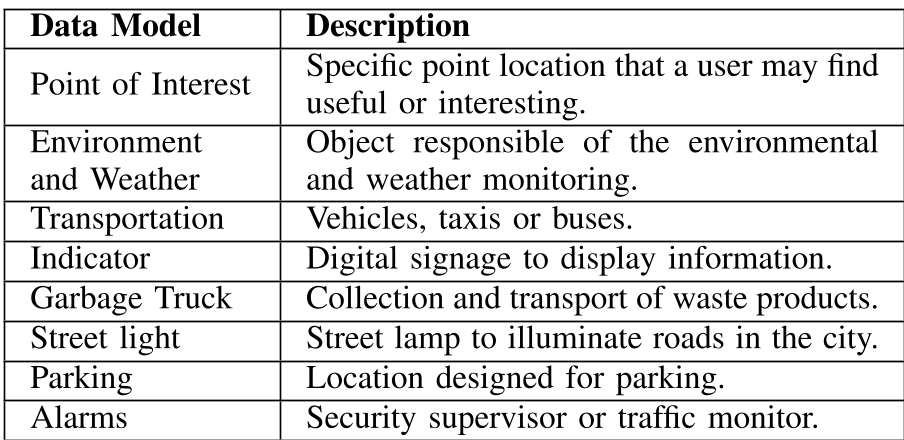
The Methodology: Optimizing the Social Graph
The paper’s most significant technical contribution is the analysis of how relationship rules affect the network's macro-properties. If every object owned by a city (the Municipality) connects to every other one, you create massive hubs that ruin the Power Law distribution required for a "Small World" network.
The authors refined four key relationship types:
- Ownership (OOR): Limited links to devices within communication range (LoRa/Wi-Fi/BT) rather than absolute ownership clusters.
- Parental (POR): Restricted to devices further than 2.5km apart to create "long-distance links" that assist in global navigability.
- Co-Location (C-LOR) and Social (SOR): Tuned via a "number of meetings" (N) threshold to balance network connectivity with the avoidance of noise.
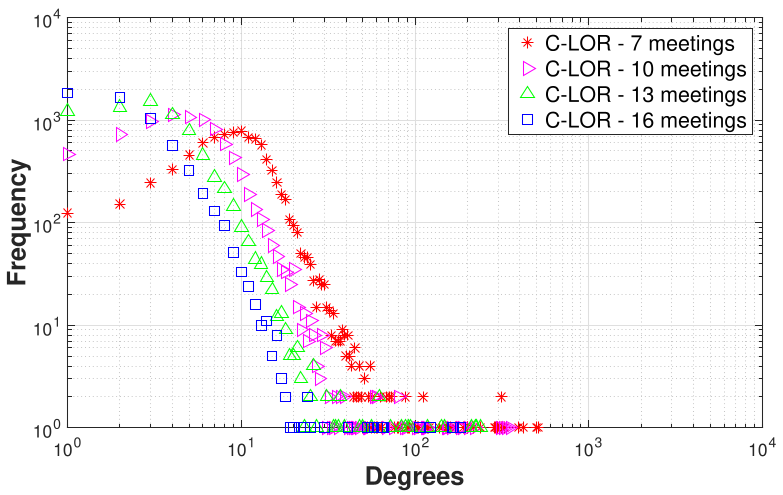 Figure 1 & 2: Comparing naive (red/blue) vs. optimized (green) rules for OOR and POR. Note how the green lines align better with a power-law tail.
Performance & Navigability Results
By applying these optimized rules, the authors achieved a "Giant Component" (a single connected cluster) that includes almost all 16,000+ nodes.
Key metrics improved significantly:
- Diameter: Reduced from 7 to 6.
- Average Path Length: Dropped from 3.8 to 3.3 (a 15% efficiency gain).
- Navigability: The degree distribution shifted closer to a power law, which is the "Gold Standard" for decentralized search and robustness against failures.
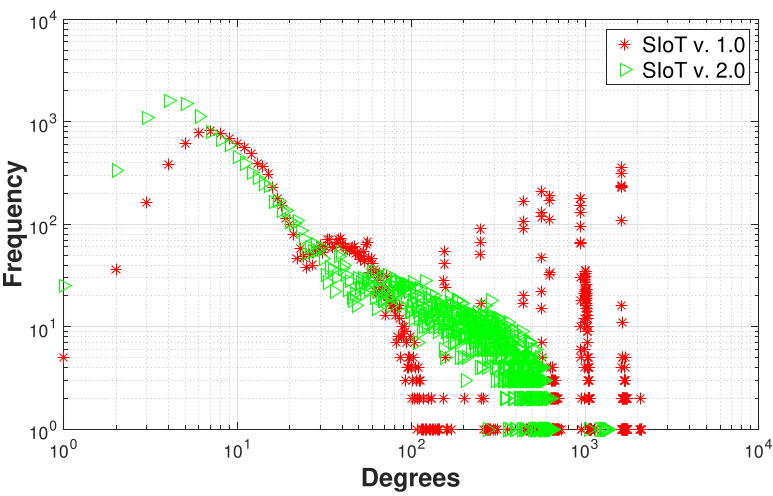 Figure 6: The finalized SIoT degree distribution showing the effectiveness of refined social rules.
Critical Insight & Conclusion
This work demonstrates that the "Social" in IoT isn't just a metaphor—it's a topological requirement. Simply connecting things isn't enough; we must engineer the intensity and sparsity of these links to ensure that a service search doesn't get lost in a sea of redundant connections.
Future Work: The community can now use this dataset to test Trust Management (detecting malicious nodes) and Service Discovery algorithms in a graph that finally resembles a real smart city’s digital nervous system.