
DBStrata: Breaking the Density Barrier in Unsupervised Learning
DBStrata: a system for density-based clustering and outlier detection based on stratification
The paper introduces DBStrata, a Python-based software system for density-based clustering and outlier detection. It integrates the classic DBSCAN and OPTICS algorithms with a novel "Space Stratification" mechanism to handle datasets with varying densities and automate parameter tuning.
TL;DR
DBStrata is a comprehensive software framework that revitalizes density-based clustering by introducing Space Stratification. It addresses the two biggest headaches in clustering: the "varying density" problem—where traditional algorithms fail to see clusters of different concentrations—and the "parameter sensitivity" problem, by reducing manual tuning to a single intuitive parameter.
Background & Positioning
In the landscape of unsupervised learning, DBSCAN (Density-Based Spatial Clustering of Applications with Noise) has long been the gold standard for discovering arbitrary-shaped clusters. However, it is notoriously brittle when clusters have different densities or when the user doesn't know the exact epsilon () value to use. DBStrata positions itself as an evolution, bridging the gap between classical density clustering and intelligent, stratified outlier detection.
The Core Motivation: Why "Density" Isn't Enough
The authors identify a fundamental flaw in standard DBSCAN: it uses a global density threshold. If your dataset contains one very dense cluster and one sparse cluster, a single will either merge the sparse cluster into noise or merge the dense cluster with nearby points incorrectly.
The insight here is Stratification. By treating the dataset as a series of layers based on "outlierness," we can analyze the structure of the data before we even start clustering. This allows the system to recognize that "density" is relative to the neighborhood, not an absolute global constant.
Methodology: The Power of Symmetric Neighborhoods
The engine behind DBStrata comprises four main modules, with Spatial Stratification being the pièce de résistance.
1. Symmetric Neighborhoods (ISk)
Unlike standard K-Nearest Neighbors (kNN) which is a directed relationship (A might have B as a neighbor, but B might not have A), DBStrata uses ISk-neighborhoods. This is the intersection of kNN and Reverse kNN.
- Intuition: A point is only your neighbor if you both "agree" you are close. This symmetry is the secret sauce for isolating clusters with different densities.
2. Space Immersions & Stratification
The system maps points into a higher-dimensional space by adding a "density dimension"—the sum of distances to its ISk-neighbors. This projection effectively "pushes" outliers away from dense cores, making them easier to bipartition.
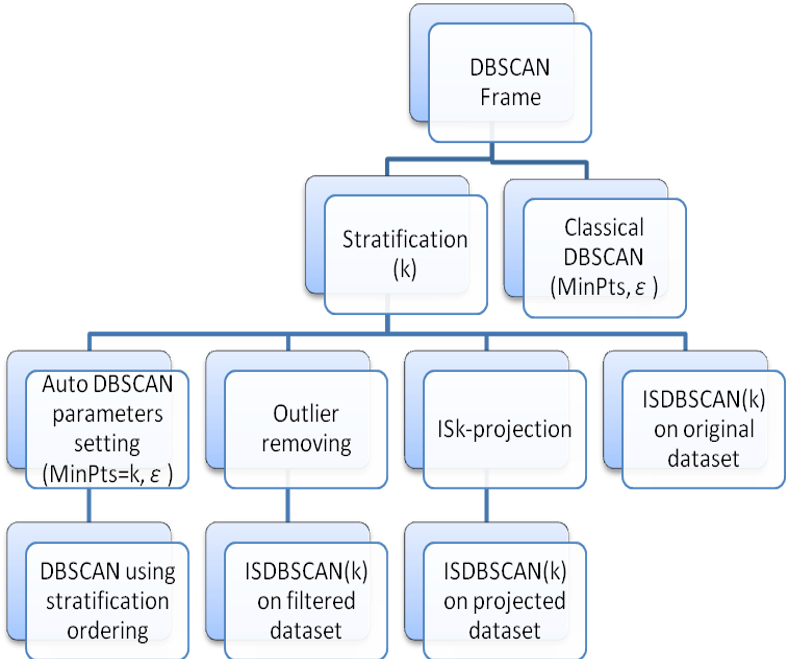 Figure 1: The DBStrata architecture showing the flow from input data to stratified clustering and outlier detection.
Experiments & Effectiveness
Through its GUI, DBStrata allows for real-time comparison between DBSCAN, OPTICS, and the new stratified methods.
- Parameter Reduction: By analyzing the curve (Density Function), the system estimates the range automatically. Users only need to provide (the number of neighbors).
- Computational Efficiency: By leveraging kdTree indexing, the system maintains complexity, making it viable for practical multidimensional datasets.
- Hierarchical Insights: The integration of OPTICS allows users to generate reachability plots and dendrograms, providing a "tree-view" of how clusters contain sub-clusters.
Critical Analysis & Future Outlook
DBStrata is a significant step toward making density-based clustering "user-proof." Its primary strength lies in the Symmetric Neighborhood relationship, which acts as a natural filter for noise that might otherwise bridge two distinct clusters.
Limitations: While the system handles multidimensional data, complexity still looms for extremely high-dimensional datasets where kdTree indexing breaks down (the "curse of dimensionality"). Future iterations would benefit from approximate nearest neighbor (ANN) search algorithms like HNSW.
Conclusion: DBStrata isn't just a wrapper for DBSCAN; it's a sophisticated data-profiling tool. Its ability to rank objects by "outlierness" before clustering provides a layer of interpretability that is often missing in unsupervised pipelines.
 Figure 2: The system interface, highlighting the multifaceted approach to data analysis.