
Percolation Graph Matching: How Social Clustering Makes Anonymity Fragile
De-anonymizing Clustered Social Networks by Percolation Graph Matching
This paper investigates the de-anonymization of social networks via Percolation Graph Matching (PGM) within a random geometric graph framework. By introducing a model that accounts for user clustering, the authors demonstrate that a wave-like propagation mechanism allows for successful node matching across networks using a significantly smaller seed set than previously required for Erdös–Rényi graphs.
TL;DR
Social networks are not random; they are clustered. This paper reveals that the "clustering" we see in our social circles — where your friends are also friends with each other — is a massive security loophole. By leveraging a "wave-propagation" effect, an attacker needs only a tiny, concentrated group of known users (seeds) to unmask an entire anonymized network.
The Problem: The "Twin" Paradox of Dense Clusters
Previously, researchers used the Percolation Graph Matching (PGM) algorithm to match users between two networks (like Twitter and Flickr) based purely on link structure. While this worked for (Erdös–Rényi) graphs, it failed miserably on clustered graphs.
The Pain Point: In a dense cluster, many nodes look identical to their immediate neighbors. If you only look at local connections, the algorithm picks "bad pairs" (wrong matches) that satisfy the threshold, leading to a cascade of errors that destroys the de-anonymization process.
Methodology: Why "Filtering" and "Compact Seeds" Change the Game
The authors argue that clustering actually helps, provided you change the matching strategy. They move away from the "uniform seed" assumption to a Compact Seed approach and introduce Edge Filtering.
1. The Wave-Like Propagation
Instead of scattered seeds, having seeds in one small physical or social sub-region allows the matching to move like a wavefront. Once a local cluster is matched, those nodes act as high-confidence seeds for the next boundary, reducing the total seeds needed to almost negligible levels.
2. Fingerprinting via Long-Range Edges
To avoid the local ambiguity of dense clusters, the authors propose an ingenious "Filtered PGM":
- Ignore the "Noise": Discard edges that are "too short" (local connections within a cluster).
- Use the "Signal": Match nodes based on their long-distance edges. These long-range links act as unique "fingerprints" because it's highly unlikely that two different nodes in the same cluster share the exact same distant neighbors.
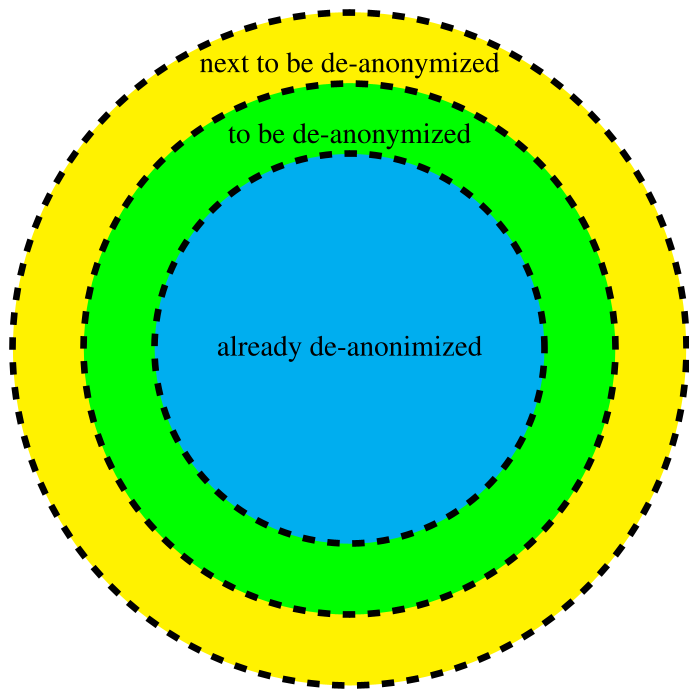 Figure: The Bipartite strategy for high-density clusters. By focusing on inter-region edges between sub-regions H1 and H2, the algorithm avoids local "clique" confusion.
Experiments: Real-World Vulnerability
The researchers tested their theory on synthetic graphs and real snapshots from Pokec and Facebook.
The Results:
- Seed Efficiency: In a network of 133k nodes (Pokec), traditional uniform seeding is inefficient. Compact seeding triggers percolation with 3x fewer seeds.
- Error Correction: On Facebook data, standard PGM had a disastrous 40% error rate. By using Highest Count First (HCF) matching and filtering out the nearest 30 neighbors, the error rate plummeted to 0.3%.
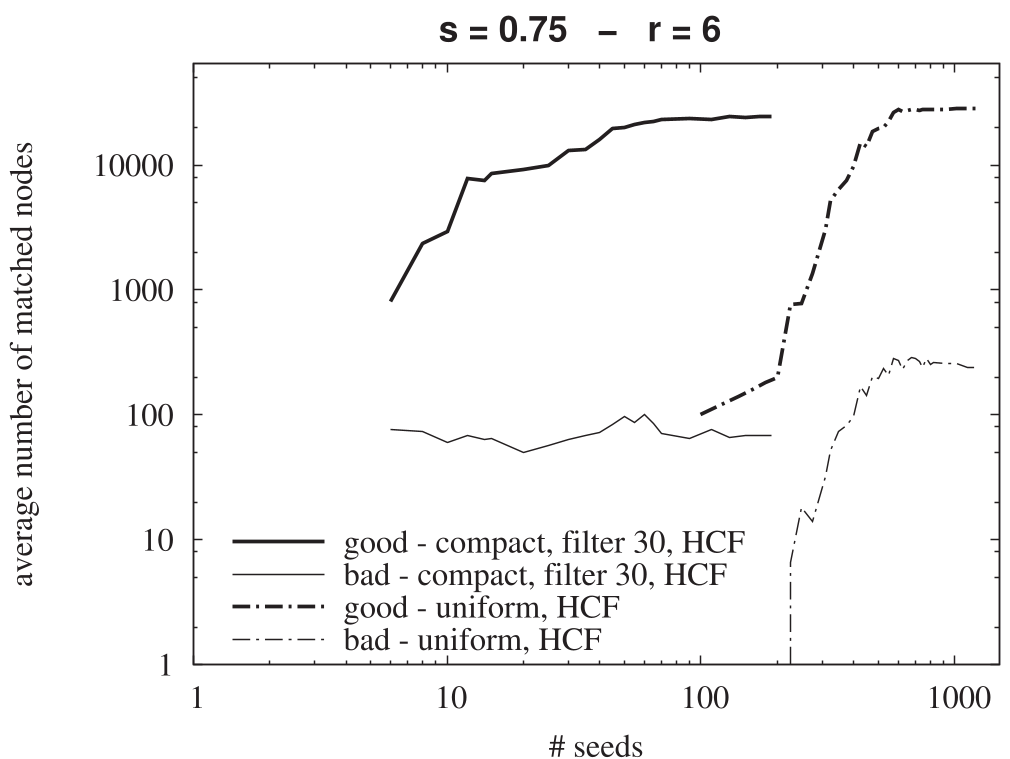 Figure: Comparison of deferred matching (HCF) and standard PGM on the Facebook graph. The "Compact, Filtered" approach reaches massive matching scale with minimal seeds.
Deep Insight: The Counter-Intuitive Truth
One of the most striking findings in this paper is that increasing the average degree of a clustered network can actually make it harder to de-anonymize.
Usually, more data (more edges) helps an attacker. But here, if the cluster density increases without increasing the "fingerprint" links, nodes become more indistinguishable. This suggests that "densification" in social networks might actually provide a natural form of privacy against structural attacks, provided the long-range links don't grow at the same rate.
Conclusion
This work redefines the "critical seed set" for social network privacy. It proves that our tendency to form tight-knit communities makes us easier to track, not harder. For developers and privacy advocates, the takeaway is clear: simple anonymization (removing names) is useless against structural percolation—especially when the attacker understands the underlying geometry of human social clusters.
Limitations: The model assumes independent edge sampling between the two networks. In reality, users might vary their behavior significantly between platforms, which could provide a "buffer" against this specific type of percolation.