
Unmasking the Crowd: How Overlapping Communities Fuel Social Network De-Anonymization
De-Anonymizing Social Networks With Overlapping Community Structure
This paper introduces a novel framework for seedless social network de-anonymization focusing on overlapping community structures. It proposes a cost function based on the Minimum Mean Square Error (MMSE) and implements it via the Convex-concave Based De-anonymization Algorithm (CBDA), achieving a 90% re-identification rate in dense overlapping scenarios.
TL;DR
Researchers have developed a new method to de-anonymize social networks by exploiting the fact that we all belong to multiple social circles. By combining a Minimum Mean Square Error (MMSE) estimator with a novel Convex-concave Based De-anonymization Algorithm (CBDA), this work proves that overlapping communities act as "fingerprints," allowing for nearly 90% re-identification accuracy in real-world datasets without even needing pre-identified "seed" nodes.
The Problem: The Myth of Disjoint Communities
The current landscape of social network privacy usually relies on anonymizing identities while keeping the graph structure. However, adversaries use auxiliary networks (like mapping a public LinkedIn graph to an anonymized Facebook dataset) to re-identify users.
Previous research suffered from two fatal flaws:
- The Disjoint Assumption: They assumed communities were separate buckets. In reality, you are a member of a hobbyist group, a family, and a workplace—simultaneously.
- Mathematical Fragility: Prior cost functions like Maximum A Posteriori (MAP) were brittle. If the "true" mapping wasn't the exact global minimum, the results became unpredictable junk.
Methodology: High-Dimensional Fingerprinting
The authors utilize the Overlapping Stochastic Block Model (OSBM). They noticed that as the "overlapping strength" increases—meaning as users belong to more communities—the uniqueness of their position in the network grows exponentially.
1. From MMSE to WEMP
Instead of just looking for the most probable mapping, the authors aim to minimize the expected number of errors using the Minimum Mean Square Error (MMSE). Since this is NP-hard, they transform it into a Weighted-Edge Matching Problem (WEMP). In this setup, weights are proportional to the number of communities nodes co-exist in, turning community membership into a weighting matrix .
2. The CBDA Algorithm
To solve the WEMP without getting stuck in local minima, the CBDA (Convex-concave Based De-anonymization Algorithm) was proposed.
- It starts by relaxing the problem to a convex state, where an initial global solution is easy to find.
- It gradually shifts the objective function toward a concave state.
- Because the optimum of a concave function lies on the boundaries of the feasible region (the discrete mappings), the algorithm "pushes" the solution towards a valid permutation matrix.
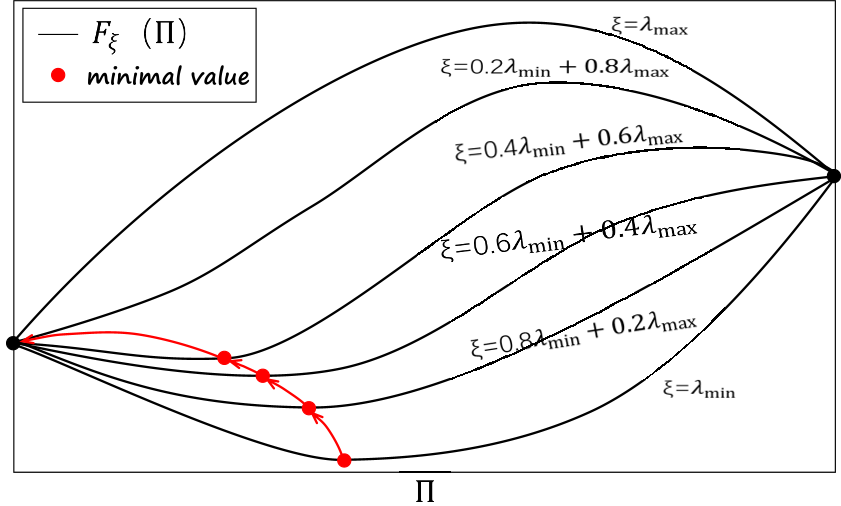 Figure: The trajectory of the CCOM method moving from a convex relaxation to the concave boundary where the discrete solution resides.
Experimental Battleground
The researchers tested CBDA across synthetic graphs, sampled social networks (LiveJournal), and real cross-domain co-author networks (MAG).
Key Discoveries:
- Scalability: As the network size increases, the error rate vanishes (), verifying the theoretical claims of asymptotic optimality.
- The Overlap Advantage: Overlapping communities increased the re-identification ratio by 70% over non-overlapping models. When communities overlap densely, 90% of users were unmasked.
- Weighting Matters: Comparing a weighted cost function (MMSE-derived) vs. a non-weighted one showed significant accuracy gains, proving that the math behind the "weight" captures real structural entropy.
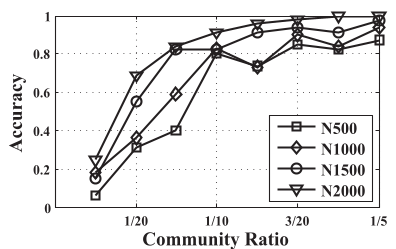 Figure: Experimental results on cross-domain co-author networks, showing CBDA outperforming Genetic Algorithms and other baselines in overlapping scenarios.
Technical Summary & Outlook
This work represents a major shift in de-anonymization research. By proving that WEMP resolves the tension between optimality and complexity, the authors have shown that the complexities of real-world social structures (overlapping memberships) are actually a liability for privacy.
Takeaway for Practitioners: If your data protection strategy assumes that "clustering" or "anonymizing IDs" is enough, it likely fails to account for the unique structural fingerprint created by overlapping communities. The more multifaceted a user's social life is, the easier they are to unmask.
Limitations: The algorithm still carries an or higher complexity profile, which, while polynomial, remains a challenge for graphs with millions of nodes. Future work must bridge the gap between these global optimization strategies and localized, sub-linear time heuristics.