
Decentralized Economic Dispatch: Solving the Cost-Reliability Dilemma in Microgrids
Decentralized Economic Dispatch Scheme With Online Power Reserve for Microgrids
This paper proposes a comprehensive decentralized economic dispatch scheme for microgrids that optimizes distributed generator (DG) operation without communication infrastructure. By integrating generation costs, power ratings, and online power reserves into a modified droop control framework, it ensures the most cost-effective DGs are prioritized.
TL;DR
Researchers have developed a new decentralized control scheme that allows microgrids to operate at maximum economic efficiency without needing a central "brain" or communication links. By re-engineering the standard droop control to account for generation costs and power ratings, the system autonomously prioritizes cheaper energy sources while maintaining a strictly defined online power reserve to handle sudden surges. This approach achieved up to 60% cost savings in experimental tests compared to traditional methods.
Background: The Limits of "Proportional" Thinking
In a typical microgrid, multiple Distributed Generators (DGs) like microturbines, fuel cells, and diesel generators must work together. Traditionally, this is done via Droop Control, which forces DGs to share the load proportionally based on their size.
The Problem: Reliability is high, but economy is ignored. A cheap fuel cell and an expensive diesel generator will both ramp up equally, wasting money. Earlier "cost-prioritized" attempts tried to fix this by looking at "no-load" costs, but they stumbled when different DGs had similar starting costs or when the grid needed a sudden buffer (reserve) to stay stable.
Methodology: The Move Beyond No-Load Costs
The proposed scheme replaces the fixed droop slope with a dynamic, cost-aware logic. It uses three key levels of optimization:
- Average Cost Priority: Instead of just looking at the cost to start a generator, it looks at the Moving Average Total Generation Cost (TGC) over the entire operating range.
- Recursive Frequency Mapping: It assigns specific "dispatch frequencies" () to each DG. The cheapest DG starts at the highest frequency (e.g., 51Hz), while more expensive units only kick in when the frequency drops due to increased load.
- Active Power Reserve (): Unlike previous models, this formula includes a buffer. It ensures that a generator doesn't just "turn on" when the previous one is at 100% capacity, but rather when the previous one still has enough headroom to handle a sudden load step.
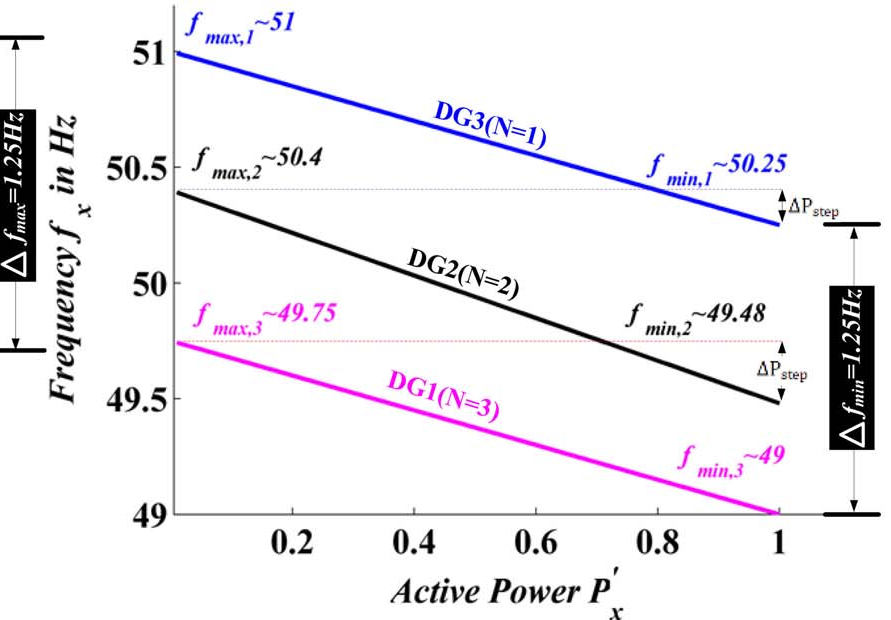 Figure 1: The proposed economic droop characteristics showing how DGs are staggered based on cost and reserves.
The Mathematical Intuition
The core of the logic lies in the modified droop equation: Where (the gradient) is specifically tuned so that cheaper DGs have "flatter" slopes, allowing them to absorb more of the load before the frequency drops enough to trigger the next, more expensive unit.
Experimental Validation
The team tested the system using a physical setup with three DGs and varying load conditions.
Scenario 1: Three Dispatchable DGs
When load decreased from 75% to 50%, the system automatically identified that the most expensive unit (DG1) was no longer needed economically. It shut down DG1 autonomously, shifting the load to the cheaper DG2 and DG3.
- Cost Savings: 12.7% to 54.6% depending on the load.
- Frequency Stability: Maintained within the 49Hz to 51Hz window.
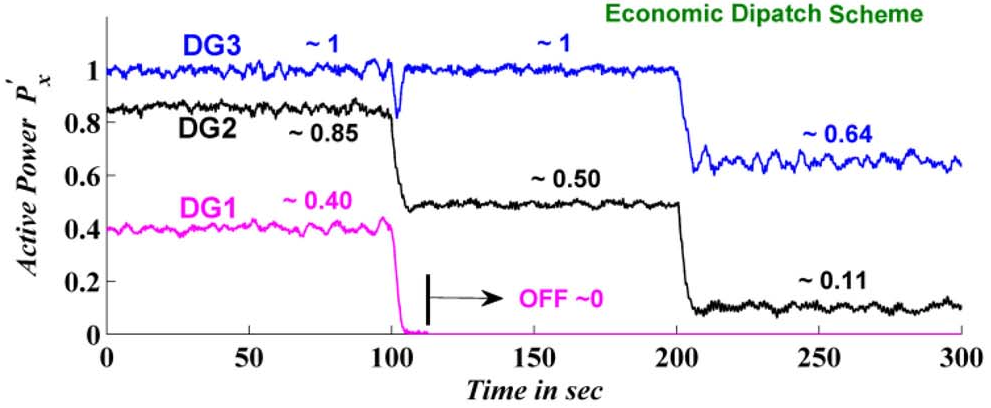 Figure 2: Power sharing comparison between traditional droop (all share) vs. the proposed economic scheme (expensive DGs turn off).
Scenario 2: Integration with Renewables (Solar PV)
In a "real-world" test, the researchers replaced one DG with a non-dispatchable Solar PV. The proposed scheme treated the solar output as a "negative load." As the sun peaked, the system automatically ramped down and eventually turned off the most expensive fuel-based DGs, maximizing the use of free solar energy while keeping the cheaper dispatchable units as the primary backup.
Critical Insight & Conclusion
The true value of this research is the Online Power Reserve (). In previous decentralized models, if a load doubled instantly, the system might crash because the "next" generator hadn't started yet. By mathematically "overlapping" the generator schedules based on a reserve requirement, this scheme provides the speed of a decentralized system with the safety of a centralized one.
Limitations: While highly effective for AC microgrids, the paper notes that for resistive networks (common in low-voltage microgrids), additional virtual impedance or transformation methods are needed to handle the coupling between active and reactive power.
Final Takeaway: This is a major step toward practical, autonomous "Smart Grids" where every generator knows exactly when it is—and isn't—economically needed.