
Decentralized Services Computing: Breaking the Monopoly of Big Data Silos
Decentralized Services Computing Paradigm for Blockchain-Based Data Governance: Programmability, Interoperability, and Intelligence
This paper proposes a "Blockchain-Based Decentralized Services Computing" paradigm for big data governance. It introduces a 6-plane architectural framework to shift data management from centralized cloud silos to a user-centric, decentralized model, utilizing blockchain for traceability and Service Data Objects (SDO) for interoperability.
TL;DR
In this seminal position paper, researchers from Peking University and CNRI argue that the era of centralized "Big Data" governance—dominated by tech giants—is reaching its limit due to privacy concerns and data silos. They propose a Blockchain-Based Decentralized Services Computing Paradigm. By decoupling data from the applications that produce it and treating it as an independent Service Data Object (SDO), they offer a framework for a world where users truly own their data while still enabling advanced AI and analytics via decentralized intelligence.
The Problem: The "Matthew Effect" of Data
The current success of AI and big data is built upon a foundation of Centralized Governance. Companies like Apple, Google, and Amazon collect data through their specific ecosystems. This has created two major issues:
- Data Silos: Valuable data from "long-tail" applications and legacy systems remain trapped because they cannot penetrate the high entry barriers of giant platforms.
- Loss of Control: Users "exchange" their privacy for services, losing all visibility into how their data is used, leading to scandals like Cambridge Analytica and the resulting strict regulations like GDPR.
The authors argue we are at the dawn of a radical shift: moving from centralized service providers to decentralized data assets.
Methodology: The 6-Plane Architecture
To realize this vision, the paper defines a comprehensive architecture that transforms how services are designed and consumed.
1. Programmable DaaS (Service Design)
The foundation is Data-as-a-Service (DaaS). Unlike traditional DaaS, which is hosted by the provider, this model allows data owners to specify where their data is stored (personal devices, private clouds, etc.) and who can access it via programmable APIs. This effectively turns "locked-in" data into "independent assets."
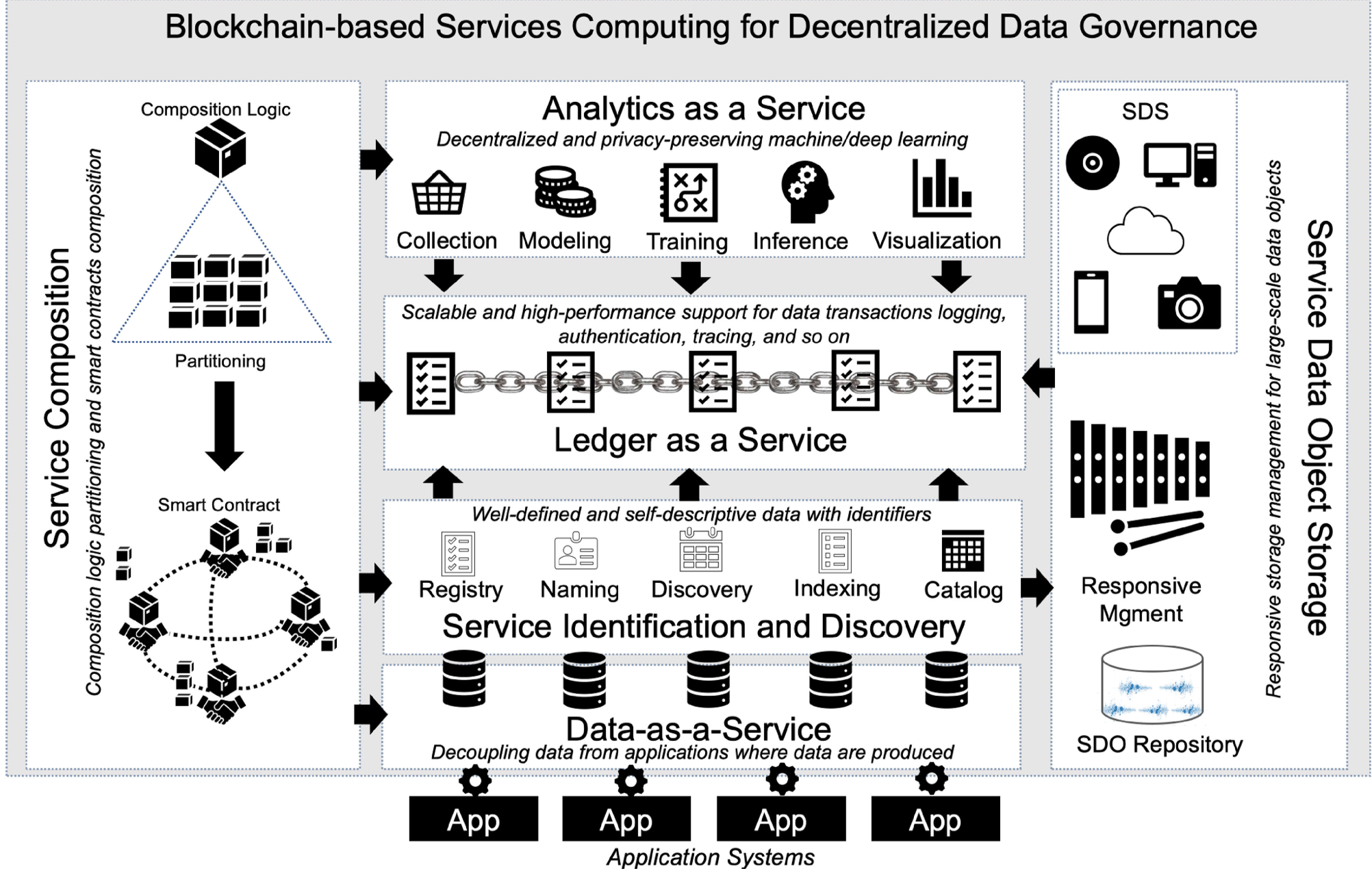 Figure: The 6-plane architecture for decentralized data governance.
2. Service Data Objects (SDO) and Interoperability
The authors leverage the Digital Object Architecture (DOA) to encapsulate data into "Service Data Objects." Every SDO has a unique, persistent identifier (similar to a DOI for research papers), making it searchable and linkable across the entire internet without a central registry.
3. Decentralized Intelligence (Analytics as a Service)
How do we perform AI on decentralized data without compromising privacy? The paper points to Federated Learning and Differential Privacy. Instead of moving data to the model (centralized), we move the model to the data (decentralized). Only encrypted model updates are shared, keeping raw personal data on the user's device.
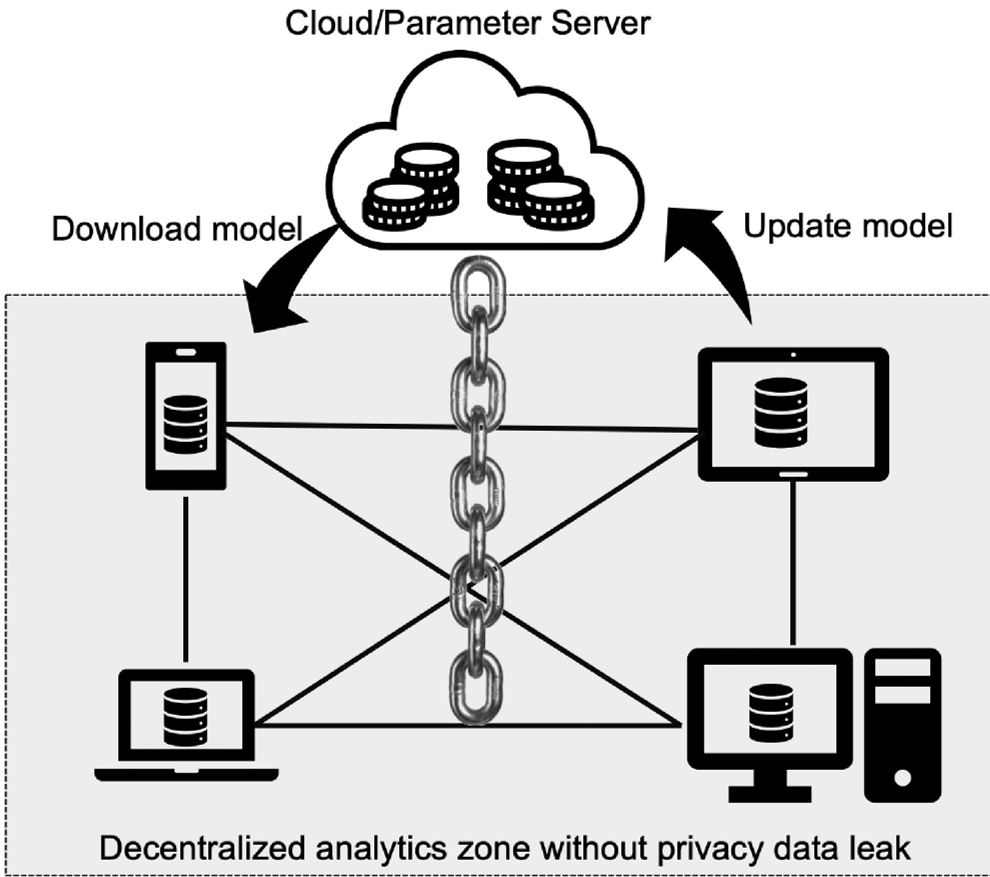 Figure: The principle of Analytics-as-a-Service with privacy guarantees.
Experiments & Insights: The Role of Blockchain
The blockchain does not store the raw data (which would be inefficient). Instead, it acts as the Ledger-as-a-Service (LaaS). It provides a:
- Trust Proof: Record of every data operation (who, when, why).
- Accountability: Tracking the "secondary value" created when data is analyzed.
- Smart Contracts: Used for Service Composition, allowing different data services to be automatically combined to solve complex tasks without a central coordinator.
The authors acknowledge that current blockchains (like Ethereum) face scalability issues and suggest moving toward Consensus Zones or Sidechains to handle the high throughput required for global data governance.
Critical Analysis & Conclusion
Takeaway
The paper effectively bridges the gap between the 2000s-era "Services Computing" and the 2020s-era "Blockchain/AI" world. Its greatest contribution is the conceptual decoupling of data ownership from application providers.
Limitations
- Incentives: Why would big companies like Facebook adopt a DaaS model that reduces their data monopoly? The authors suggest that legal frameworks like GDPR will eventually force this adoption.
- Complexity: Managing billions of SDOs across heterogeneous storage (phones, IoT, cloud) introduces massive synchronization and consistency challenges.
Future Outlook
This paper sets the stage for "Software-Defined Cyberinfrastructure," where data is no longer a byproduct of an app but a first-class citizen of the internet. For developers, this means shifting focus from building monolithic databases to building Interoperable Data Services.
Main Reference: Liu, X., Sun, S. X., & Huang, G. (2026). "Decentralized Services Computing Paradigm for Blockchain-Based Data Governance." IEEE.