
Turning Patrons into Experts: A Social Computing Approach to Library Book Acquisition
Decision Support in Library Book Acquisition: A Social Computing-Based Approach
This paper introduces a social computing-based decision support system for library book acquisition. By constructing an "egocentric network" of book recommenders and calculating their "representative degree" through historical circulation records, the system ranks user-recommended books to optimize limited library budgets.
TL;DR
Libraries face a constant struggle: how to spend a limited budget on books that people actually want to read. While many libraries allow patrons to "recommend" books, these suggestions are often selfishly motivated. This paper proposes a system that uses Social Computing to analyze the historical borrowing patterns of recommenders. By identifying "representative" readers whose past tastes align with the community, libraries can mathematically rank recommendations to ensure high future circulation.
Problem & Motivation: The "Individual Interest" Trap
Librarians are the traditional gatekeepers of knowledge, but they are not mind readers. Even with sophisticated data mining of past circulation, a major gap remains: historical data only tells you about books you already own.
To bridge this, libraries use recommendation services. However, a student might recommend a niche textbook only they need, leading to "shelf-warmers" that waste the budget. The challenge is to distinguish between a niche request and a representative suggestion. The authors argue that if we can verify that a recommender has shared interests with a large group of other readers in the past, their future recommendations are likely to be "hits."
Methodology: The Power of Egocentric Networks
The core innovation lies in treating the library's circulation database as a Social Network. If Reader A and Reader B both borrowed the same five books on "American Literature," a link is formed between them.
1. Building the Egocentric Network
For every person who recommends a book, the system builds an egocentric network. This network identifies everyone else who has borrowed the same books as the recommender in that specific category.
 Figure 1: The network shows how a recommender (CM) connects to related readers (RD) through shared interests.
2. Quantifying "Representation"
Not all links are equal. The system calculates a Representative Degree using several factors:
- Book Importance: Is the recommender borrowing "hot" books (high circulation, recent activity) or "dead" books?
- Link Strength: How many books does the recommender share with a specific peer?
- Temporal Decay: The system accounts for "idle periods" (how long since a book was last touched) and "active periods" (how long it has been in the system).
The math effectively says: If you consistently borrow books that many other people ended up borrowing, your next recommendation is highly valuable.
Experiments & Results: Validation through Correlation
The authors tested their system against two benchmarks:
- Actual Circulation: How much were the recommended books actually borrowed after purchase?
- Librarian Ranking: How did human experts rank these same books?
Using Spearman’s rank correlation coefficient, the results showed a moderate to high positive correlation. Specifically, the system's ranking for categories like "Language and Literature" was very close to actual reader needs, often proving more accurate than a librarian's manual selection.
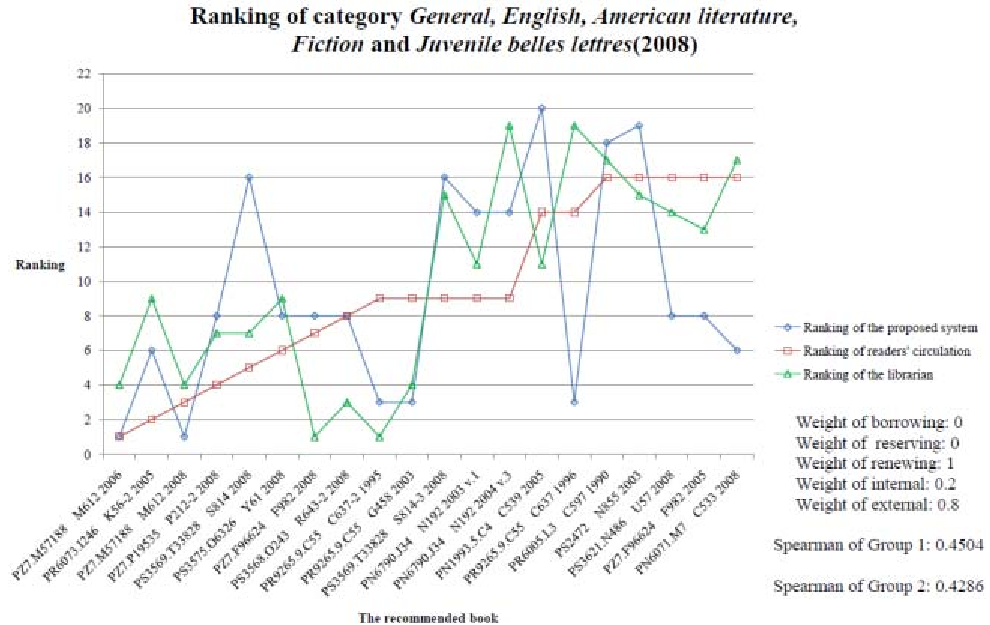 Figure 2: Comparisons between the proposed system's rankings, reader circulation, and librarian choices.
Critical Analysis & Conclusion
Takeaway
This research shifts the library from a top-down "expert-driven" model to a bottom-up "community-driven" model. It leverages Social computing to find the "hidden influencers" within a library's ecosystem.
Limitations & Future Work
While robust, the model currently relies heavily on historical data. If a library has a poor initial collection in a specific category, the social network for that category will be sparse, making it harder to evaluate recommenders. Additionally, the system doesn't yet account for "cold-start" recommenders who have no previous borrowing history.
Looking ahead, the authors suggest that integrating more diverse reader behaviors (like digital book views or inter-library loan requests) could further refine the "Representative Degree," making library acquisition an almost predictive science.