
CNNs and SVMs: Pushing the Boundaries of Automatic Gender Recognition
Deep Convolutional Neural Networks and Support Vector Machines for Gender Recognition
This paper presents a hybrid gender recognition system that combines Deep Convolutional Neural Networks (CNN) with Dropout Support Vector Machines (SVM). By fine-tuning a pretrained CaffeNet and utilizing oversampling techniques, the authors achieve state-of-the-art results on the FERET and Adience datasets, reaching an accuracy of 97.3% and 87.2% respectively.
TL;DR
This research demonstrates that gender classification—a task often hindered by pose and lighting—can be solved with high precision by marrying deep learning with classical statistical classifiers. By fine-tuning a pretrained CaffeNet and employing Dropout-SVMs, the authors achieved a record-breaking 87.2% accuracy on the challenging Adience dataset and 97.3% on FERET, proving that transfer learning is the key to mastering domain-specific facial analysis.
Background & Motivation: Moving Beyond "Identity Memorization"
In the realm of computer vision, gender classification is frequently treated as a secondary task to face recognition. However, the authors identify a critical flaw in prior literature: Mixed Partitioning. Many previous models were tested on datasets where the same person appeared in both the training and testing sets. This allowed models to "cheat" by identifying the individual rather than learning gender-specific morphological traits.
The motivation here is to build a robust system that generalizes to unseen faces in "unfiltered" environments—images taken on smartphones with heavy makeup, poor lighting, or extreme angles.
Methodology: The Hybrid Architecture
The authors propose a multi-stage pipeline that transitions from raw pixels to a final gender label.
1. The Neural Backbone
The system utilizes the BVLC CaffeNet, a variant of the famous AlexNet architecture. The core innovation lies in the transition from general object recognition (ImageNet) to gender-specific features.
- Feature Extraction: Features are pulled from the
fc7layer (4,096 dimensions). - Fine-Tuning: The final 1,000-unit softmax layer is replaced with a 2-unit layer optimized via squared hinge loss.
2. The Dropout-SVM
To prevent overfitting—especially on the smaller FERET dataset—the authors integrate Dropout training into the SVM. By randomly setting feature components to zero during training, the SVM is forced to find a more redundant and robust decision boundary.
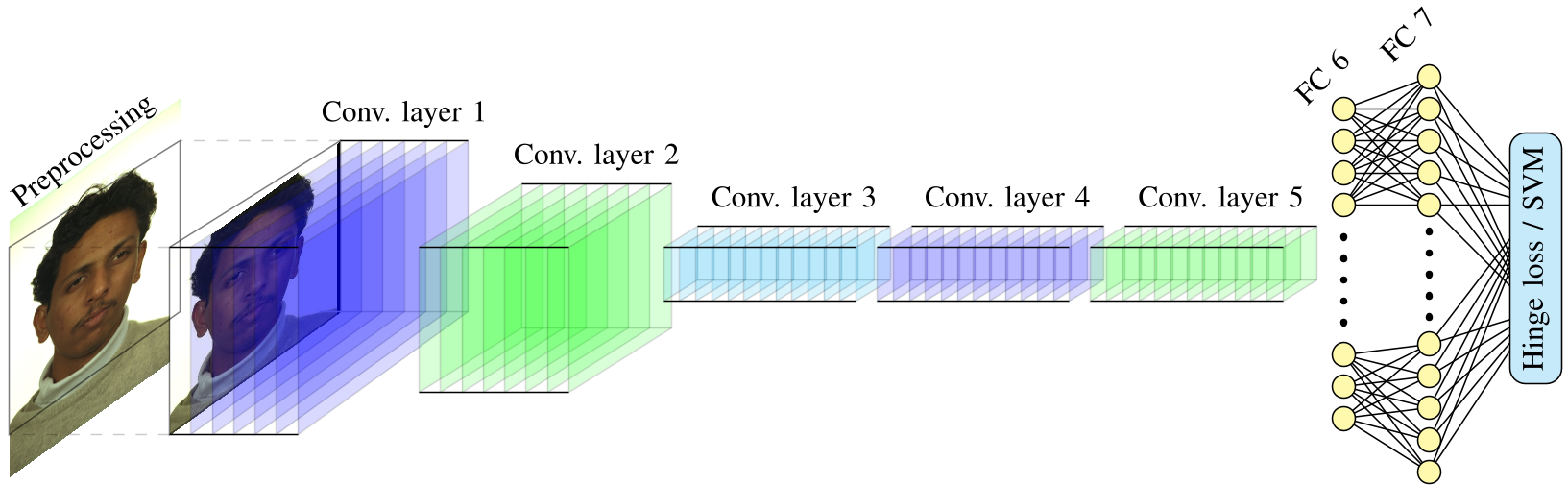 Figure 1: The general pipeline: Face detection -> Data Augmentation -> CNN Feature Extraction -> SVM Classification.
Experiments and Results
The study was conducted on two major benchmarks:
- Color FERET: Controlled but multi-angle.
- Adience: Unconstrained, "in-the-wild" images from Flickr.
Key Breakthroughs
- Fine-tuning is King: Simply using a pretrained network as a feature extractor reached ~80% accuracy on Adience. Fine-tuning the weights specifically for gender pushed this to over 86%.
- The Power of Oversampling: By taking five crops and their mirrors for a single image and averaging the scores, the model consistently reduced "unlucky" crops' noise, boosting performance by ~1%.
| Method | Adience Accuracy | FERET Accuracy |
|---|---|---|
| CNN + Dropout-SVM | 81.4% | 95.8% |
| CNN + Fine-Tuning + Oversampling | 87.2% | 97.3% |
Error Analysis: Where Deep Learning Fails
Despite the high accuracy, the model still struggles with:
- Babies: Gender-dependent attributes are biologically less distinct in infants.
- Long Hair on Men: The model often over-relies on hair length as a proxy for gender.
- Alignment Failures: Extreme crops or poorly detected faces remain the primary source of error in unconstrained settings.
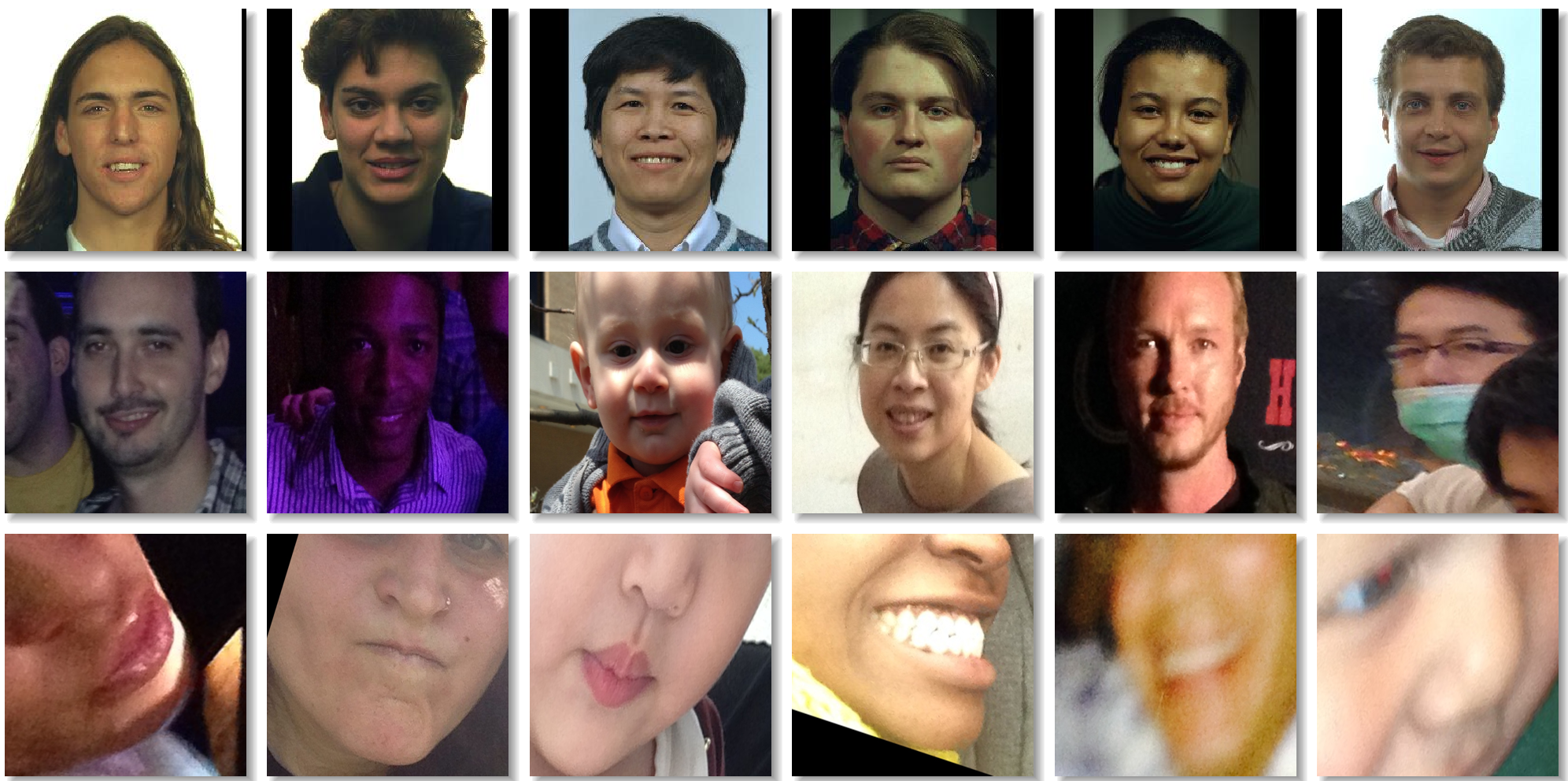 Figure 2: Examples of failure cases: Infants and men with long hair remain challenging targets for the CNN.
Critical Insight & Conclusion
The paper's cross-dataset testing reveals a sobering truth: a model trained on controlled data (FERET) drops to 67.1% when tested on "wild" data (Adience). This emphasizes that data diversity is just as important as architectural depth.
Final Takeaway: For practitioners, the winning recipe is Fine-tuning + Squared Hinge Loss + Test-time Augmentation (Oversampling). While the SVM offers a strong baseline, the end-to-end optimization of a CNN provides the nuanced feature steering required to exceed human-level performance in complex visual tasks.