
FAKEDETECTOR: Leveraging Deep Diffusive Networks for Credibility Inference
Deep Diffusive Neural Network based Fake News Detection from Heterogeneous Social Networks
The paper introduces FAKEDETECTOR, a novel deep diffusive neural network framework designed to identify fake news articles, creators, and subjects simultaneously within heterogeneous social networks. By integrating explicit textual features and latent representation learning with a Gated Diffusive Unit (GDU), the model achieves SOTA performance on the PolitiFact dataset.
TL;DR
Fake news is not just about the text; it's about who wrote it and what it's about. FAKEDETECTOR shifts the paradigm from simple text classification to Collective Credibility Inference. By treating news articles, creators, and subjects as nodes in a heterogeneous network and using a specialized Gated Diffusive Unit (GDU), this model achieves a 40% performance boost over traditional CNN and RNN-based detectors.
The "Isolation" Problem in Fake News Detection
Most existing fake news detection systems treat articles as isolated units. However, the authors argue that fake news has unique characteristics:
- High Social Impact: Unlike email spam, fake news propagates through active sharing.
- Entity Correlation: A creator who frequently publishes misinformation lowers the credibility of all their future work. Conversely, a highly credible subject (topic) might be "hijacked" by a fake article.
The core challenge is: How do we fuse textual content with these complex, multi-type relationships?
Methodology: The Deep Diffusive Architecture
FAKEDETECTOR operates in two main stages: Feature Extraction and Relationship Modeling.
1. Hybrid Feature Learning Unit (HFLU)
The model extracts two types of features:
- Explicit: Bag-of-words counting from a specific vocabulary correlated with fake/true labels.
- Latent: A 3-layer GRU (Gated Recurrent Unit) that captures the "style" and "inconsistency" of the text that explicit counts might miss.
2. The Gated Diffusive Unit (GDU)
This is the "brain" of the model. Unlike standard RNN cells, the GDU is designed for graph-structured data where nodes have different types.
- The Forget Gate: When an article node receives information from a "Subject" node, it uses a forget gate to filter out irrelevant topic aspects.
- The Adjust Gate: When information moves from a "Creator" (Person) to an "Article" (Object), the adjust gate nodes the semantic shift required for this cross-type diffusion.
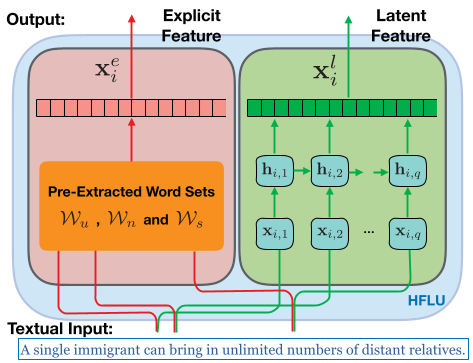 Fig 1: The overall FAKEDETECTOR architecture showing the flow between Articles, Creators, and Subjects.
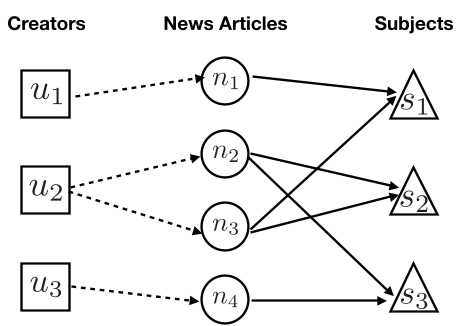 Fig 2: Detailed view of the GDU with Forget and Adjust gates.
Experimental Validation
The model was tested on the PolitiFact dataset, which includes 6 levels of truthfulness (from "True" to "Pants on Fire!").
Key Breakthroughs:
- Multi-Class Accuracy: Most models fail when moved from binary (True/False) to 6-class classification. FAKEDETECTOR maintained a significant lead, outperforming baselines by over 40% in accuracy.
- Relational Synergy: The ablation study (comparing against RNN/SVM which only use text) shows that the knowledge of who wrote the news is often as important as what was written.
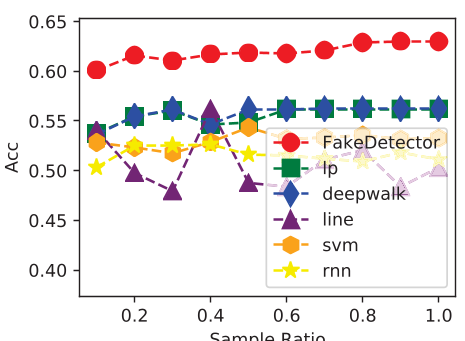 Fig 3: Efficiency vs. Sample Ratio — FAKEDETECTOR consistently stays above baselines even with limited training data.
Critical Insight & Conclusion
The genius of FAKEDETECTOR lies in its recognition that credibility is a diffusive property. By building a model that allows credibility scores to "flow" through the social network, the authors have created a tool that can flag a suspicious article even if its text is deceptive, simply because the creator or the context is untrustworthy.
Future Outlook: While powerful, the model depends on a structured heterogeneous network. Future work should explore how to apply this to "cold-start" scenarios where a new creator with no history enters the social network.