
Deep-Gap: Revolutionizing Crowdsourcing Balance through Image-Based Time Series Forecasting
Deep-Gap: A Deep Learning Framework for Forecasting Crowdsourcing Supply-Demand Gap Based on Imaging Time Series and Residual Learning
Deep-Gap is a novel deep learning framework for forecasting the supply-demand gap in mobile crowdsourcing, utilizing imaging time-series transformation and residual learning. It achieves SOTA performance on datasets like DiDi and NYC Yellow Taxi by encoding temporal data into GASF, GADF, and Recurrence Plot images.
TL;DR
Deep-Gap is a high-precision forecasting framework designed to solve the supply-demand imbalance in mobile crowdsourcing (e.g., WiFi sharing, ride-hailing). By converting 1D time-series data into 2D images (GASF, GADF, REC) and processing them through a multi-pathway Residual CNN, the model captures complex temporal patterns far better than traditional LSTMs, achieving up to a 22% reduction in error.
Backgound: The Equilibrium Challenge
In many smart city applications—from Uber's mobile hotspots to London's CabWiFi—the biggest hurdle is geographical imbalance. Providers naturally cluster in high-traffic city centers, leaving peripheral areas under-served. To fix this, platform managers need to provide incentives before the gap occurs. Deep-Gap positions itself as a proactive solution that transforms the "What happened?" of historical data into a highly accurate "What will happen?" prediction.
The Core Insight: Why Images?
While most researchers jump straight to Recurrent Neural Networks (RNNs) or LSTMs for time-series, the authors of Deep-Gap argue that 1D signals hide deep correlations. By "unrolling" time series into the 2D domain:
- GASF/GADF: These capture static angular correlations using polar coordinates.
- Recurrence Plots (REC): These reveal the dynamic "states" and periodicities of the system.
This transformation allows the model to utilize the power of Convolutional Neural Networks (CNNs) and Residual Learning, which are historically more stable and easier to train at depth than LSTMs.
Methodology: The Three-Pathway Architecture
Deep-Gap employs a sophisticated multi-branch architecture to fuse distinct information sources:
- Temporal Pathways: Three parallel CNN branches process the GASF, GADF, and REC images respectively.
- Residual Learning: Each pathway uses "ResUnits" (Skip-connections) to prevent gradient degradation, allowing the model to learn complex high-level features of the demand gap.
- External Context: A separate embedding layer processes external variables like temperature, humidity, and "Day Type" (Weekend vs. Weekday).
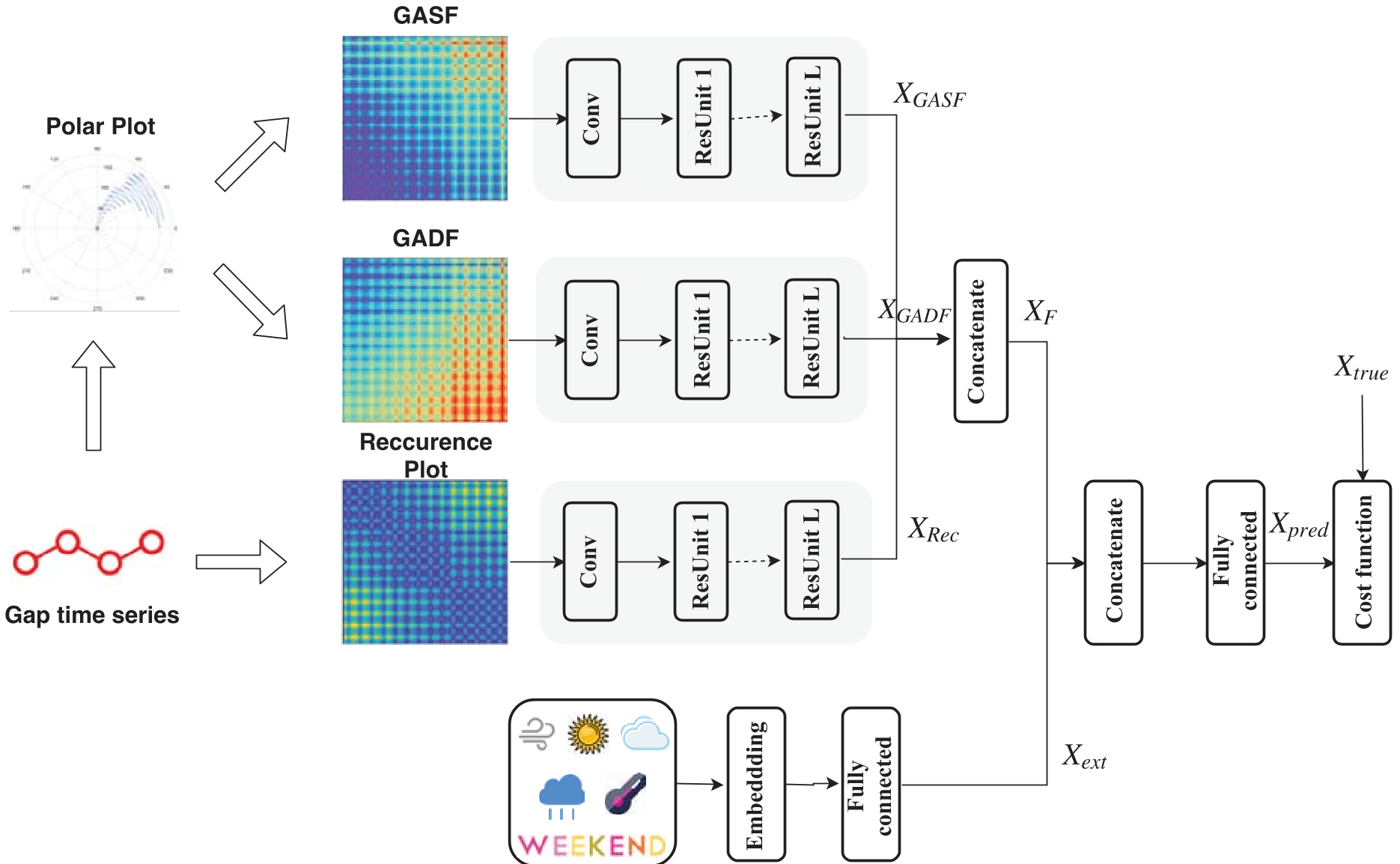 Fig 1: The Deep-Gap architecture combining image-encoded time-series with external metadata.
Experiments & Real-World Validation
The framework was tested against three massive real-world datasets: NYC Yellow Taxi, Porto Taxi, and DiDi Tech Challenge.
Key Performance Metrics:
- Superior Accuracy: Compared to ARIMA, GBDT, and LSTM, Deep-Gap achieved the lowest RMSE across the board.
- Peak Detection: Unlike traditional models that "smooth out" sudden changes, Deep-Gap effectively predicted sudden demand spikes, which is critical for real-time incentive deployment.
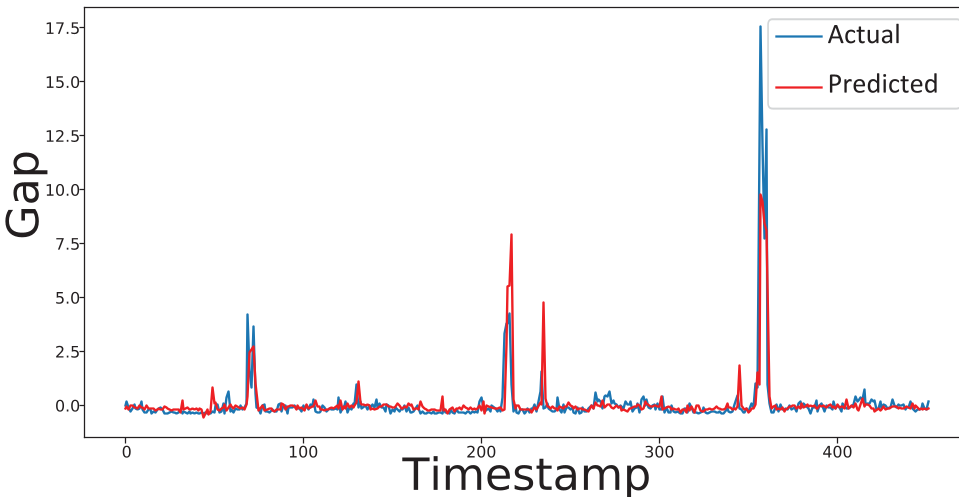 Fig 2: Actual vs. Predicted values for DiDi supply-demand gap, showing high fidelity in peak tracking.
Critical Analysis & Takeaways
The brilliance of Deep-Gap lies in its Inductive Bias. By treating time-series as images, it inherits the spatial invariance and local feature extraction capabilities of CNNs.
Strengths:
- Robustness: The use of Residual Blocks (ResNet style) makes the training more efficient and stable compared to Bi-LSTMs.
- Informed Predictions: By incorporating Accuweather data, the model understands why a gap might increase (e.g., a rainy day in London increases taxi demand).
Limitations:
- Data Hunger: Like all deep learning models, it requires a significant amount of historical data to train effectively.
- Computational Overhead: Converting every time-window into three 2D images adds a preprocessing step that might be intensive for ultra-low-latency real-time systems.
Conclusion
Deep-Gap marks a transition in spatiotemporal forecasting—from simply "remembering" the past (RNNs) to "visualizing" the patterns of the future (CNNs on images). For smart city operators, this provides a more reliable compass for navigating the volatile waves of human mobility.