
DETA: Deep Multi-Modal Fusion for Precise Social Network Alignment
Deep Heterogeneous Social Network Alignment
The paper introduces DETA (Deep nETwork Alignment), a deep learning framework for aligning users across heterogeneous social networks. It leverages an ensemble of Deep Autoencoders, LSTMs, and CNNs to fuse social, spatial, and textual data while enforcing a one-to-one cardinality constraint.
TL;DR
Connecting the dots between different social platforms (like Twitter and Foursquare) is hard because data is messy and fragmented. DETA (Deep nETwork Alignment) solves this by using a specialized deep learning suite—Autoencoders for friends, LSTMs for locations, and CNNs for text—all while ensuring the math respects a "one-to-one" rule (one person, one account per platform). It significantly outperforms traditional embedding methods by capturing the hidden nuances of user behavior.
Problem & Motivation: The Heterogeneity Headache
Aligning social networks isn't just about matching usernames. It's a high-dimensional puzzle involving:
- Structural Data: Who you follow (Social Links).
- Spatial Data: Where you check in (Trajectories).
- Content Data: What you say (Textual Posts).
Prior works often relied on manual "feature engineering"—basically, humans guessing what makes users similar. This is expensive and fails to generalize. Moreover, most models treat alignment as a simple classification task, ignoring the one-to-one constraint: a user on Foursquare shouldn't be "aligned" to five different accounts on Twitter.
Methodology: The DETA Architecture
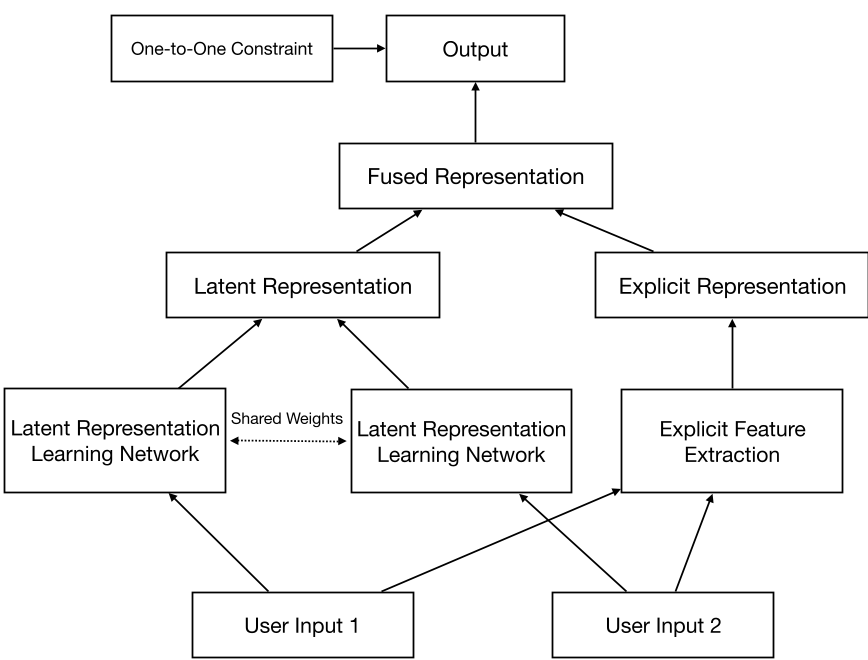
DETA utilizes a sophisticated "divide and conquer" strategy for feature learning.
1. Social Connections (Autoencoder)
Instead of just looking at immediate friends, DETA uses an Extended Deep Autoencoder. It minimizes a loss function that accounts for:
- First-order proximity: Direct friends should be close in the latent space.
- Second-order proximity: People with similar friend circles should be close, even if they aren't direct friends.
2. Trajectories (LSTM)
Location data is sequential and noisy. DETA discretizes locations into grid blocks and feeds them into an LSTM (Long Short-Term Memory) network. This allows the model to remember "routines" (e.g., going from work to a specific cafe) rather than just static coordinates.
3. Textual Posts (CNN)
To capture language style, DETA reshapes word frequency vectors into 2D matrices and processes them through a CNN (Convolutional Neural Network). This captures local "semantics" in word usage frequencies that simple Bag-of-Words models miss.
4. Mathematical Constraint: The One-to-One Rule
The final alignment isn't just a probability; it's a structural decision. DETA models the choice of anchor links as a combinatorial optimization problem where the sum of links for any node must be . They solve this using a Greedy Link Selection algorithm that provides a 1/2-approximation of the optimal solution.
Experiments & Results: Dominating the Baseline
The authors tested DETA on real-world Foursquare-Twitter pairs.
Key Findings:
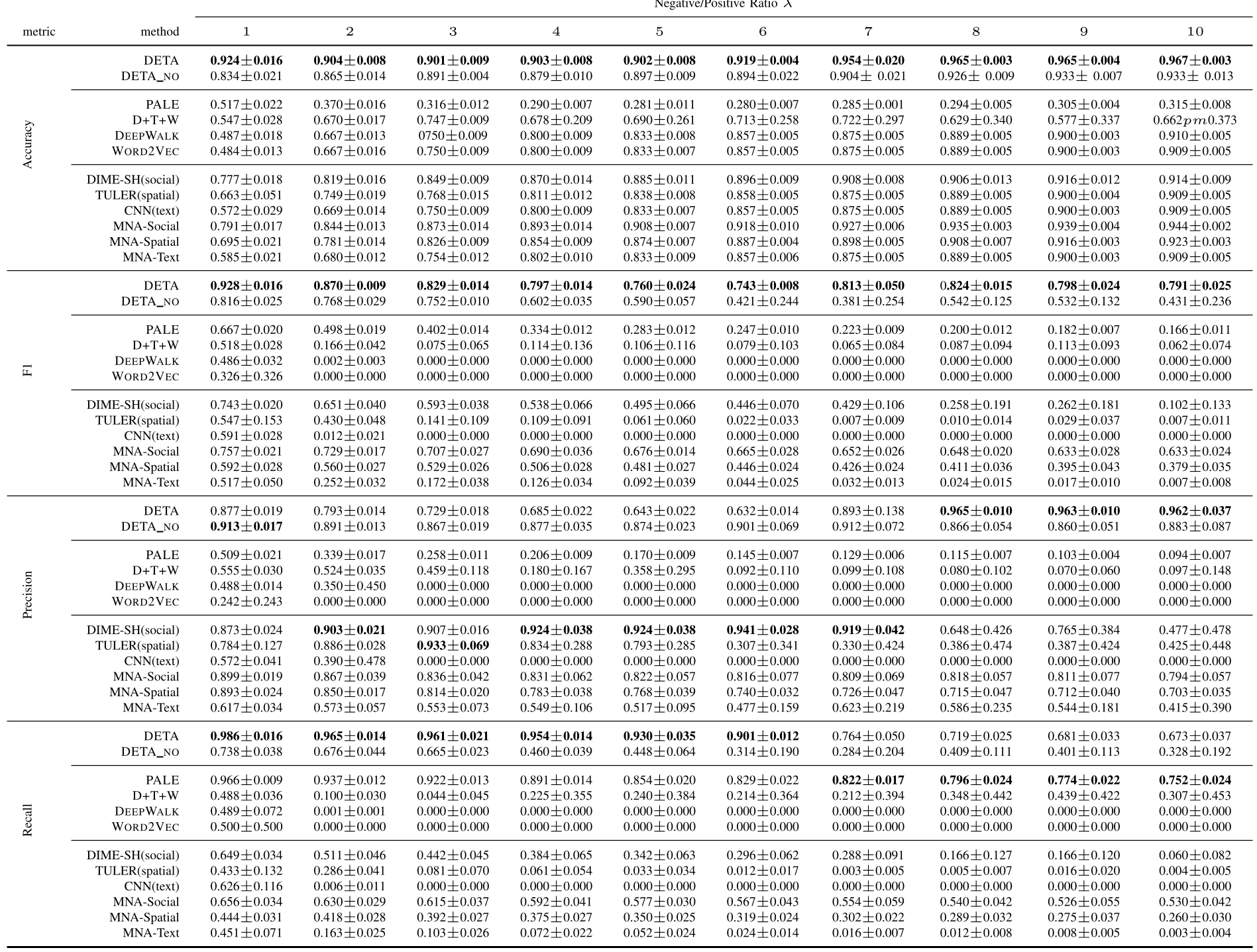
- Accuracy Boost: DETA achieved an accuracy of ~0.92-0.96 across different imbalance ratios (), consistently beating methods like PALE (an embedding-based baseline) and DeepWalk.
- Importance of Modalities: Interestingly, the Social Connection module was the most predictive. Textual data was useful but noisy, likely due to the informal nature of social media posts.
- Constraint Impact: The "DETA_NO" variant (without the one-to-one constraint) showed lower F1-scores, proving that the mathematical constraint is vital for realistic alignment.
Critical Insight & Conclusion
DETA proves that the future of social network alignment lies in latent feature fusion. By allowing deep learning models to find the hidden signatures in how we move, speak, and socialize, we can bridge the gap between platforms far more accurately than with manual rules.
Takeaway: If you are building a cross-platform recommendation system or a fraud detection tool, don't just concatenate embeddings. Enforce structural constraints (like one-to-one mapping) directly into your optimization loop to ensure physically plausible results.
Limitations
- Scalability: Combinatorial optimization on millions of nodes can be computationally heavy.
- Cold Start: The model still relies on a "small number of observed anchor links" to start the training, which might not be available in all scenarios.