
Temporal Action Detection: From Full Supervision to Zero-Shot Future
Deep learning-based action detection in untrimmed videos: A survey
This survey provides a comprehensive overview of deep learning-based temporal action detection (TAD) in untrimmed videos. It covers diverse supervision levels—from fully-supervised to weakly, semi, self, and unsupervised settings—highlighting SOTA methods like VSGN and RTD-Net that achieve high mAP on THUMOS14 and ActivityNet.
Executive Summary
TL;DR: This survey systematically dissects the evolution of Temporal Action Detection (TAD), the task of identifying "what" happened and "when" it started/ended in long, messy videos. It bridges the gap between traditional heavy-supervision models and modern, annotation-efficient learning paradigms like self-supervised and zero-shot detection.
Background Positioning: This work serves as a foundational "map" of the TAD landscape. It moves beyond simple action recognition to address the spatial and temporal nuances of untrimmed video analysis, positioning itself as a critical reference for researchers in sports analytics, surveillance, and robotics.
The Core Conflict: Why TAD is Hard
Most AI researchers are familiar with Action Recognition—classifying a 5-second clip of someone "jumping." However, real-world video is untrimmed.
- The "Needle in a Haystack" Problem: Actions of interest often cover only a small fraction (e.g., 30%) of the video. The rest is "background" noise.
- Flexible Duration: A "long jump" might last 5 seconds, while "cooking a meal" lasts 20 minutes. Rigid windows fail here.
- Annotation Fatigue: Manually marking every start and end frame in a 10-hour surveillance feed is a nightmare.
Methodology: The Technical Arsenal
1. The Architectural Split: Anchor-based vs. Anchor-free
- Anchor-based (Top-down): Similar to early object detection (Faster R-CNN), these methods place predefined temporal "boxes" across the video.
- Anchor-free (Bottom-up): These methods predict "boundary scores" (start/end probabilities) for every frame. Insight: This allows for precise, sample-level localization that isn't restricted by predefined lengths.
2. Modeling the "Long View"
Since individual video snippets lack context, the survey highlights three SOTA modeling techniques:
- Graph Convolutional Networks (GCNs): Treating video segments as nodes to capture complex, non-linear relations between sub-actions.
- Transformers: Utilizing self-attention to relate a frame at the beginning of a video to one at the very end.
- Feature Pyramids: Using U-shaped architectures to detect both "micro-actions" (flicking a switch) and "macro-activities" (cleaning a room).
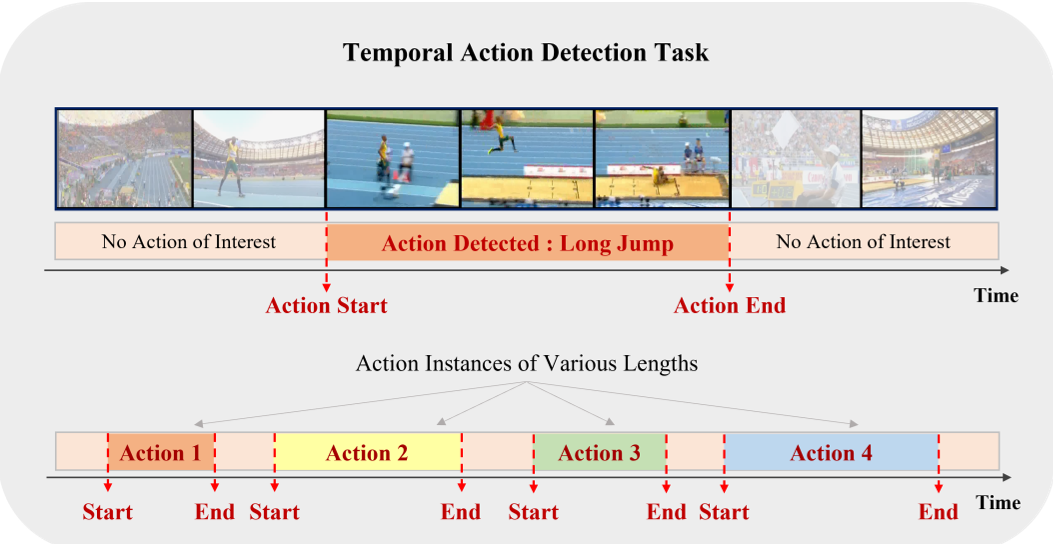 Figure 1: Comparison of temporal localization (when) vs. spatio-temporal localization (where and when).
The Shift to "Limited Supervision"
A major contribution of this survey is the detailed breakdown of how we train models with labels they've barely seen:
- Weakly-Supervised: Training using only a video-level tag (e.g., "this video contains a soccer goal") without saying where the goal is.
- Attention Mechanisms: Models learn to "attend" only to discriminative frames. Class-agnostic attention is specifically praised for its ability to filter out background noise regardless of the specific action type.
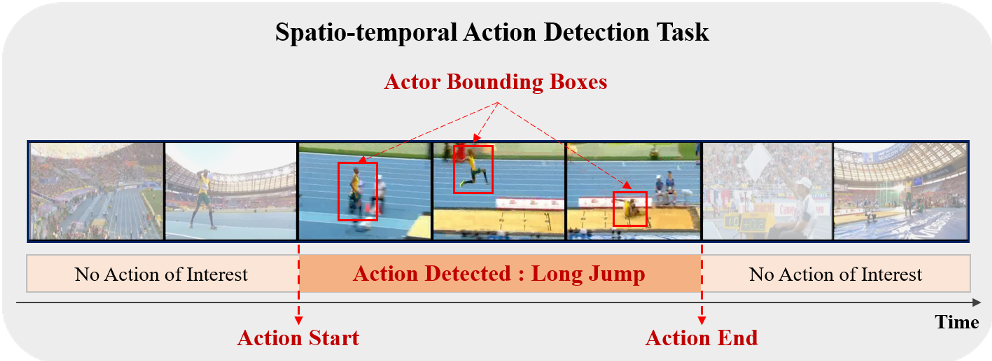 Figure 2: Spatio-temporal detection tracks the actor in both time and 2D space.
Experimental Performance Analysis
The survey compares state-of-the-art (SOTA) results across the THUMOS14 and ActivityNet benchmarks.
- SOTA Leaders: Methods like AFSD and VSGN dominate the fully-supervised leaderboard by balancing precise boundary refinement with multi-scale feature aggregation.
- The Efficiency Gap: While fully supervised models reach ~56.9% mAP on THUMOS14, weakly supervised models are catching up, with recent entries like D2-Net reaching ~36.0%.
Critical Analysis & The Road Ahead
Future Trends:
- Zero-Shot (ZSTAD): Detecting actions the model has never seen during training by using semantic word embeddings.
- Domain Transfer: Leveraging the abundance of "trimmed" YouTube clips to improve "untrimmed" detection.
- Real-world Deployment: Moving from "offline" batch processing to "online" detection for autonomous vehicles that must react in milliseconds.
Conclusion:
The field is moving away from "brute-force" annotation. The future of video understanding lies in structured self-supervision—models that understand the physics and logic of human movement without needing a human to label every frame.