
Decoding the Digital Fingerprint: Identifying Consumer Traits from Smart Meter Data via Deep CNNs
9582_Deep Learning-Based Socio-Demographic Information Identification From Smart Meter Data.
This paper proposes a deep learning framework combining Convolutional Neural Networks (CNN) and Support Vector Machines (SVM) to identify socio-demographic information (e.g., age, occupation, appliance usage) from smart meter load profiles. The hybrid CNN-SVM approach achieves SOTA results on the Irish CER dataset by automatically extracting non-linear features from raw electricity consumption data.
TL;DR
Researchers from Tsinghua University and the University of Washington have developed a deep learning framework that "looks" at your electricity usage to predict who you are. By combining the feature extraction power of Convolutional Neural Networks (CNN) with the classification robustness of Support Vector Machines (SVM), they can identify age, social class, and even appliance ownership with accuracy significantly higher than traditional manual methods.
Problem & Motivation: The "Shift" in Human Behavior
Smart meters generate massive amounts of time-series data, yet most utilities still rely on manual feature extraction—like calculating average consumption or peak ratios. This is problematic because human life is stochastic: we don't cook or shower at the exact same minute every day.
Traditional linear models struggle with Time-Shift Invariance (the peak might happen at 6:30 PM today and 7:00 PM tomorrow) and the Non-linear Relationships between household traits and kilowatts. The authors hypothesize that if a CNN can recognize a "cat" in an image regardless of where it is in the frame, it should be able to recognize a "breakfast pattern" in a load profile regardless of a 30-minute shift.
Methodology: The CNN-SVM Hybrid
The architecture moves away from the "labor-intensive" manual feature engineering toward an automated, hierarchical extraction process.
1. Feature Extraction via CNN
The core innovation lies in using the convolutional layers to learn local usage motifs.
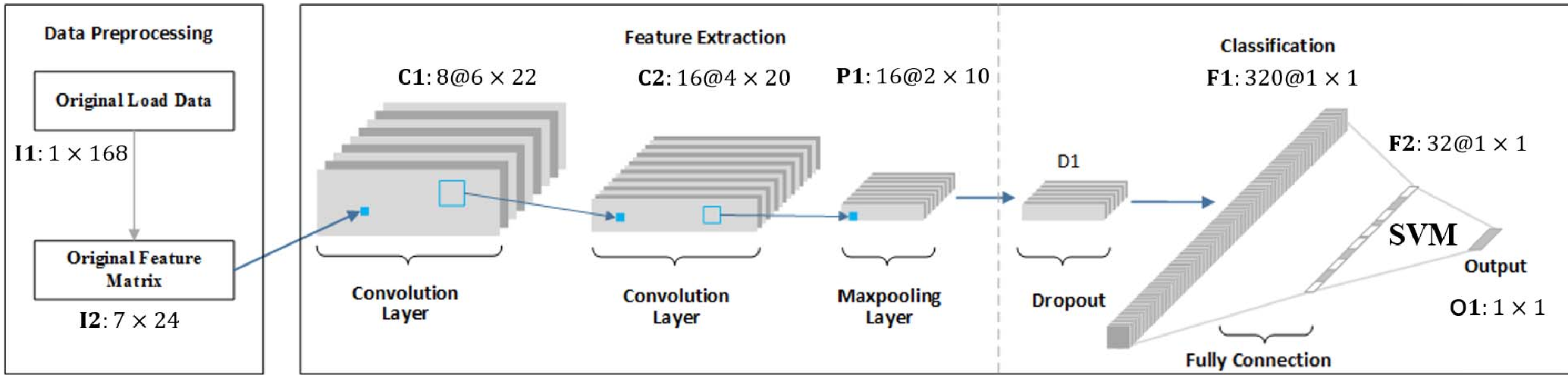
- Time-Shift Invariance: Filters sweep across the 7x24 (weekly) consumption matrices, capturing stable patterns despite small temporal fluctuations.
- Layer Stack: The model employs three convolutional layers followed by ReLU activations and max-pooling, effectively "compressing" raw data into high-level features.
2. The SVM Advantage
While standard CNNs use Softmax for the final decision, this paper swaps it for an SVM. Why? SVMs are designed to maximize the margin between classes, which provides better generalization when the dataset size is limited compared to the high dimensionality of the features.
3. Fighting Overfitting
With 10,808 parameters and a finite number of consumers, overfitting is a major threat. The authors used three shields:
- Data Augmentation: Treating different weeks from the same consumer as distinct training samples.
- Dropout: Randomly "turning off" neurons during training to prevent co-dependency.
- Weight Decay: Penalizing excessively large weights to keep the model simple.
Experiments & Results: What Do the Kilowatts Reveal?
The model was tested on the Irish CER dataset, targeting ten specific attributes ranging from "Age of chief income earner" to "Number of bedrooms."
Key Metrics:
- High Accuracy Traits: Predicting if someone is retired (#2) or has children (#4) yielded accuracies over 75%. These lifestyles create distinct, repetitive electrical signatures.
- Low Accuracy Traits: "Number of bedrooms" (#7) hovered near 51.7%. Insight: Just because you have more rooms doesn't mean you use energy in a unique way that distinguishes you from someone in a smaller house.
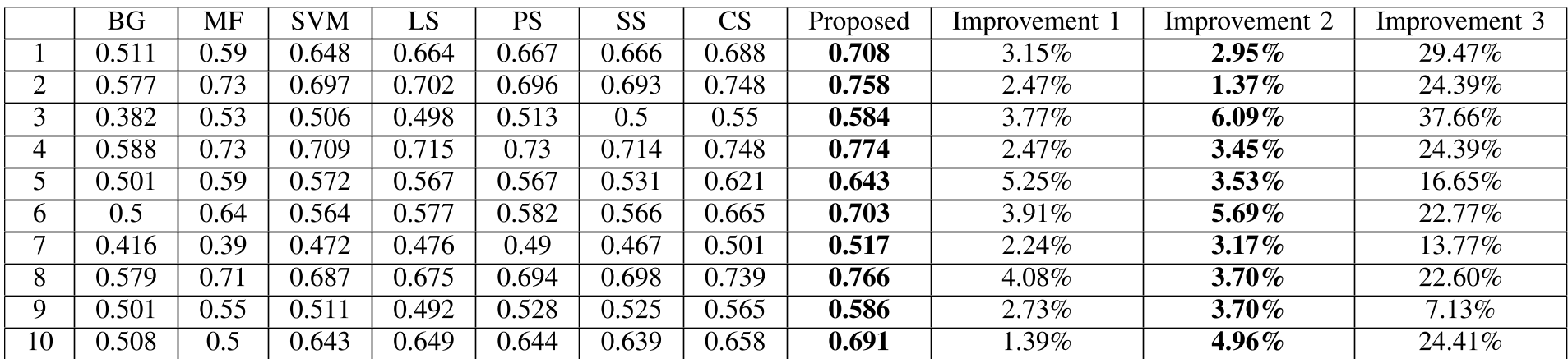
The CNN-SVM (Proposed) method consistently outshines Manual Features (MF), Principal Component Analysis (PCA), and Sparse Coding (SS). The "Improvement 2" column in the results highlights that simply switching from CNN-Softmax to CNN-SVM adds a 1-6% boost in performance.
Critical Analysis & Conclusion
Takeaway
Automated feature learning is the future of smart grid analytics. This paper proves that deep learning can bypass the need for "energy domain experts" to manually define features, instead letting the data define itself.
Limitations & Future Work
- Privacy: If a utility can predict your social class and age with 70%+ accuracy, the risk of data misuse is high. The authors acknowledge that future work must address the trade-off between "profiling accuracy" and "consumer privacy."
- Temporal Context: While CNNs handle shifts, they don't explicitly model long-range sequential dependencies like LSTMs or Transformers. Future iterations could incorporate Recurrent layers to track how a household evolves over years, not just weeks.
Final Verdict: A foundational work that bridges the gap between Computer Vision techniques and Power Systems, providing a robust roadmap for more personalized energy management.