
Decoding Laughter: A Deep Learning Approach to Cross-Cultural Humor Recognition
Deep Learning Model for Humor Recognition of Different Cultures
This paper presents a Deep Learning-based cross-cultural humor recognition model using a Convolutional Neural Network (CNN) to classify sentences as humorous or non-humorous across both English and Chinese languages. By optimizing hyperparameters and utilizing pre-trained GloVe embeddings, the model achieved a high SOTA accuracy of 96.73% on a large-scale dataset of over 570,000 sentences.
TL;DR
Researchers from Tsinghua University have developed a 15-layer Convolutional Neural Network (CNN) capable of distinguishing humor from serious text across English and Chinese cultures. By moving beyond simple word-counting to deep semantic vector mapping, the model achieved a staggering 96.73% accuracy, proving that AI is becoming increasingly adept at navigating the most subjective of human traits: our sense of humor.
The "Why": Why Computers Struggle with a Good Joke
For decades, humor was considered the "final frontier" for AI. Traditional lexicon-based approaches simply counted "funny" words, failing to understand that a joke's power often lies in subtext, sarcasm, or cultural specificities.
The authors identified three major hurdles:
- Semantic Ambiguity: Humor often uses irony where the literal meaning is the opposite of the intended sentiment.
- Cross-Cultural Nuance: What is funny in a Western "one-liner" might be lost in translation within a Chinese tonal pun.
- Domain Discrepancy: Models often "cheat" by memorizing the source of the data (e.g., news vs. joke sites) rather than learning the essence of humor.
Methodology: The 15-Layer Architecture
The core of this research lies in a sophisticated CNN architecture designed to capture "linguistic patterns" at multiple scales.
1. Vectorizing Culture (Embedding)
Instead of treating words as isolated strings, the model uses GloVe (Global Vectors for Word Representation). It maps words into a 200-dimensional space where "funny" concepts cluster together based on context.
2. Multi-Scale Convolutional Filters
The model doesn't just look at one word at a time. It uses five different filter sizes (2, 3, 4, 5, and 6) to "scan" the sentence.
- A 2-word filter might catch a simple pun.
- A 6-word filter captures a complex semantic structure.
 Figure 1: The data flow from raw text to cultural embedding, managed through a multi-filter convolutional process.
Experiments: From Naïve to SOTA
The researchers initially struggled with a "naïve" model that only reached 64.5% accuracy. The gap between training and testing was wide, signaling overfitting.
The Optimization Breakthrough
By systematically tuning the "Hyperparameters," the team transformed the model:
- Layers: Increased from 11 to 15.
- Activation: Switched from Sigmoid to ReLU (Rectified Linear Unit) to avoid "vanishing gradients" in deeper layers.
- Optimizer: Implemented the Adam optimizer to dynamically stabilize the learning rate.
| Metric | Naïve Model | Optimized Model | Improvement |
|---|---|---|---|
| Accuracy | 64.48% | 96.73% | +32.25% |
| Batch Size | 200 | 512 | Optimized Throughput |
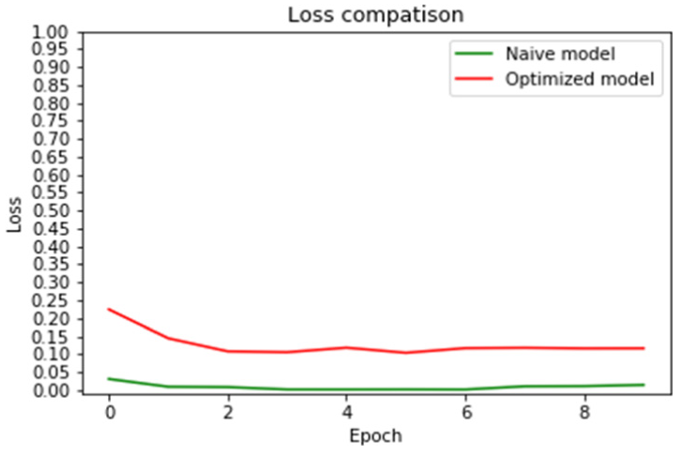 Figure 2: The dramatic leap in testing accuracy after hyperparameter optimization.
Real-World Nuance
An interesting finding was the model's ability to recognize humor in sentences like "I have a pen, I have an apple." To a traditional model, this is nonsense. To this CNN, which accounts for the viral context of 2016, it is recognized as a humorous reference. This proves the model is learning contextual humor, not just dictionary definitions.
Critical Insight & Limitations
While the 96.73% accuracy is impressive, the authors are refreshingly objective about the limitations:
- Short Form Bias: The dataset consists mostly of "one-liners." The model might struggle with longform comedic essays or sitcom scripts.
- The Humor vs. Joke Distinction: A "joke" is a format, while "humor" is a quality. The model currently detects the former to infer the latter.
- Subjectivity: Humor remains one of the most personal human traits. Even with 96% accuracy, the "degree" of funniness is still a mountain yet to be climbed.
Conclusion: Beyond a Laugh
This isn't just about making AI funny—it's about making AI human-aware. The implications for Cross-Cultural Marketing (knowing if your slogan sounds like a joke in another language) and Fake News Detection (identifying clickbait that uses "outrageous humor" to spread) are immense. By mastering the structure of a joke, we are one step closer to AI that truly understands the "vibe" of human conversation.