
Enhancing LBSN Security: Synergizing LSTMs and XGBoost for Malicious Account Detection
Deep Learning-Based Malicious Account Detection in the Momo Social Network
This paper presents a deep learning-based framework for detecting malicious accounts in the Momo Location-Based Social Network (LBSN). By integrating an LSTM-based time-series model with traditional XGBoost classification, the system achieves a state-of-the-art F1-score of 0.918 using real-world data from over 180 million users.
TL;DR
Mobile social networks are under constant siege from malicious accounts spreading spam and manipulating data. This paper introduces a hybrid detection framework tested on Momo (a giant LBSN with 180M+ users). By combining the temporal sensitivity of LSTM with the robust classification of XGBoost, researchers achieved a high 0.918 F1-score, proving that how a user behaves over time is far more telling than who they claim to be.
Motivation: The Static Feature Trap
Traditional malicious account detection is often "static." It looks at profile pictures, registration dates, and friend counts. However, professional malicious actors have become adept at mimicking legitimate demographic profiles.
The researchers identified a critical gap: Dynamic Behavior. Legitimate users have natural, semi-predictable rhythms in their posting and commenting, whereas bots and malicious agents follow specific, often repetitive or abnormal temporal patterns. The challenge in a platform like Momo—where location check-ins aren't always public—is to extract these patterns purely from social interactions.
Methodology: A Hybrid Architecture
The core innovation lies in the fusion of two distinct feature processing pipelines:
- Statistical Feature Stream: Processes demographic data, general UGC (User Generated Content) statistics, and social graph metrics via standard machine learning.
- Temporal Feature Stream (LSTM): This is the "brain." It treats user interactions (posts, comments) as a time-series. The Long Short-Term Memory (LSTM) network is uniquely suited for this as it can remember long-term dependencies in behavior that simple classifiers ignore.
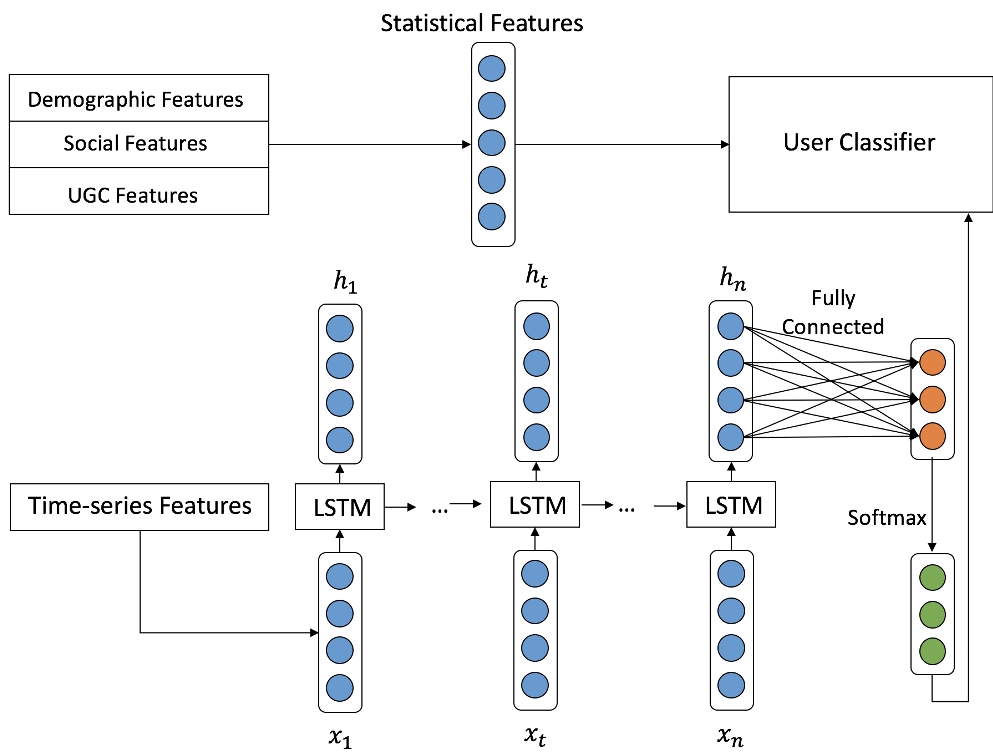
The outputs from the LSTM are treated as a high-level "behavioral vector" and appended to the conventional feature set. This combined vector is then passed to XGBoost, a powerful gradient-boosting algorithm known for its efficiency and accuracy in tabular data classification.
Experimental Results & Insights
Using a balanced dataset of 20,000 accounts from Momo, the authors conducted a rigorous evaluation comparing multiple algorithms like SVM, Random Forest, and C4.5.
- The Winner: XGBoost + LSTM (F1: 0.918).
- Ablation Success: Removing the LSTM (dynamic features) dropped the F1-score to 0.90, confirming that temporal patterns provide a distinct signal that profile data lacks.
- Feature Importance:
- Dynamic Features: 0.845 F1 (Top Performer)
- UGC Content: 0.764 F1
- Social Connections: 0.552 F1 (Surprisingly Low)
The low performance of social features suggests that malicious accounts on Momo are increasingly isolated or use "stealth" tactics that avoid traditional social-network-analysis detection.
Critical Analysis & Conclusion
The real value of this work is its accessibility. Unlike many proprietary systems that rely on private IP logs or hardware IDs, this framework uses publicly-accessible information. This means third-party app developers building on top of social platforms can implement it to protect their own sub-communities.
Future Work: The authors plan to deepen the analysis by adding NLP (Natural Language Processing) and media content analysis. Currently, the system looks at the timing and metadata of posts; understanding the sentiment and semantic intent of the text would likely push the F1-score even closer to perfection.
Takeaway: In the cat-and-mouse game of cybersecurity, temporal dynamics are the new frontier. If you want to catch a bot, don't look at its profile—watch its rhythm.