USAN: Toward Robots That Understand Social Context and Navigate Accordingly
A Deep Learning Approach To Multi-Context Socially-Aware Navigation
The paper presents a Unified Socially-Aware Navigation (USAN) architecture that enables robots to adapt their navigation strategies across multiple social contexts. By combining a CNN-based visual classifier, an SVM-based laser feature analyzer, and a multi-objective local planner utilizing Pareto Concavity Elimination Transformation (PaCcET), the system autonomously selects and optimizes social objectives for scenarios like hallways, art galleries, and queues.
TL;DR
Navigating a crowded hallway is fundamentally different from joining a group conversation or browsing an art gallery. This paper introduces the Unified Socially-Aware Navigation (USAN) architecture, which allows robots to perceive their social environment using CNNs and SVMs, and then adapt their movement using a multi-objective optimizer called PaCcET. The result is a robot that doesn't just avoid people, but respects the social purpose of the space.
Context Matters: The Limitations of Single-Context SAN
The robotics community has long moved past simple "collision avoidance." We now have Socially-Aware Navigation (SAN). However, most SAN models are "one-trick ponies"—they excel at passing people in hallways but fail when they encounter a queue at a vending machine or a spectator looking at a painting.
The core challenge isn't just how to move, but which social rules apply right now. Previous methods using Layered Costmaps or Inverse Reinforcement Learning (IRL) often require heavy computation or lack the mechanism to switch behaviors autonomously based on the visual and spatial "vibe" of the scene.
Methodology: The USAN Architecture
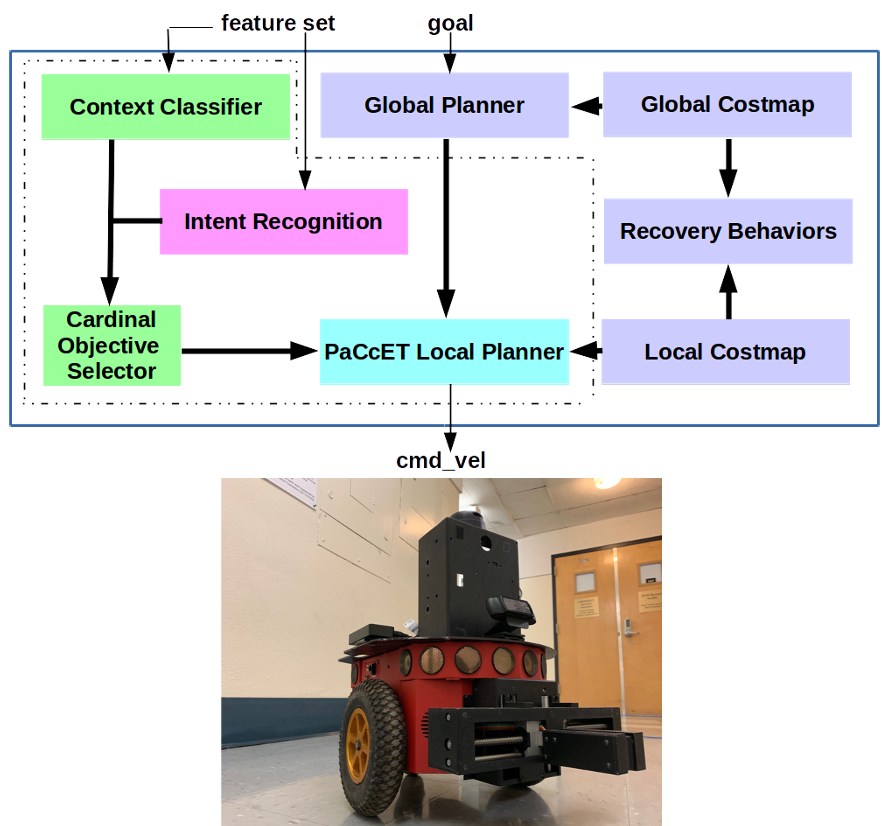
The authors propose a hierarchical decision-making framework. Instead of a single "black box" model, they split the task into Perception (Context Classification) and Execution (Local Planning).
1. The Context Classifier (CNN + SVM)
The robot uses two distinct sensors to determine its surroundings:
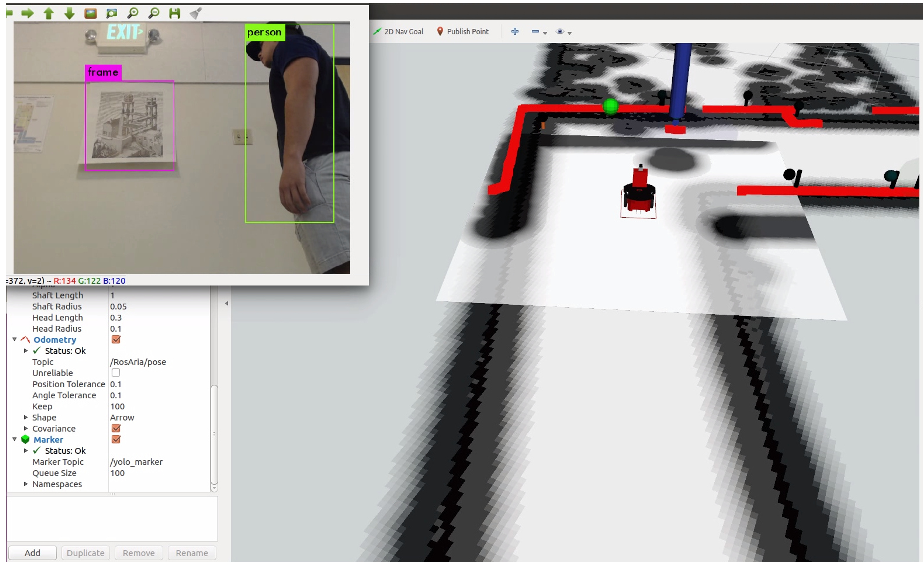
- Vision-based (CNN): A shallow CNN identifies stable environmental features to classify the scene as an Art Gallery, Hallway, or Vending Machine area.
- Laser-based (SVM): Lasers are better at detecting "fleeting" social structures. The system extracts Circularity and Linearity from human positions. For instance, a high circularity score indicates an O-formation (a group talking), while high linearity indicates a queue.
2. The Executioner: PaCcET Local Planner
Once the context is known, the robot selects "Cardinal Objectives." If it's a hallway, it prioritizes staying to the right. If it's an art gallery, it prioritizes not crossing the activity zone (the space between a person and a painting).
The PaCcET (Pareto Concavity Elimination Transformation) algorithm handles the math. It samples potential velocities and scores them across multiple conflicting objectives (e.g., speed vs. personal space). It efficiently finds the "sweet spot" on the Pareto front to produce trajectories that are safe, comfortable, and socially appropriate.
Experimental Results: Real-World Adaptation
The system was tested on a Pioneer mobile robot. The researchers collected thousands of images from the internet and supplemented them with real-world data from the University of Nevada, Reno.
- Perception Performance: The CNN reached ~94% accuracy. Even in messy real-world transitions, the system remained stable thanks to a "rolling average" method on its predictions.
- Social Accuracy:
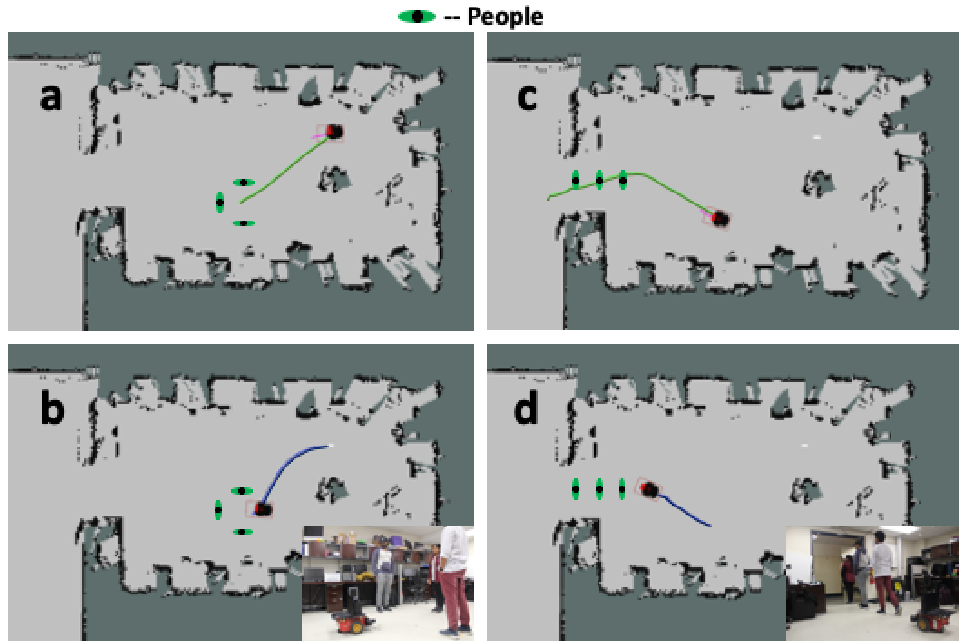
- Art Gallery: The robot successfully "gave a wide berth" to spectators instead of cutting through their line of sight.
- Queueing: Instead of cutting to the front (a classic "robotic" mistake), the SVM identified the line and the robot navigated to the tail.
Critical Insight: Why This Works
The brilliance of this paper lies in its Heuristic-Driven Optimization. By using lightweight classifiers (CNN/SVM) to trigger pre-defined social rules, the authors bypass the need for an end-to-end model that would require astronomical amounts of training data for every possible social scenario.
Limitations and Future Outlook
While USAN is a major step forward, it still relies on hand-picked objectives for each context. The authors acknowledge that a truly "smart" robot should learn these rules through observation (Inverse Reinforcement Learning) and use more advanced reasoning (Knowledge Graphs) to understand why it shouldn't stand in front of a vending machine.
Takeaway
Social navigation isn't just about geometry; it's about context. The USAN architecture proves that by combining robust perception with multi-objective optimization, we can create robots that transition from "machines that move" to "agents that behave."