
Neural LoFi: Decoding the Spectral Logic of Deep Feature Learning
Deep Learning as Neural Low-Degree Filtering: A Spectral Theory of Hierarchical Feature Learning
The paper introduces Neural Low-Degree Filtering (Neural LoFi), a spectral surrogate for gradient-based training in deep neural networks. It reframes hierarchical feature learning as an iterative procedure where each layer selects directions with maximal low-degree correlation to labels, matching the early-training performance of backpropagation while offering a tractable mathematical framework.
TL;DR
Researchers from EPFL have introduced Neural Low-Degree Filtering (Neural LoFi), a theory that suggests deep learning isn't a chaotic optimization process, but a structured, layer-by-layer spectral filtering. By selecting features based on their low-degree correlation with labels, Neural LoFi matches the early-stage performance of Backpropagation without needing a single backward pass.
Background: Beyond the "Lazy" Regime
For years, theoretical AI has been split between the Lazy Regime (where weights barely move, and the model acts like a fixed kernel) and the Feature Learning Regime (where representations evolve). While the latter is what makes AI powerful, it is notoriously hard to analyze. Neural LoFi bridges this gap by providing a "stylized limit" of gradient descent where feature learning becomes an explicit, iterative eigendecomposition problem.
The Core Insight: Relevance vs. Complexity
The paper posits that each layer in a deep network solves a variational problem. It looks for features that are:
- Relevant: High correlation with the labels (specifically, 2nd-order label-weighted correlation).
- Simple: Low complexity in the geometry defined by the previous layer.
The Neural LoFi Mechanism
Neural LoFi replaces the implicit madness of SGD with two clean steps per layer:
- Filter: Form a label-weighted moment operator and project the current data onto its top eigenvectors.
- Lift: Pass these "principal features" through a random nonlinear map to expand the dimensionality for the next layer.
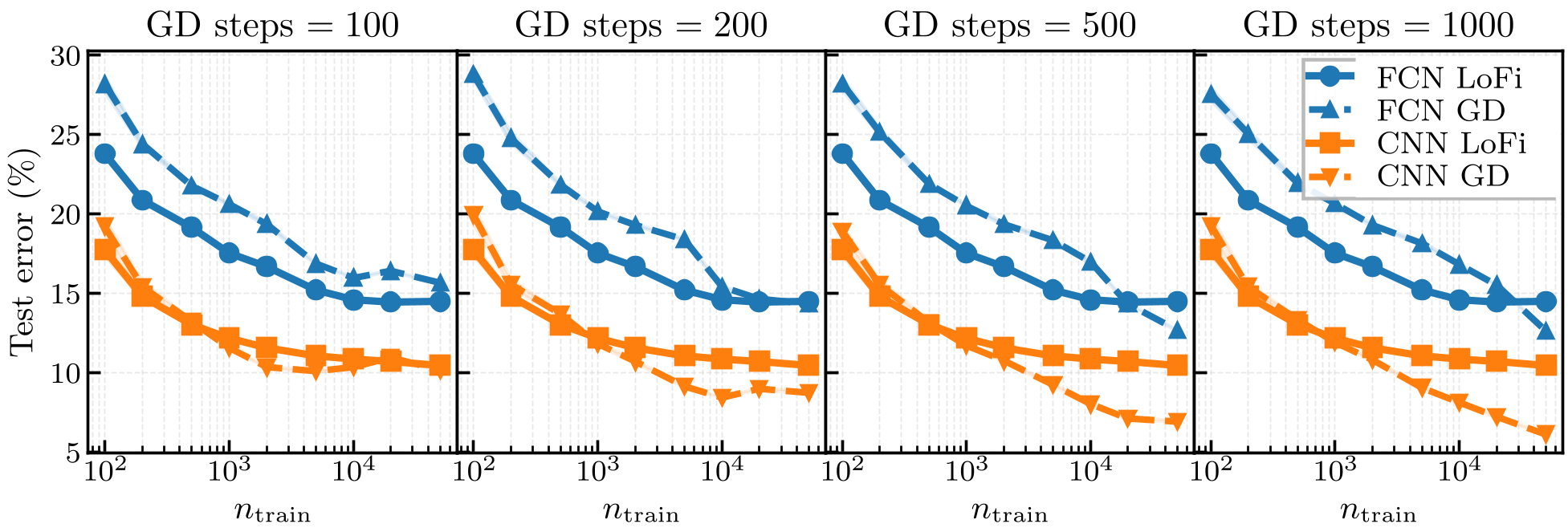 Figure 1: Comparison on CIFAR-10. Notice how Neural LoFi (a one-pass spectral method) tracks the performance of early Gradient Descent (GD) across both FCN and CNN architectures.
Why Depth Actually Works: Low-Degree Compositionality
One of the most profound takeaways from this work is the principle of Low-Degree Compositionality.
A target function might be "high-degree" (very complex) relative to the raw input pixels. However, if the function is compositional, each layer can extract a "low-degree" (simple) component. By the time the signal reaches the deep layers, what was once a complex high-dimensional problem has been "coarsened" into a simple linear or quadratic task.
Feature Emergence: A Phase Transition
The theory explains why deep networks often show "jumps" in ability. A feature only "emerges" when the signal-to-noise ratio—governed by the residual effective dimension of the kernel—crosses a specific threshold.
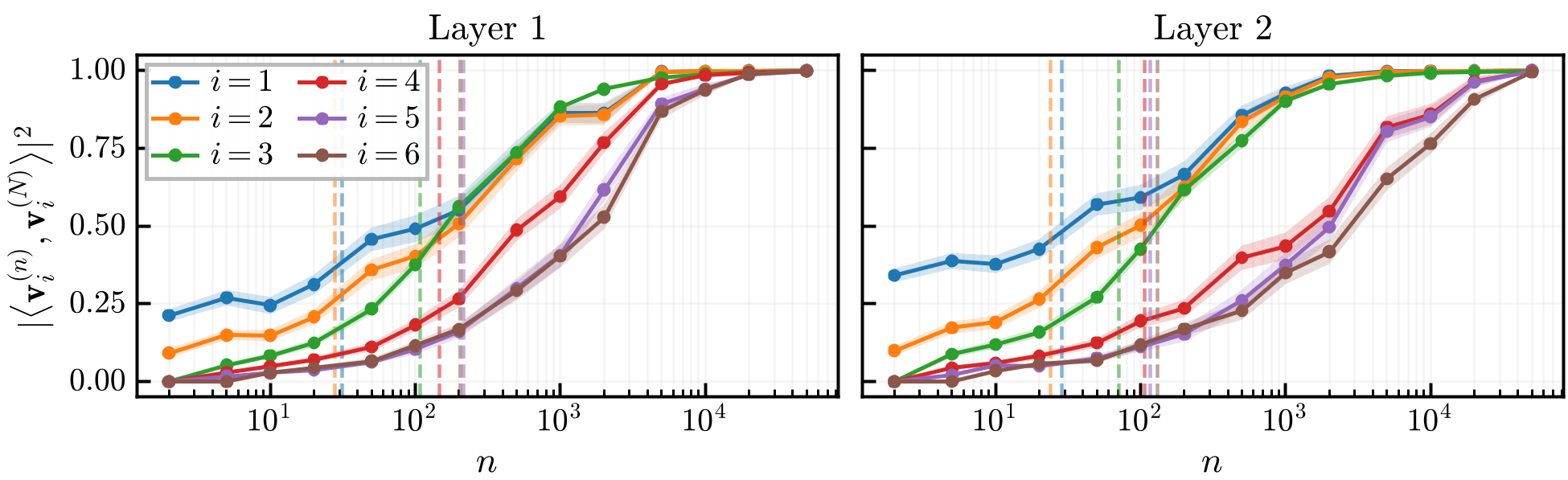 Figure 2: Predicting "Concepts." The dashed lines represent predicted sample complexity thresholds where specific task-relevant directions (features) separate from the noise.
Experiments: Spectral Vision
In convolutional networks (CNNs), Neural LoFi recovers classical edge detectors and Gabor-like filters. Strikingly, it does this without backpropagation. The filters emerge purely from the labels' relationship to local patches of the data.
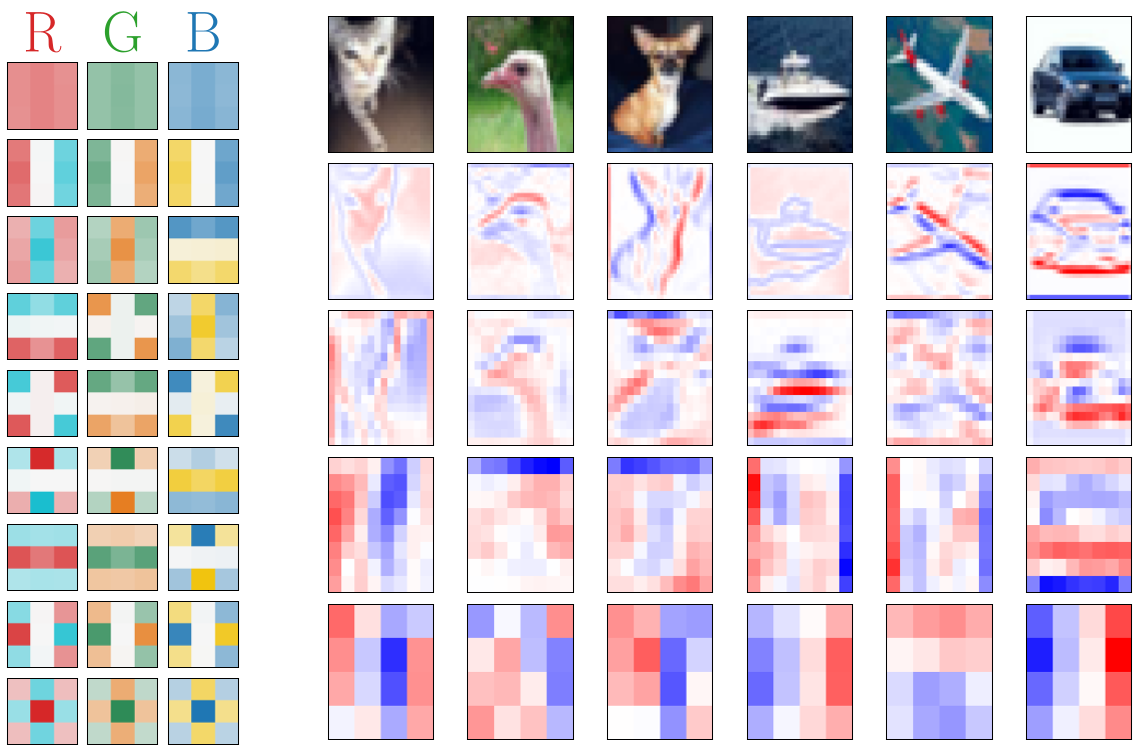 Figure 3: CNN Filters. The top row shows filters learned by LoFi directly from pixels, while the bottom rows show how these features become more selective/semantic as they go deeper.
Critical Perspective: Is Backprop Obsolete?
Hardly. The authors are clear: Neural LoFi is a mechanistic surrogate.
- The Strength: It provides a mathematical "microscope" to see why some features are learned before others.
- The Limitation: It captures "early" feature learning. Standard backpropagation eventually performs better because it allows for multi-pass refinement and "feature correction" that a greedy one-pass algorithm lacks.
Conclusion
Neural LoFi suggests that deep neural networks are essentially adaptive multi-layer kernels. This work moves us closer to a world where we can predict the "learning trajectory" of a model before we even hit "train," potentially leading to more efficient architectures and better-informed pruning strategies.
Takeaway for Practitioners: Understanding the spectral bulk and the effective dimension of your hidden layers isn't just theory—it's the diagnostic for whether your model is actually learning "concepts" or just over-fitting the noise floor.