
SNICA: Revolutionizing Social Network Analysis through Deep Learning
Deep Learning for Social Network Information Cascade Analysis: a surve
This paper provides a comprehensive survey of Deep Learning (DL) applications in Social Network Information Cascade Analysis (SNICA). It covers core tasks such as cascade prediction, rumor detection, and user behavior analysis, highlighting how DL models outperform traditional diffusion models by capturing implicit features and non-linear patterns in social graph data.
TL;DR
Information cascades—the "viral" spread of ideas, news, or rumors—are the lifeblood of social networks. This survey explores how Deep Learning (DL) has fundamentally replaced traditional mathematical models in Social Network Information Cascade Analysis (SNICA). By leveraging GNNs and RNNs, researchers can now predict the scale of a viral post and detect rumors with unprecedented accuracy.
The Evolution: From Rigid Assumptions to Latent Insights
For decades, researchers relied on the Independent Cascade (IC) or Linear Threshold (LT) models. These required heavy assumptions about how "infection" probabilities worked between users. As social data grew into a "Big Data" monster, these models broke down.
The core shift introduced by Deep Learning is the ability to treat social networks as non-Euclidean graphs that can be embedded into vector spaces. Instead of guessing why a user shares a post, DL models like DeepCas and DeepInf learn the hidden "social gravity" directly from historical data.
Methodology: The General SNICA Pipeline
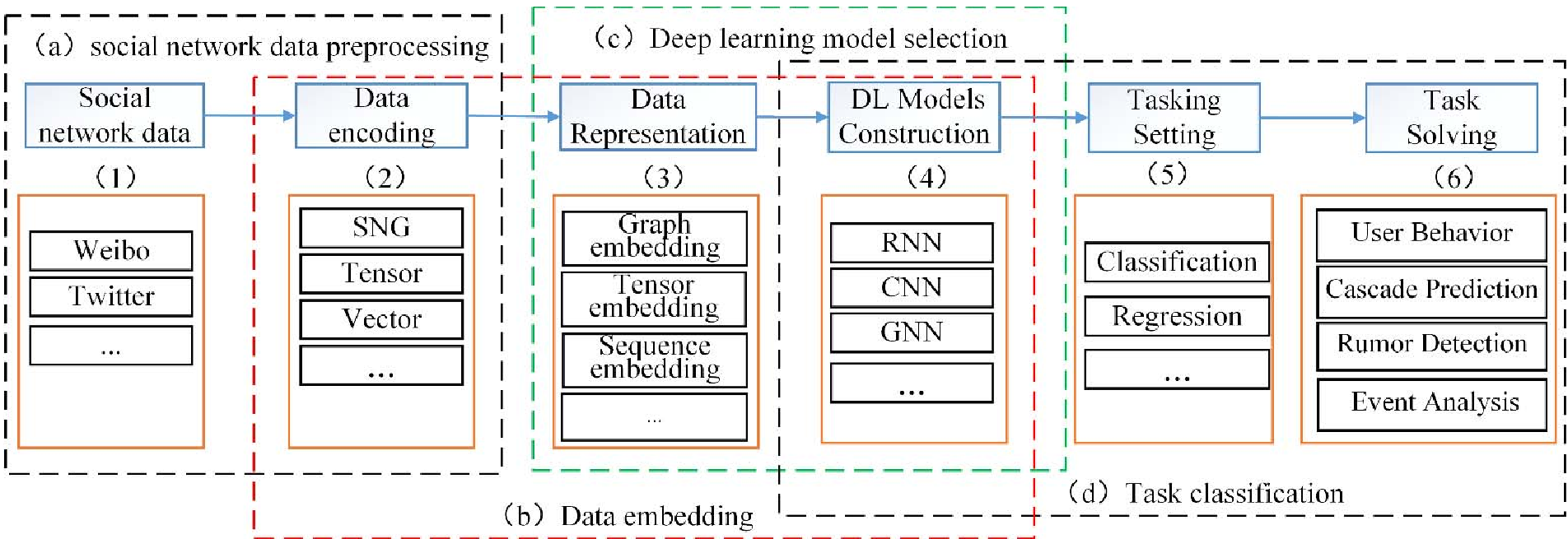
The paper outlines a robust 6-step framework for any DL-based cascade analysis:
- Preprocessing: Converting raw retweets and follows into Directed Graphs.
- Embedding: Using techniques like
DeepWalkorNode2Vecto turn users into numbers. - Representation: Mapping these to tensors.
- DL Architecture: Choosing between GNNs (for structure), RNNs/LSTMs (for timing), or CNNs (for content).
- Task: Defining whether it's a classification (will this be a rumor?) or regression (how many shares?).
- Solving: Final application in marketing, event detection, or safety.
Core Applications & SOTA Milestones
1. Cascade Prediction (The "Viral" Metric)
Models like DeepCas use GRUs with attention to look at the sequence of early adopters. They don't just count users; they analyze the order and influence of the path.
2. Rumor Detection
Speed is critical here. Using Bi-LSTMs and Attention Mechanisms, researchers can now capture "emotional spikes" and "linguistic anomalies" early in the cascade to flag misinformation before it peaks.
3. User Behavior (Micro-perspective)
While cascade prediction looks at the forest, user behavior looks at the trees. Techniques like Topo-LSTM model the specific topological dependencies to predict if one specific user will click "share."
| Application | Key DL Models | Primary Task |
|---|---|---|
| Cascade Prediction | GCN, LSTM, MLP | Regression (Count) |
| Rumor Detection | RNN, CNN, GAT | Classification |
| Popularity | Hierarchical Attention | Regression |
Future Outlook: Beyond the Black Box
Despite the success, the survey identifies two "monists" of concern:
- Multimodality: We are good at analyzing text, but "Visual Cascades" (TikTok/Instagram) require fusing video features into graph structures.
- Explainability: Why did the model flag a post as a rumor? In a social context, we need "Because" more than we need a "Probability Score."
Conclusion
Social networks are increasingly complex, but our tools are catching up. The transition to DL-based SNICA allows for a more nuanced, automated, and accurate understanding of human digital behavior. The next decade will likely see these models moving from prediction to intervention—proactively stopping harmful cascades before they start.