
Cultural Lenses in Wikipedia: Decoding "Nazism" via Deep Multi-view Learning
Deep Multi-cultural Graph Representation Learning
This paper introduces a multi-step pipeline for Deep Multi-cultural Graph Representation Learning to analyze cultural disparities in online knowledge platforms. By focusing on the concept of "Nazism" across English and German Wikipedia, the authors utilize Deep Canonical Correlation Autoencoders (DCCAE) and random surfing to achieve SOTA performance in cross-lingual word similarity and sentiment analysis.
TL;DR
How does the same historical concept differ when viewed through the lens of different cultures? This research presents a deep learning framework designed to visualize and quantify cultural nuances in Wikipedia. By leveraging Deep Canonical Correlation Autoencoders (DCCAE) and Graph Representation Learning, the authors demonstrate that even a single concept like "Nazism" carries distinct sentiment weights and semantic associations across English and German linguistic groups.
The Motivation: Moving Beyond Simple Word Counts
Most studies on cultural differences in Wikipedia (e.g., comparing how different versions describe wars) have historically relied on manual tools like Gephi or simple word-occurrence matrices. These approaches miss the structural context of how articles are linked and the deep semantic correlation between languages. The authors argue that to truly understand cultural gaps, we must project different languages into a shared latent space where their maximum correlations can be measured and compared objectively.
Methodology: The Deep Learning Pipeline
The authors propose a sophisticated five-step pipeline:
- Graph Construction: Building a weighted undirected graph of Wikipedia pages related to the root concept ("Nazism"), using TF-IDF and Cosine Similarity.
- Structural Retrieval (Random Surfing): Using a PageRank-inspired random surfing algorithm to capture the graph's manifold structure.
- Cross-lingual Mapping: Employing the Europarl Parallel Corpus and Jaccard Similarity to find related documents across the language barrier.
- Feature Fusion (DCCAE): This is the core innovation. DCCAE uses two Deep Neural Networks ( and ) to extract features from English and German data views, maximizing their canonical correlation.
 Above: The optimization objective for DCCAE, combining correlation maximization with reconstruction loss.
Experiments and Cultural Insights
The researchers tested their approach on two fronts: word similarity benchmarks and a real-world sentiment analysis task.
1. Superior Word Similarity
On the WS353 dataset, DCCAE achieved a Spearman's correlation of 74.68, outperforming established methods like PPMI and SVD. This confirms that the multi-view approach captures semantic relationships better than single-view models.
2. Quantifying Sentiment Divergence
By training an SVM on the bilingual Webis-CLS-10 dataset, the researchers calculated a "Sentiment Score."
- English Sentiment Score: -14.2 (Negative)
- German Sentiment Score: -21.1 (Significantly more negative)
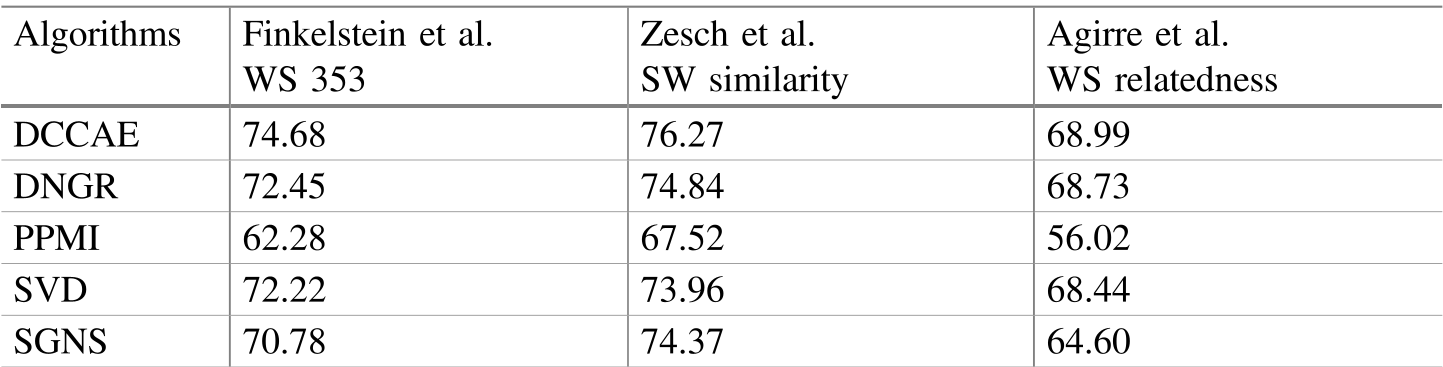 Table 1: DCCAE vs. Baselines on Word Similarity Tasks.
Critical Analysis & Conclusion
The study successfully proves that language is more than just a translation; it is a carrier of history. The significantly lower sentiment score in German Wikipedia reflects a more intensive cultural processing of the history of Nazism in Germany.
Limitations: While powerful, the method currently relies on parallel corpora (WMT 2014) for initial training, which might not be available for low-resource languages. Furthermore, the sentiment analysis is currently supervised; moving toward an unsupervised DCCAE-based sentiment model would be a major leap forward.
Future Impact: This research paves the way for automated systems that can alert users to cultural biases in online knowledge bases, fostering a more globalized and objective understanding of sensitive historical topics.