
DM-NKLFL: Bridging Non-linear Feature Selection and Deep Learning for Healthcare Big Data
Deep multilayer and nonlinear Kernelized Lasso feature learning for healthcare in big data environment
This paper introduces the Deep Multilayer and Non-linear Kernelized Lasso Feature Learning (DM-NKLFL) framework, designed for high-dimensional healthcare big data. It combines Stepwise Regression Non-linear Kernelized Lasso (SR-NKL) for feature selection with Deep Multilayer Pattern Learning (DMPL), achieving superior accuracy while significantly reducing computational overhead.
TL;DR
The healthcare industry is overwhelmed by a "data explosion," particularly in medical imaging. The paper "Deep multilayer and nonlinear Kernelized Lasso feature learning" proposes a hybrid framework, DM-NKLFL, which leverages a novel Kernelized Lasso approach to prune massive datasets before feeding them into a deep multilayer perceptron. It reduces computational time by up to 29% while maintaining higher diagnostic accuracy than standard Deep Learning or Autoencoder baselines.
Problem & Motivation: The Non-linearity Trap
In the era of Big Data, medical imaging (like CT scans) generates millions of features. Most traditional Machine Learning (ML) models face a dilemma:
- Linear Models (SVM with Linear Kernels): Fast, but they miss the complex, non-linear biological relationships crucial for accurate diagnosis.
- Standard Deep Learning: Powerful, but can become computationally prohibitive and prone to overfitting when applied directly to raw, high-dimensional "Big Data" without intelligent feature selection.
The authors' insight is that the "quality" of big data is as important as the volume. By filtering for Minimum Redundancy and Maximum Relevancy (mRMR) using a non-linear kernelized approach, we can drastically simplify the task for a deep neural network.
Methodology: The Two-Pillar Approach
The DM-NKLFL architecture is divided into two distinct phases to handle scalability and complexity separately.
1. SR-NKL Feature Selection
Instead of standard Lasso, the authors use a Stepwise Regression Nonlinear Kernelized Lasso.
- Kernelization: They use the Laplacian Kernel to transform data into a high-dimensional space where non-linear relationships can be captured linearly.
- Redundancy Elimination: If two features are highly dependent, the Lasso penalty encourages the weight of one to drift toward zero, ensuring only the most informative "sketch" of the data remains.
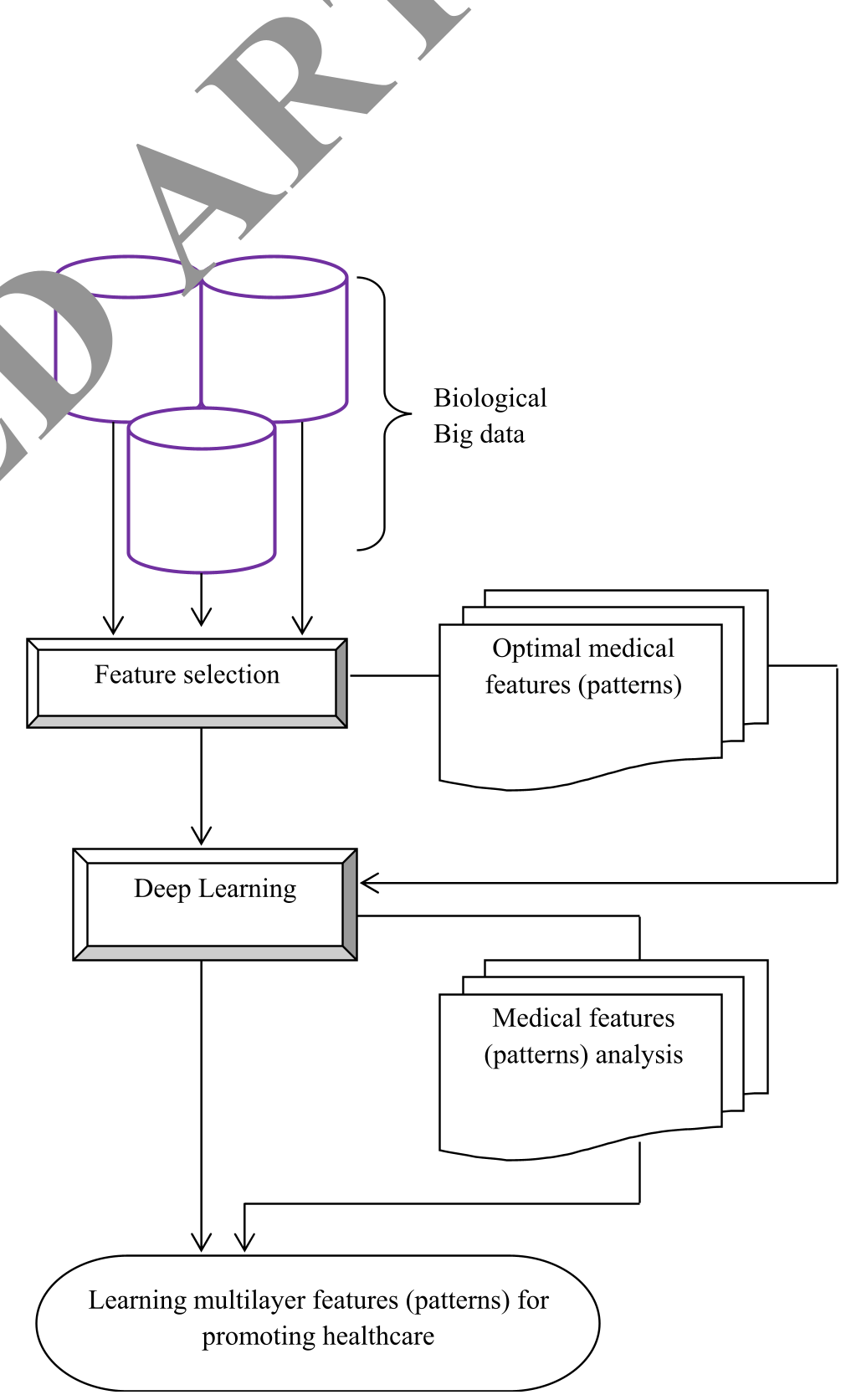
2. Deep Multilayer Pattern Learning (DMPL)
Once the features are optimized, they are passed to a Multi-Layer Perceptron (MLP). The network focuses on learning data-driven features—meaning it doesn't need doctors to manually label every specific biological "trait." It discovers patterns in the reduced feature space using a iterative weight update mechanism that compares target outputs against actual predictions to minimize error.
Experimental Results: Faster and More Accurate
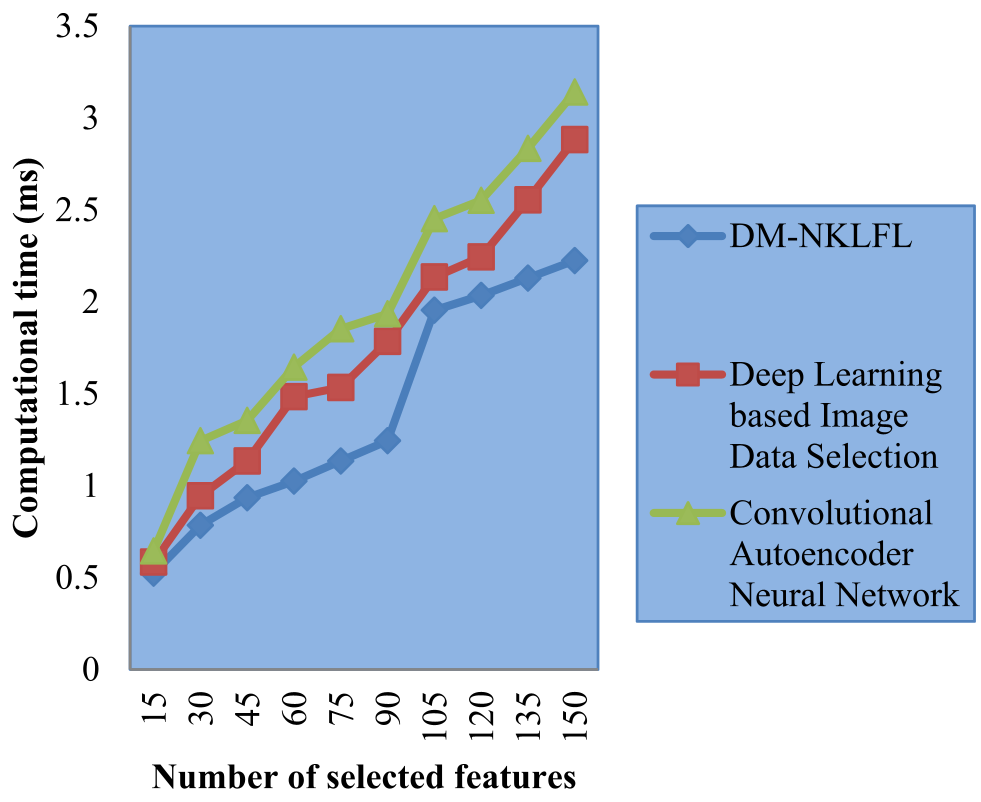
The authors validated their model against two prominent baselines: a Deep Learning-based Image Data Selection model (Ding et al., 2017) and a Convolutional Autoencoder Neural Network (CANN).
Efficiency Gains
The DM-NKLFL method demonstrated a clear advantage in Computational Time. For selecting 150 features, the proposed method significantly undercut the time required by CANN and SVM-based deep models.
- Reduction: Time efficiency improved by 19% and 29% compared to the two baselines, respectively.
Accuracy Performance
In terms of diagnostic accuracy, the model achieved 86.66%, which is a substantial leap from the 80% and 73.33% observed in the comparison models. This confirms that the "Kernelized" part of their Lasso effectively identifies the features that actually matter for disease classification.
Critical Analysis & Conclusion
Takeaway
The DM-NKLFL framework proves that feature selection is not obsolete in the age of Deep Learning. On the contrary, for specialized domains like healthcare where resources (time and memory) are critical, a non-linear sparse selection layer can act as a powerful "pre-processor" that makes subsequent deep learning more stable and efficient.
Limitations
While the paper shows strong results on benchmark datasets for lung nodules/CT images, the "data-driven" nature of DMPL means the model's interpretability remains a challenge. Healthcare practitioners often require "Why" a diagnosis was made, and the non-linear kernel transformation makes it harder to trace the output back to specific biological markers.
Future Outlook
The next step for this technology lies in Multi-modal Fusion—applying DM-NKLFL to combine CT images, genomic data, and electronic health records (EHR) into a single unified diagnostic pipeline.