
Beyond Words: Bridging the Emotional Gap in Deep Neural Models
Explorations into Deep Neural Models for Emotion Recognition
This study presents a hybrid deep learning framework for emotion recognition in Twitter streams, combining Convolutional Neural Networks (CNN) with Bidirectional Long Short-Term Memory (BiLSTM) networks. The research introduces augmented word representations by integrating emoji-specific embeddings (emoji2vec) and affective lexicons to achieve state-of-the-art results on the SemEval-2018 multi-label emotion task.
TL;DR
Recognizing human emotion in 280 characters is a nuanced battle against ambiguity. This paper demonstrates that standard deep learning models (CNN-BiLSTM) are insufficient when relying solely on traditional word embeddings. By augmenting models with emoji-specific vectors and affective lexicons, the researchers achieved a top-10 finish in the SemEval-2018 challenge, proving that specialized emotional context is the "secret sauce" for high-accuracy sentiment analysis.
Background: The Semantic Paradox
In the world of Natural Language Processing (NLP), we often assume that words appearing in similar contexts have similar meanings. However, for emotion recognition, this "Distributional Hypothesis" breaks down. In a vector space, "Happy" and "Sad" often appear suspiciously close because they share similar syntactic roles. The authors' exploratory study (Table 1) revealed that GloVe and word2vec struggle to distinguish between opposite emotions, with cosine similarities as high as 0.59 for "Joy" and "Sadness."
Methodology: A Hybrid Architecture for Affective Context
The core innovation lies in a dual-stream architecture that doesn't just look at the words, but also at the intent and symbolism behind them.
1. The Baseline: CNN-BiLSTM
The model starts with a 1D-Convolutional layer to extract local n-gram features, followed by a Max-Pooling layer to reduce dimensionality. This "feature map" is then fed into a Bidirectional LSTM (BiLSTM), which captures the long-term dependencies and sequential context of the tweet—crucial for understanding irony or shifts in mood.
2. The Extended Model: Emoji and Lexicon Integration
To fix the "Semantic Paradox," the authors introduced two critical components:
- Emoji2Vec: Since emojis are the "body language" of the digital age, the authors mapped Unicode emojis into the same 400-dimensional space as words.
- Lexicon Embeddings: They utilized the W2V-DP-CC-Lex, mapping words to a 10-dimensional vector representing specific emotional intensities (Anger, Anticipation, Disgust, Fear, Joy, Sadness, Surprise, Trust, and Sentiment).
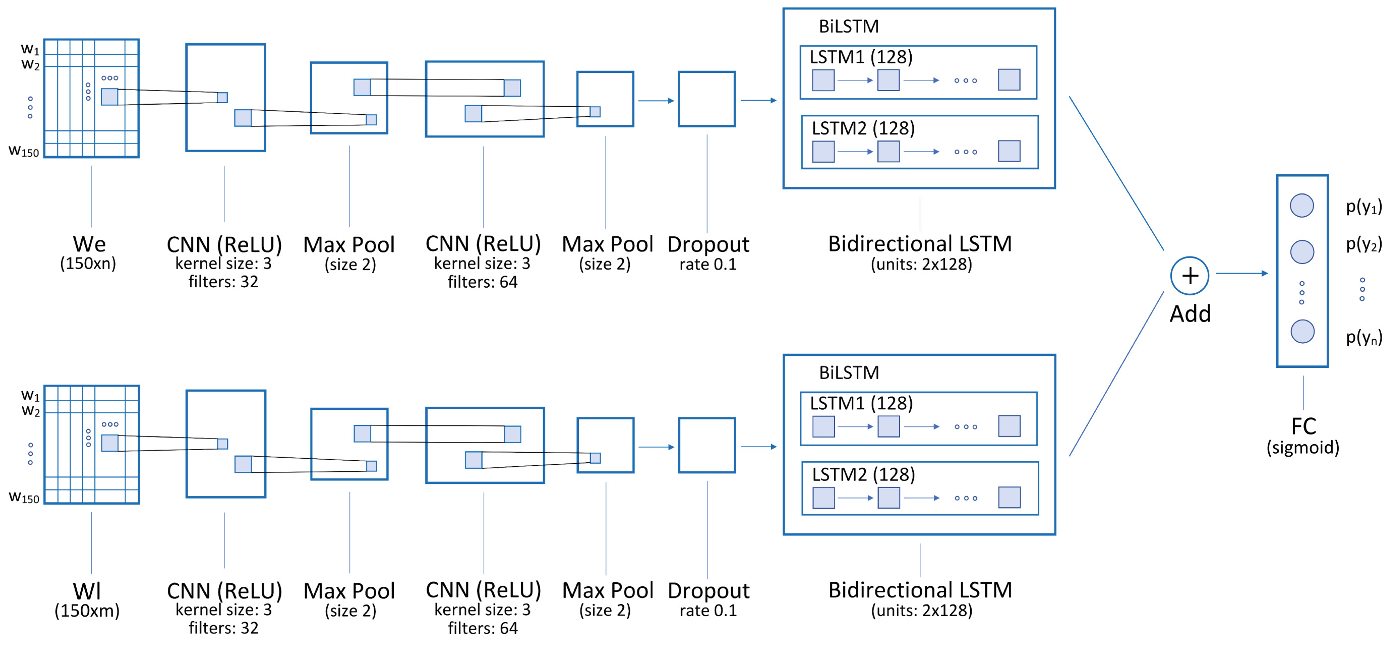 Fig 1. The parallel CNN-BiLSTM architecture incorporating lexicon-based feature streams.
Experiments & Results
The researchers tested their approach on the SemEval-2018 (multi-label) and Crowdflower (single-label) datasets.
Key Breakthroughs:
- The Power of Lexicons: Moving from a baseline (Model 1) to a lexicon-augmented model (Model 3) increased Accuracy from 0.406 to 0.468 (using word2vec).
- Dimensionality Matters: 400D word2vec vectors consistently outperformed 200D GloVe vectors, suggesting that emotion recognition requires high-capacity representations to distinguish subtle nuances.
- Class Imbalance: The model performed exceptionally well on "Joy" and "Anger" but struggled with "Surprise" and "Trust," likely due to the scarcity of training examples for these categories in the dataset.
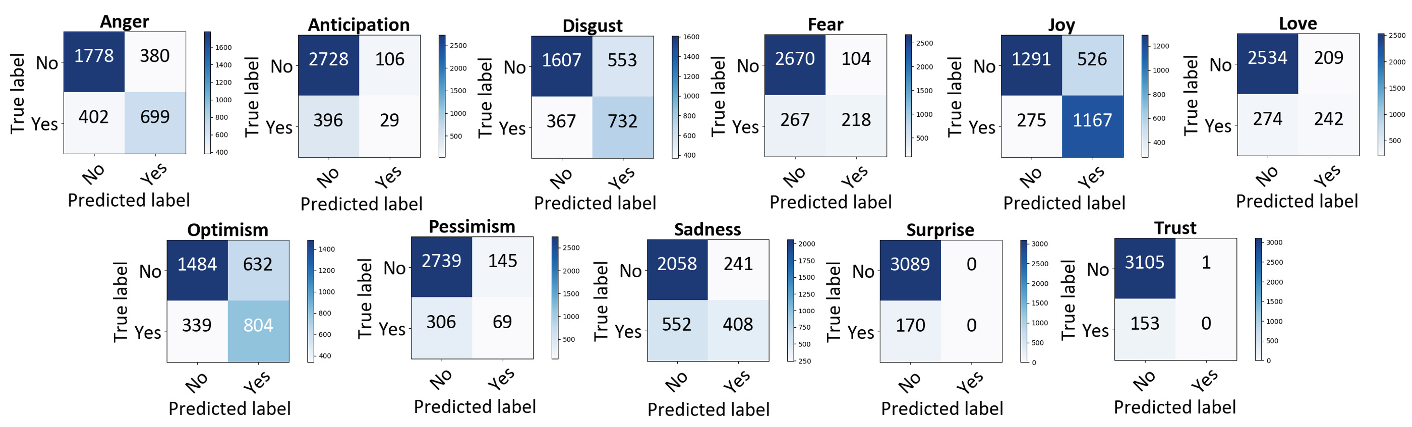 Fig 2. Per-emotion performance metrics showcasing high True Negative rates but challenges in minority classes.
Critical Insight & Conclusion
The takeaway is clear: Deep learning is not a magic black box for emotion. To build truly "empathetic" AI, we must inject human-annotated knowledge (lexicons) and cultural symbols (emojis) into the network.
While this paper uses CNNs and LSTMs, the findings serve as a vital reminder for the "Transformer Era": Pre-trained models like BERT or Llama might have the syntax down, but without fine-tuning on explicit affective data, they will continue to confuse "I'm thrilled" with "I'm terrified" in high-entropy environments like Twitter.
Future Directions: The next logical step is applying these augmented embeddings to Transformer-based architectures and exploring how Attention Mechanisms can further isolate the "emotional triggers" in a sentence.