
Deep Learning for Social Good: Tackling Gender Violence in Mexican Tweets
Deep Neural Network to Detect Gender Violence on Mexican Tweets
2021-01-01
Summary
Problem
Method
Results
Takeaways
Abstract
This paper develops an enhanced Deep Learning Multilayer Perceptron (DL-MLP) to detect Gender-Based Violence (GBV) in Mexican Spanish tweets. By leveraging CountVectorizer and Random Over Sampling (ROS), the model achieves an Area Under the ROC (AUC) of approximately 90%, significantly outperforming previous baselines in classifying violent vs. non-violent content.
## TL;DR
Researchers have developed a deep learning framework specifically designed to identify Gender-Based Violence (GBV) within the Mexican Twitter landscape. By combining a deep Multilayer Perceptron (MLP) with robust oversampling techniques, the system achieves a strong **90% AUC**, providing a scalable tool for digital safety in regional contexts.
## The Motivation: A Pandemic within a Pandemic
During the COVID-19 lockdowns, Gender-Based Violence didn't just stay behind closed doors; it migrated online. Platforms like Twitter became breeding grounds for harassment. However, detecting this in Mexican Spanish is difficult because:
* **Class Imbalance**: Violent tweets are "needles in a haystack" compared to everyday conversation.
* **Linguistic Nuance**: Slang, regionalisms, and technical "stop words" in Mexican Spanish require specific preprocessing.
## Methodology: Deepening the Architecture
The core of this research is an evolution of a previous Multilayer Perceptron (MLP) model. While the predecessor used a shallow structure, this work introduces a **7-layer deep architecture** with a trial-and-error optimized neuron count (ranging from 20 to 40 per layer).
### Key Technical Pillars:
1. **Preprocessing**: A surgical approach to removing hashtags, emojis, and URLs to focus on the semantic weight of the text.
2. **Feature Extraction**: Utilizing **CountVectorizer** to transform qualitative tweets into quantitative vectors, resulting in over 27,000 distinct features.
3. **Balancing the Scales**: The authors compared **Random Over Sampling (ROS)** and **SMOTE** to ensure the neural network didn't simply ignore the minority "violent" class.

## Experimental Results
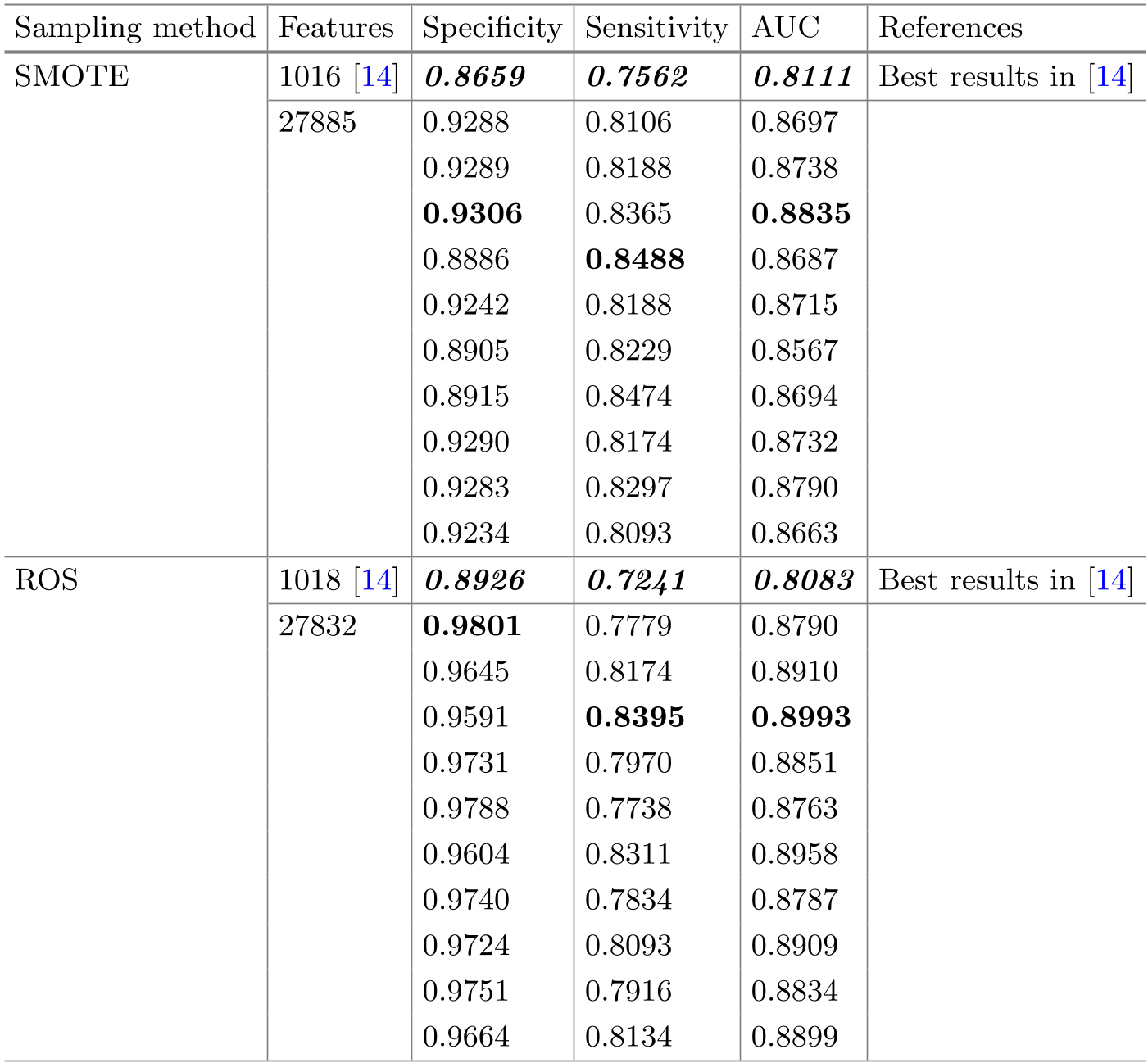
The shift from a shallow to a deep network, combined with better sampling, yielded impressive gains. The **ROS (Random Over Sampling)** method proved superior, maintaining high specificity (detecting non-violent tweets accurately) while dramatically increasing sensitivity to violent ones.
| Sampling Method | AUC (Current Work) | AUC (Prior Best [14]) | Improvement |
| :--- | :--- | :--- | :--- |
| **ROS** | **~89.9%** | 80.8% | **+9.1%** |
| **SMOTE** | **~88.3%** | 81.1% | **+7.2%** |
## Critical Insights & Future Outlook
The study reveals a classic trade-off: as the model becomes better at spotting violence (Sensitivity), it occasionally misidentifies non-violent tweets (a slight drop in Specificity). This is a common hurdle in **Class Imbalance** problems.
**The Road Ahead:**
While the MLP model is highly efficient, the authors acknowledge that the next frontier involves **Transformers (like BERT)** and **Continuous Learning Systems**. These would allow the model to adapt to the ever-evolving slang and tactics used in online harassment.
Ultimately, this work serves as a vital benchmark for regional social computing, proving that deep learning is not just for commercial optimization, but a critical tool for human rights protection.