
DQL-PSO: Accelerating Social Bot Detection via Evolutionary Deep Reinforcement Learning
Deep Q-Learning and Particle Swarm Optimization for Bot Detection in Online Social Networks
This paper introduces DQL-PSO, a novel framework that integrates Deep Q-Learning with Particle Swarm Optimization to detect social bots in Online Social Networks (OSNs). By utilizing PSO to optimize the Q-value update process, the model achieves a precision of 95% and a recall of 93% on real-world Twitter datasets, outperforming traditional reinforcement learning baselines.
TL;DR
Social bots are no longer simple scripts; they are dynamic adversaries that "act human" to bypass filters. This paper presents DQL-PSO, a hybrid approach that replaces the standard (and often slow) Q-value update logic of Deep Reinforcement Learning with a Particle Swarm Optimization (PSO) mechanism. Tested on Twitter data, it hits a 95% precision rate while converging faster than traditional RL models.
The "Moving Target" Problem in Bot Detection
The core challenge in Online Social Networks (OSNs) is that bots are adaptive. They manipulate their "trust value" by mixing malicious URLs with legitimate-looking interactions.
Current detection methods—ranging from Random Forests to standard Deep Q-Learning (DQL)—often struggle with:
- Convergence Speed: DQL needs to explore vast state-action pairs, leading to slow training.
- Memory Efficiency: Storing Q-values for every possible social interaction is computationally expensive.
- Behavioral Mimesis: Bots camouflage their activity, requiring a model that can optimize its detection strategy globally across many types of behavior.
Methodology: When Swarm Intelligence Meets DRL
The researchers' core insight was to treat the search for the "best bot-detecting strategy" as an optimization problem handled by a swarm.
1. Architecture Overview
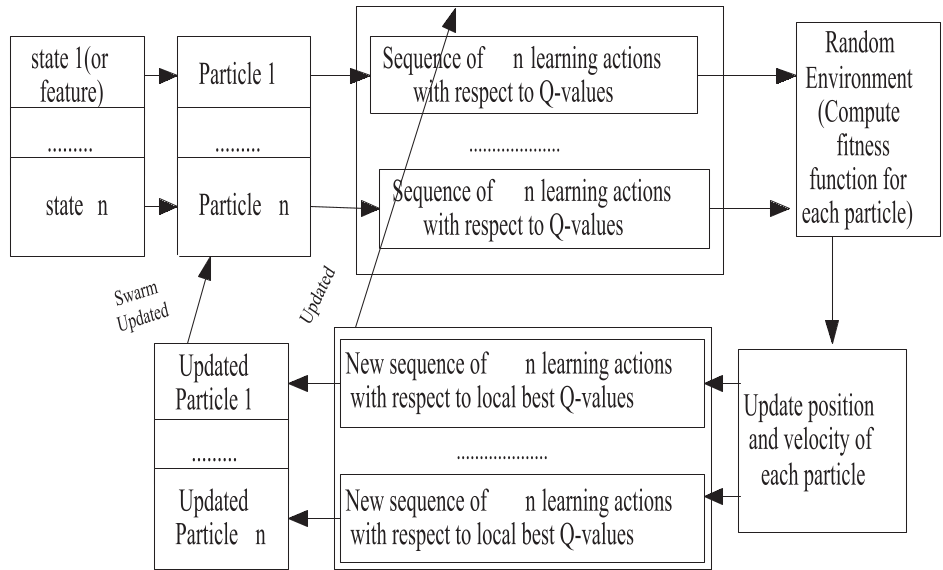
Instead of a single agent learning in isolation, DQL-PSO treats each feature/state as a particle in a swarm.
2. Redefining PSO for Reinforcement Learning
In this framework:
- Position (): Represents the Q-value for a specific sequence of learning actions (e.g., analyzing hashtag ratios or follower counts).
- Velocity (): Represents the probability of transitioning from one state to another.
- The Update Rule: Instead of traditional backpropagation alone, the Q-values are adjusted based on the
Local Best(an individual user's specific behavioral patterns) and theGlobal Best(the collective patterns of bots recognized across the entire dataset).
The velocity and position updates are governed by:
Experiments: Superior Precision and Speed
The model was validated using the User Popularity dataset (containing 320 bots and 476 legitimate users with nearly half a million tweets).
Convergence Performance
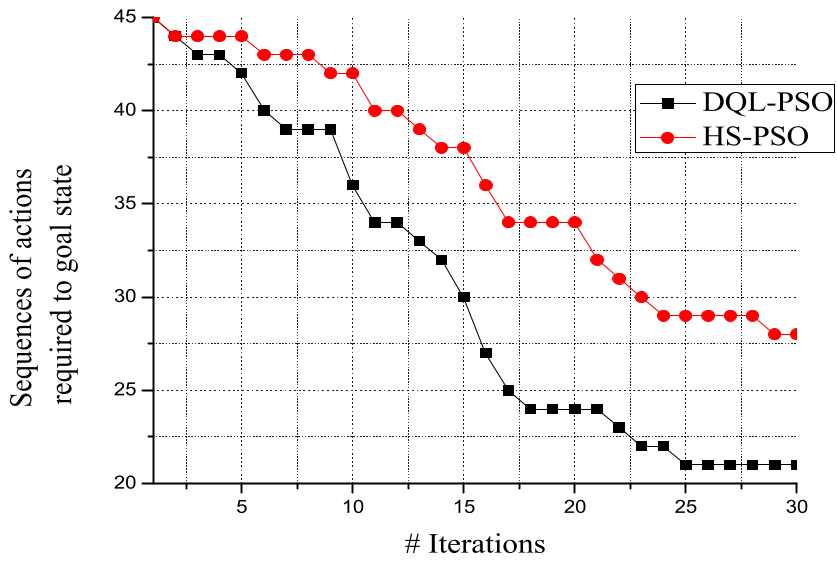
A critical finding was that DQL-PSO required fewer actions to reach the "Goal State" (successful detection) compared to Pure PSO or standard RL.
Benchmark Results
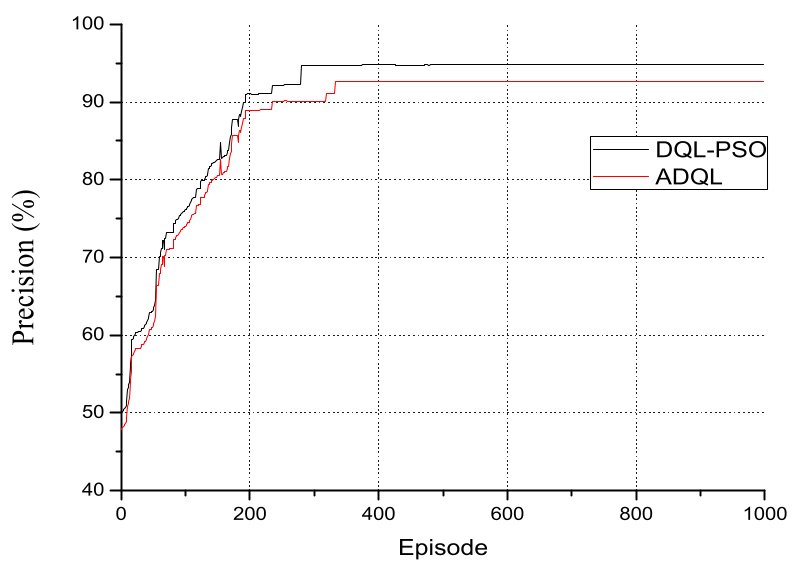
In a head-to-head comparison with Adaptive Deep Q-Learning (ADQL):
- Precision: DQL-PSO achieved ~95%, outperforming ADQL's 93%.
- Recall: Set at ~93%, indicating the model is highly effective at minimizing "False Negatives" (missing actual bots).
Deep Insight: Why PSO Helps Q-Learning
Traditional DRL often gets stuck in local optima, especially in noisy social media environments. By incorporating PSO, the model maintains a "swarm" of possible detection strategies. If one detection agent fails to identify a bot, the Global Best () signal from other agents pulls the population toward the correct behavior signatures.
Conclusion & Future Outlook
DQL-PSO proves that integrating population-based heuristics into neural networks can solve the efficiency bottlenecks of Reinforcement Learning. Potential Limitation: While effective on Twitter, the 16-state vector used by the authors (including things like GPS availability and sentimental scores) may need to be expanded as bots move toward LLM-generated content that mimics human sentiment perfectly.
The next frontier for this research likely involves Multi-Agent Deep RL, where different "swarms" specialize in different types of botnets (e.g., political influence bots vs. crypto collectors) to provide a layered defense.