
DDPG-Based Energy Management: Smarter Hybrid Control via History Cumulative Trip Information
12151_Deep Reinforcement Learning-Based Energy Management for a Series Hybrid Electric Vehicle Enabled by History Cumulative Trip Information.
Summary
Problem
Method
Results
Takeaways
Abstract
This paper proposes a Deep Reinforcement Learning (DRL)-based Energy Management Strategy (EMS) for series hybrid electric vehicles (SHEVs) using the Deep Deterministic Policy Gradient (DDPG) algorithm. By integrating History Cumulative Trip Information (HCTI), the method achieves adaptive State of Charge (SoC) guidance across the full battery range without requiring a priori knowledge of future driving cycles.
## TL;DR
Researchers have developed a novel Energy Management Strategy (EMS) for Series Hybrid Electric Vehicles (SHEVs) that doesn't need to "see the future." By using the **Deep Deterministic Policy Gradient (DDPG)** algorithm and a simple yet effective "History Cumulative Trip Information" (HCTI) mechanism, this method achieves near-optimal fuel economy and real-time computation speeds that leave traditional predictive controllers in the rearview mirror.
## Background: The Predictor's Paradox
In the world of Hybrid Electric Vehicles (HEVs), the holy grail is the "Global Optimum"—the perfect balance of fuel and electricity consumption. For years, the industry relied on:
1. **Dynamic Programming (DP)**: Theoretically perfect but requires knowing the entire trip beforehand (impossible for real-world driving).
2. **Model Predictive Control (MPC)**: Reasonable but only as good as its "velocity predictor." If the predictor is wrong, efficiency plummets.
This paper breaks the cycle by asking: *Can we achieve near-optimal results using only what we've already done?*
## Identifying the Pain Points
Traditional Reinforcement Learning (RL) like Q-learning or DQN has a major flaw in vehicle control: **Discretization**. Real-world engine power isn't a series of "clicks"; it's a continuous flow. Discretizing actions leads to jerky control and the "curse of dimensionality" during training. Furthermore, most RL agents lack a global sense of battery budget, often exhausting the battery too early or too late.
## Methodology: DDPG meets HCTI
The authors introduce a framework that operates in **continuous action space**. Using an Actor-Critic architecture, the model learns to output precise engine power increments ($\Delta P_{eng}$).
### 1. The HCTI Secret Sauce
Instead of guessing the future, the model looks at **travelled distance ($d$)** and compares current SoC against a **space-domain-indexed reference**. This reference acts as a "bread-crumb trail," guiding the battery to deplete linearly over a 100km range.
### 2. Architecture for Efficiency
The system uses two deep neural networks:
* **Actor Network**: Maps the current state (velocity, acceleration, SoC, and HCTI) directly to a continuous action.
* **Critic Network**: Evaluates how "good" that action was, guiding the Actor's learning.
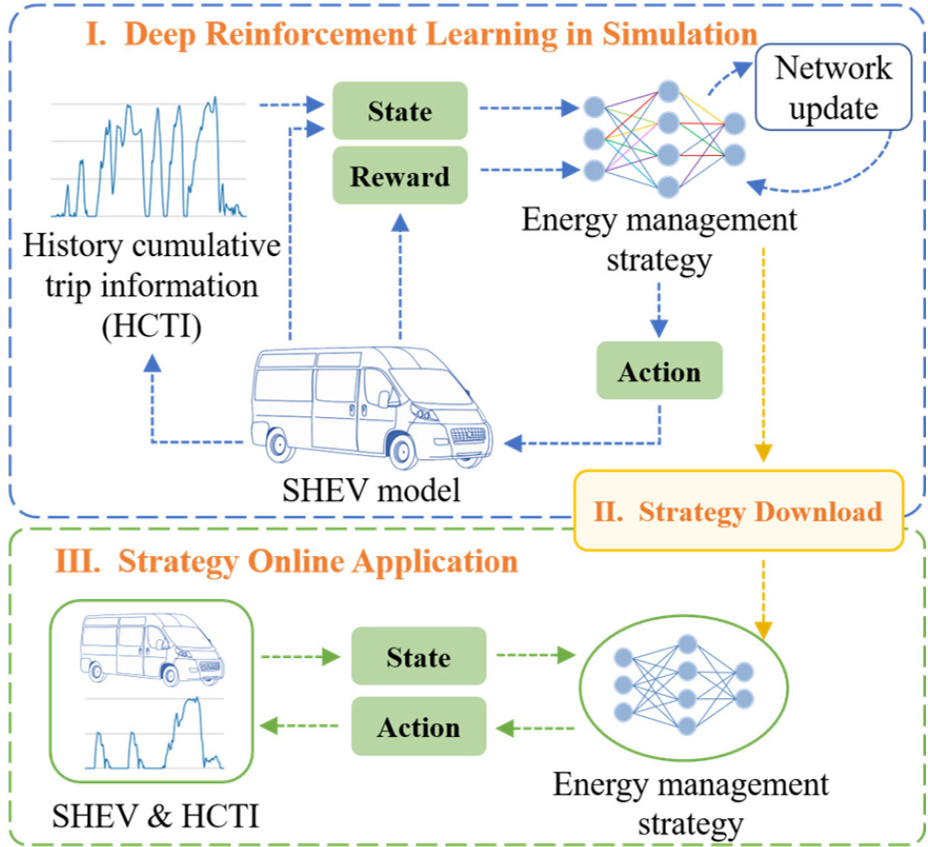
*Figure 1: Overall schematic of the DRL-based EMS training and application.*
## Experimental Results: The Performance Leap
The model was trained on the China Typical Urban Driving Cycle (CTUDC) and tested on unseen, mixed driving cycles to prove its **Generalization**.
### SOTA Comparison
The DRL-based EMS was compared against MPC and DP benchmarks:
* **Near-Optimality**: The original DRL policy achieved a fuel consumption within **3.5%** of the DP benchmark.
* **Real-time Power**: Each computation step takes merely **0.001 seconds**, making it orders of magnitude faster than MPC which needs to solve optimization problems on the fly.
* **Engine Longevity**: By adding an "output frequency adjustment," the authors reduced engine start times significantly, outperforming the benchmark in terms of mechanical wear and tear.
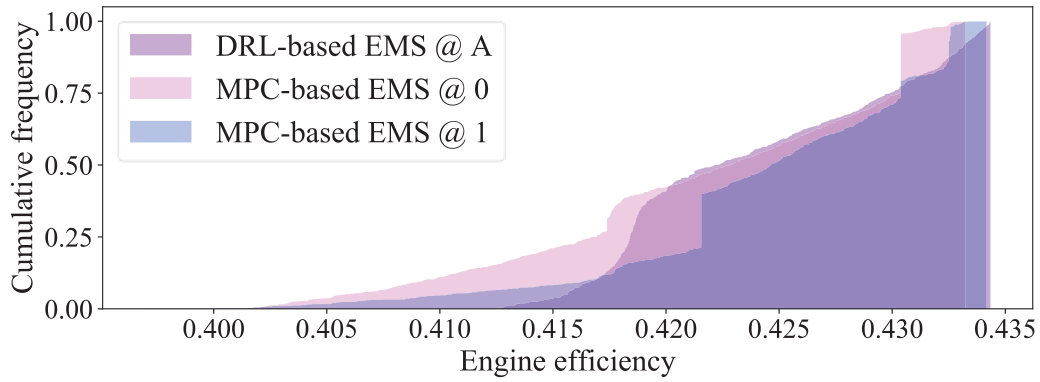
*Figure 2: Performance on unseen driving cycles. The DRL-based EMS (Blended Mode) successfully follows the optimal SoC depletion trend.*
## Critical Analysis & Takeaways
The genius of this paper lies in its **simplicity**. By shifting from "Predictive" logic to "Corrective" logic (using HCTI), it bypasses the need for expensive sensors or V2X infrastructure.
**Key Takeaways:**
* **Continuous is Better**: DDPG’s ability to handle continuous variables is vital for smooth automotive control.
* **Generalization is Key**: The model performs consistently on trips it has never "seen" during training, solving a major hurdle for RL in the automotive industry.
* **Future Work**: The authors suggest that combining global SoC planners (like those used in connected vehicle environments) with this DRL execution layer could close the 8% gap even further.
## Conclusion
This DRL-based EMS represents a shift toward more robust, model-free vehicle intelligence. It proves that with the right state representation (HCTI), we don't need a crystal ball to drive efficiently.