
DeepDirect: Decoding the "Hidden Flow" of Social Ties via Edge-Based Embedding
DeepDirect: Learning Directions of Social Ties with Edge-Based Network Embedding (Extended Abstract)
DeepDirect is a novel edge-based network embedding framework designed for the Tie Direction Learning (TDL) problem. It maps social ties directly into low-dimensional vectors to predict the orientation of undirected edges and quantify the relative weights of bidirectional relationships, achieving state-of-the-art performance in direction discovery and link prediction.
TL;DR
Understanding who followed whom—or highlighting the dominant party in a mutual friendship—is critical for social network analysis. DeepDirect moves away from traditional node-centric embeddings to a dedicated edge-based embedding architecture. By preserving topology and incorporating a priori social patterns, it accurately predicts directions in undirected ties and quantifies the "strength" of directions in bidirectional ones.
Problem & Motivation: The Gap in Node Embeddings
In the world of Graph Representation Learning, we usually focus on nodes (users). If we want to represent a "tie" between User A and User B, we typically concatenate or calculate the distance between their node vectors.
The authors of DeepDirect argue that this indirect approach is fundamentally flawed for directionality:
- Information Loss: Node vectors capture "user identity" but often dilute the specific "interaction context" of a tie.
- The Mixed Network Challenge: Real-world social networks are messy—they contain confirmed directed edges, ambiguous undirected edges (like Facebook friends), and bidirectional ties where one person might be more influential than the other.
DeepDirect addresses these by treating the tie itself as the first-class citizen in the embedding space.
Methodology: The DeepDirect Framework
The core of the paper is the E-Step (Embedding) and the D-Step (Directionality Learning). Unlike Node2Vec which walks nodes, DeepDirect maps each edge to a vector .
The Triple-Aspect Optimization
The model optimizes a joint loss function to ensure the embeddings are robust:
- Topology Preservation (): Ensures that ties sharing similar local structures are close in the latent space.
- Label Utilization (): A supervised component that uses known directed edges (the "ground truth") to pull embeddings into discriminative clusters.
- A Priori Patterns (): Since labeled data is often scarce, the authors introduce "pseudo-labels." They use social science heuristics (e.g., if A follows B and B follows C, there is a certain probability A follows C) to guide the training for undirected ties.
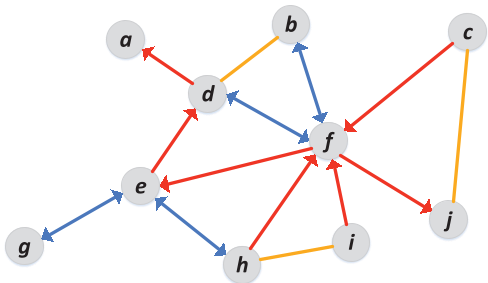 Fig 1: A Mixed Social Network (MSN) containing directed (red), bidirectional (blue), and undirected (yellow) ties.
Experiments & Results
The researchers tested DeepDirect on two primary missions: Direction Discovery (DD) and Direction Quantification (DQ).
- Superior Prediction: In the DD task, DeepDirect significantly outperformed versions of the algorithm that strictly used hand-crafted features, proving that learned embeddings capture nuances that manual features miss.
- Link Prediction Boost: By understanding the directionality of ties, the model outperformed standard adjacency-matrix-based methods. As seen in Fig 3, the AUC (Area Under Curve) for link prediction showed consistent gains across multiple platforms like Twitter and Weibo.
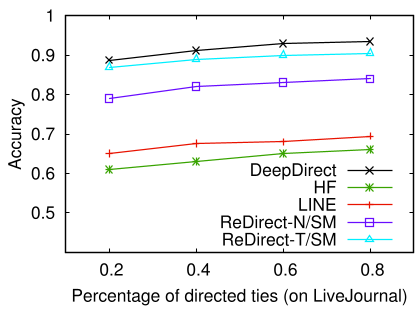 Fig 3: Performance gain in Link Prediction (AUC) across three major datasets.
Critical Insight: Why it Works
The "magic" of DeepDirect lies in its Inductive Bias. Most NE methods assume that homophily (similarity) is the only thing that matters. DeepDirect recognizes that asymmetry is the defining characteristic of social influence. By supervising the embedding process with both topology and direction labels, the latent space learns to encode "flow" rather than just "proximity."
Limitations & Future Work
While DeepDirect is powerful, it currently relies on a static view of the network. Social ties are dynamic—directions change as influence shifts over time. A logical next step for this research would be integrating temporal dynamics into the edge-based embedding to see how directionality evolves.
Conclusion
DeepDirect bridges the gap between unsupervised structural embedding and supervised relationship classification. Its ability to handle Mixed Social Networks (MSNs) makes it a practical tool for modern social media platforms looking to refine their recommendation engines and influence mapping.